
How to use agentic AI in marketing workflows
Published on April 24, 2026/Last edited on April 24, 2026/11 min read

Team Braze
By 2028, 60% of brands will use agentic AI to power one-to-one customer interactions, according to Gartner.
Agentic AI marketing, or agentic marketing, describes the use of autonomous AI systems that connect to your existing tools, make decisions, and execute multi-step tasks without needing a human in the loop at every stage.
Unlike a chatbot or a content generator, these systems can pursue a goal by planning, acting, and adjusting in real time. Complex, time-consuming workflows like campaign planning, audience segmentation, lifecycle messaging, and performance optimization can run continuously, at a scale that manual processes can't match.
In this article, we’ll look at how to implement agentic AI across your marketing stack.
What is agentic AI in marketing?
Agentic AI refers to autonomous AI systems that can set a plan, make decisions, and take action across multiple steps, all in pursuit of a defined goal, and without needing human input at each stage.
These systems can do more than generate a piece of content or produce a report. They can receive a high-level objective—increase conversions among lapsed customers, for example—and then work out how to achieve it. They do this by identifying the right audience, selecting channels, creating and testing content variations, monitoring results, and adjusting their approach based on what's working.
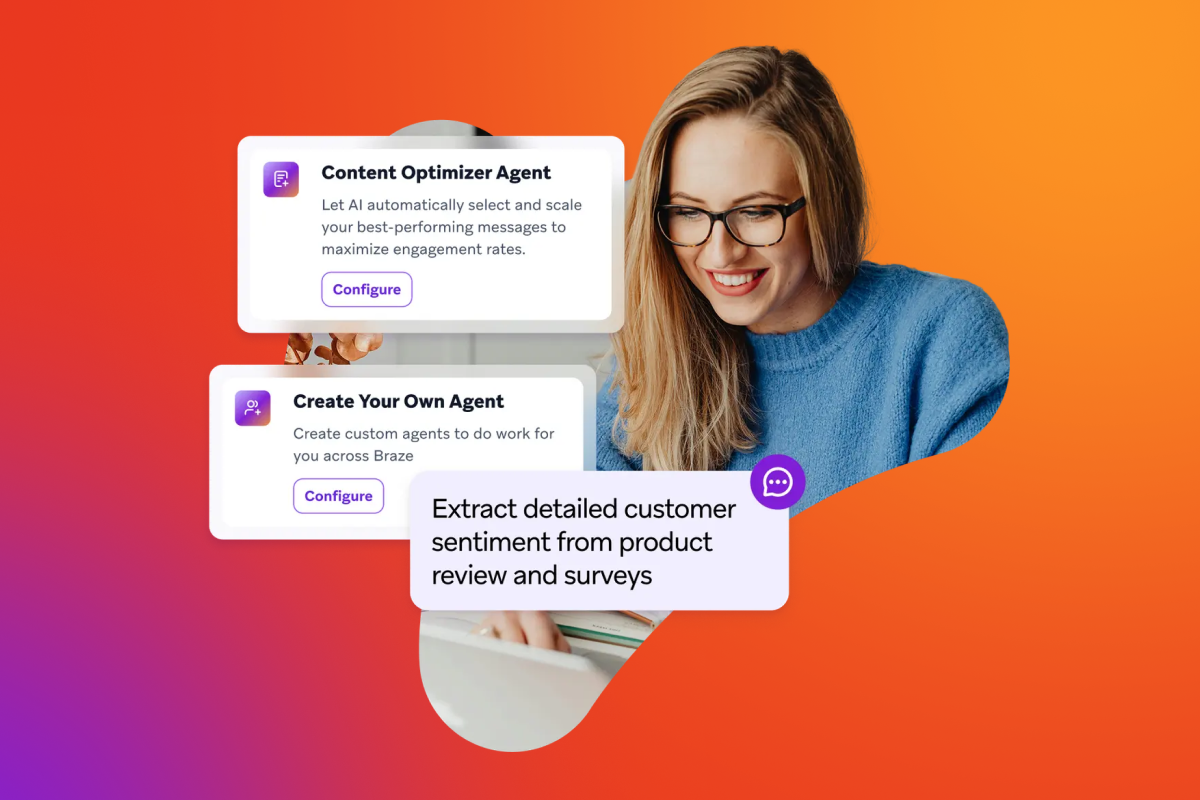
For example, BrazeAI™ Agents go beyond content generation by autonomously identifying target audiences, selecting channels, creating and testing message variants, and optimizing campaigns in real time to continuously improve outcomes.
Tool connectivity allows agents to interact with external platforms—CRMs, customer data platforms, ad networks, analytics tools—taking real actions, not just producing text. And because they retain context across tasks, they use the outcome of each action to continuously improve their own decision-making.
AI agents and marketing automation work alongside your existing platforms, connecting into existing tools and acting on the data those platforms hold.
How agentic AI transforms marketing workflows
Agentic AI changes how marketing workflows operate by removing the dependency on human intervention between each step, allowing complex, multi-stage processes to run from start to finish autonomously.
Most marketing workflows today are sequential by necessity. A campaign brief gets written, then a segment gets built, then content gets created, reviewed, approved, and scheduled. Each handoff requires someone to pick it up. Agentic AI removes many of those handoffs, creating what are effectively autonomous marketing operations, where agents move work forward without waiting for a human to initiate the next step. An agent can move through each stage of a workflow independently, making decisions along the way based on real-time data rather than waiting for a human to advance the process.
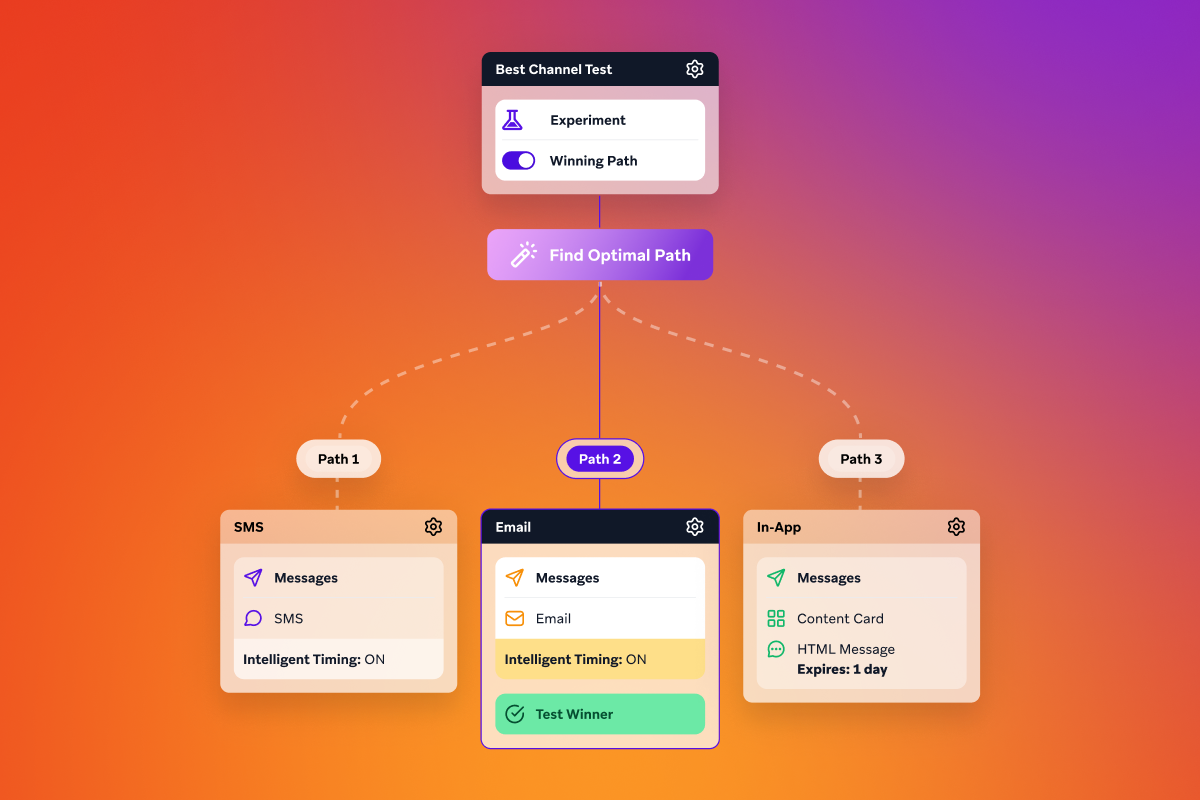
Autonomous multi-step campaign execution is where this becomes most tangible. An agent can handle the sequencing by launching variations, monitoring early performance signals, reallocating budget toward what's working, and retiring what isn't. All of this can happen within a single campaign cycle, without a regular review meeting to trigger the next action. And human involvement can be built in at any point, so if you want sign-off before a budget change goes through, or a review step before content sends, that's straightforward to configure.
AI workflow automation in marketing also changes the quality of decisions being made, not just the speed. Because agents are continuously processing performance data across channels, this kind of AI decision orchestration produces a fuller picture than any individual analyst could hold at once.
Campaign planning, segmentation, lifecycle messaging, and performance optimization are where agentic AI tends to save the most time and each of those looks quite different with an agentic system involved.
What does this look like in practice? With BrazeAI™ Agents, marketers can automate complex, multi-step campaigns that dynamically adjust messaging, budget allocation, and channel selection based on live performance data. All while maintaining configurable human checkpoints for governance.
Common marketing workflows powered by agentic AI
Agentic AI delivers the most value in workflows that involve multiple decisions in sequence, where the output of one step should directly inform the next. These four are among the most common areas where marketing teams are putting it to work.
1. Campaign planning
Campaign planning is typically a time-intensive process, pulling together performance data, identifying audience opportunities, mapping out creative and channel requirements, and aligning on objectives before a brief is even written. Agentic AI can compress a significant portion of this.
AI campaign planning agents can analyze historical campaign data, current audience behavior, and business objectives simultaneously, producing a structured starting point that a marketer then reviews and refines. It can also monitor conditions continuously, flagging when a planned campaign may need adjusting before it launches based on audience behavior or performance benchmarks.
2. Audience segmentation
Static audience segments have a short shelf life. A customer who qualified for a re-engagement segment last month may have since made a purchase, changed their behavior, or shown entirely different intent signals and a segment built on last month's data won't reflect that.
Agentic AI can maintain segments dynamically, continuously analyzing behavioral signals and customer attributes to adjust membership in real time. An agent monitors the relevant data and updates segment definitions automatically, so the audience a campaign reaches reflects who those customers actually are today.
3. Lifecycle messaging
Lifecycle messaging are the journeys designed to guide customers from acquisition through activation, engagement, and retention. Managing the branching logic, updating content, and responding to performance signals across multiple journeys is one of the more demanding parts of running a customer engagement program.
An agentic system can monitor where individual customers are in their journey, identify when engagement is dropping, and trigger the appropriate response—whether that's a re-engagement message, a change of channel, or a different offer entirely. The agent handles the sequencing and adapts it based on how each customer is actually behaving, which is exactly what agentic AI workflows are designed to do across complex, multi-step customer journeys. Managing that kind of personalization across every channel a customer uses becomes far more achievable when an agent is doing the coordination work.
4. Performance optimization
Campaign analysis has traditionally been a backward-looking activity: Pull the report, identify what worked, apply the learning next time. The time between data becoming available and a team acting on it means underperforming campaigns often run longer than they should.
An agentic system makes this continuously active. A performance optimization agent can monitor campaigns across channels in real time, tracking conversion rates, engagement metrics, and revenue attribution, and making targeted adjustments without waiting for a human review cycle. Underperforming creatives get paused. Budget moves toward higher-performing channels. Content variations are tested and resolved automatically within your defined guardrails. AI marketing automation at this level means the time between insight and action effectively disappears.
How to implement AI marketing automation workflows in your stack
The most common reason agentic AI implementations stall is not the AI itself. It's that the data, systems, and connections it needs to operate aren't ready for it. These are the considerations worth working through before you deploy.
1. Start with one workflow
Before building anything, identify a single workflow with high manual overhead, clear inputs and outputs, and a measurable result. Audience segmentation, campaign reporting, and A/B test management are strong starting points—they follow consistent logic, run on data your team already has, and produce results you can evaluate quickly. Trying to automate everything at once makes it harder to learn what's working and what needs adjustment.
2. Data sources
An agentic system is only as useful as the data it can access. For an agent to make good decisions—about who to target, what to send, or when to adjust—it needs a unified, current view of customer behavior across touchpoints. That means bringing together your CRM, customer data platform, website, app, and transactional data in a way the agent can read and act on in real time.
One example: BrazeAI™ Agents integrate deeply with the Braze platform’s data and messaging infrastructure, providing bidirectional, event-driven connectivity that allows agents to read data and execute marketing actions across channels.
3. Automation systems
Where data sources are about what the agent knows, automation systems are about what it can do. This is the operational layer is the marketing platform, ad networks, and campaign tools that an agent needs to write actions back to, not just read from. A well-connected automation layer means an agent can trigger a message, update a campaign, or pause a creative without requiring manual intervention for every execution step. Reviewing which of your existing platforms support this kind of bidirectional, event-driven connectivity is one of the more important steps before any agent goes live—these connections form the AI marketing pipelines that agentic systems depend on to function.
4. AI orchestration tools
The orchestration layer manages AI task orchestration, such as how agents are coordinated, how they hand off tasks, and how the overall workflow is controlled. LangChain helps teams build custom agentic workflows, offering extensive integrations and code-level control. CrewAI is a strong choice for multi-agent systems where different agents take on specific roles and collaborate across complex tasks. For enterprise teams in Microsoft and Azure environments, the Microsoft Agent Framework—which unifies AutoGen and Semantic Kernel—is purpose-built for that ecosystem.
For teams who need to build or customize agentic workflows but don't have deep engineering resources, agentic coding tools are increasingly bridging that gap. Cursor is an AI-first code editor that lets developers build and orchestrate complex, multi-step agentic systems with significantly less manual effort. Vercel's v0 takes this further, allowing non-developers—including marketers and product managers—to build custom tools and interfaces by describing what they need in plain language.
Going a step further, BrazeAI™ Agents are designed to act as intelligent, autonomous entities that execute personalized customer engagement strategies, while BrazeAI Decisioning Studio™ provides a robust environment for designing, testing, and deploying adaptive decisioning models. Together, they enable marketers to orchestrate complex, multi-step AI-driven workflows that dynamically respond to customer behavior and preferences. This orchestration capability helps enable smooth coordination and handoff between AI agents and decisioning processes, empowering brands to deliver highly relevant, timely, and effective messaging at scale without requiring extensive engineering resources.
5. Governance and guardrails
Autonomy needs defined boundaries. The most effective agentic implementations include clear rules about what an agent can do independently and where a human reviews before an action is taken—a budget reallocation above a set threshold, a message going to a high-value segment, or a campaign change during a sensitive period, for example. Building these checkpoints into the workflow from the start keeps things moving without removing oversight where it matters.
Evaluating agentic AI platforms
Choosing an agentic AI platform is less about finding the most technically impressive option and more about finding one that fits how your team actually works and what your workflows genuinely need. These steps give you a framework to help you make a thorough assessment.
1. Define what you need the agent to reason through
Start with the complexity of the decisions you want the agent to make. Some platforms handle narrow, well-defined tasks well but struggle when goals are more open-ended or when conditions change mid-campaign. Testing how a platform responds to edge cases and incomplete data gives you a clearer picture than a feature list alone.
2. Assess AI reasoning capability
LLMs are commonly integrated as the reasoning layer within agentic systems—handling goal interpretation, decision-making, and output generation at each step of a workflow. Additionally, reinforcement learning and AI decisioning approaches, like those in BrazeAI Decisioning Studio™, play a crucial role in agentic systems by continuously learning from interactions and optimizing decisions toward measurable business goals.
3. Check automation flexibility
Look for systems that allow you to define agent behaviour at a granular level while still giving the agent room to make decisions within those parameters. Rigid platforms can handle routine tasks but struggle when campaigns need to respond to signals that weren't anticipated at setup.
4. Evaluate data integration depth
Assess how a platform connects to your existing data sources, how frequently it syncs, and whether it can act on real-time signals or only batch updates. A platform that reads from and writes to your customer data platform, CRM, and analytics tools in a coordinated way will significantly outperform one that treats each connection as isolated.
5. Test workflow control and visibility
Look for platforms that offer clear audit trails, configurable approval steps, and the ability to adjust or pause agent behaviour without rebuilding the entire workflow. This matters more as campaigns get more complex and the stakes of an autonomous decision get higher.
6. Consider how it fits your existing stack
LangChain remains the most widely adopted framework for teams building custom agentic workflows, offering extensive integrations and code-level control. CrewAI has become a leading choice for multi-agent systems where different agents take on specific roles and collaborate on complex tasks. For enterprise teams operating in Microsoft and Azure environments, the Microsoft Agent Framework—which unifies AutoGen and Semantic Kernel—is purpose-built for that ecosystem. The right choice is the one your team can implement, maintain, and build on.
Related Tags
Releated Content
View the Blog
The new Black Friday Cyber Monday consumer expectations

Meredith Mitchell

Predictive customer analytics: How to forecast behavior and drive proactive marketing
Team Braze

What is next best experience? Definition, strategy, and how it differs from next best action