
Email and SMS marketing: How to build a combined cross-channel strategy
Published on July 09, 2026/Last edited on July 09, 2026/11 min read

Madison Tiemtoré
Content Marketing LeadTo combine email and SMS marketing, map the customer journey first, then assign each moment to the channel that fits: email for detail, SMS for urgency. Coordinate frequency across both channels so customers aren't over-messaged, keep content consistent, and measure the two together rather than as separate programs.
Most teams don't, though. Email and SMS reach the same customers, often on the same day, yet the two get run in isolation: one team owns the inbox, another owns the text thread, and the customer hears from both without either side knowing what the other sent.
Running them as one removes that disconnect. Each channel still handles its own content and timing, now as part of one wider conversation with the customer.
So the question is not which channel to use but how to coordinate them across the customer journey. This article breaks down when to use each channel, how to sequence them, and how to keep frequency and content in sync so customers hear from you the right amount and don't get overwhelmed.
TL;DR
- Email and SMS are complementary: email carries detailed content and a lasting record, while SMS carries short, urgent messages that get read fast.
- Build around the customer journey, mapping which moments suit email, which suit SMS, and which need both.
- Use channel preference and customer behavior to decide who gets which message, and where.
- Coordinate frequency across both channels together instead of capping each one separately, so no one gets hit twice.
- Measure email and SMS together, so you see the combined effect instead of two disconnected reports.
Email vs SMS marketing: Strengths of each channel
Email and SMS marketing are good at different things. Email is the channel with room to explain. SMS is the one that gets read in the next few minutes.
You can see it in how each one lands. A text pops up on the lock screen and gets a glance right away. An email waits in the inbox until someone's ready to deal with it. So a lot of the email vs SMS marketing decision comes down to the moment you're trying to reach someone.
Comparing email to SMS
Email is the better pick when there's more than a line to say:
- There's room for longer copy, images, and a few links, so it suits newsletters, product education, and detailed offers.
- It's cheap to send in bulk, which makes it the sensible home for regular, content-heavy sends a text could never justify.
- It sticks around in the inbox, so it's the right place for receipts, confirmations, and anything someone might dig out later.
Reach for SMS when something can't wait:
- Texts get read within minutes, so they're built for alerts and anything with a deadline attached.
- You only get one short line, which is perfect for a single time-sensitive thing: a flash sale, a low-stock warning, an appointment reminder.
- It feels personal, and people can reply straight away, which is how a quick text turns into a real conversation.
The two barely overlap, which is the whole reason they're worth running together. The real value comes when they hand off to each other instead of firing side by side.
Why SMS and email marketing work better together
SMS and email marketing work better together because customers don't settle on a single channel. Most are signed up to both, and they lean toward one or the other depending on what you're sending and what's most convenient for them in the moment.
SMS and email marketing also build on each other. One channel tees something up, the other follows through at the right moment, and together they carry a customer through a journey.
When the two channels share what they know, the customer gets one helpful, engaging, cross-channel experience instead of confusing, clunky messaging that feels out of step.
How to build a combined email and SMS strategy
Building a combined email and SMS marketing strategy starts with the customer and the journey they're on, then works outward to the channels. Although each channel still needs its own craft (the fundamentals of a strong email program and an effective SMS strategy don't change), coordination is the layer that sits on top, as part of a wider integrated marketing strategy.
The framework below shows how you can combine email and SMS into five decisions you apply to any strategy.
1. Start by combining email and SMS around the customer journey
Map the customer journey before you touch the channels. Write down the moments that matter, like sign-up, first purchase, a lapse in activity, or a renewal, then match each one to the channel that fits it. Let the journey set the order rather than a fixed content calendar.
2. Use channel preference and behavior to decide who gets what
Once you know the moments, decide which customer hears about them on which channel. Channel preference and past behavior make that call. Someone who only opted into email shouldn't get a text. Someone who opens every text but ignores email should get more SMS. What each person opens, clicks, and acts on points you to where the next message should land.
3. Manage frequency across both channels at once
Cap how often you contact someone across email and SMS together, rather than setting a limit on each channel separately. Three emails and three texts in a week is six messages, even if neither channel looks heavy on its own. Cross-channel frequency management treats a customer's total contact as one budget to spend with care.
4. Keep content and timing consistent across email and SMS
Line up what each channel says and when it says it, so they read as one conversation. If an email announces a sale, the follow-up text should point to the same offer in the same voice, and land before the deadline rather than after it. This consistency stops the two from contradicting each other.
5. Measure email and SMS together
Judge the program on what the two channels achieve together rather than on two separate reports. A text that gets no clicks of its own might be the reason an email converts an hour later, and you only catch that by looking across both. Track the outcome that matters, like whether the customer converted, stayed, or came back, and credit the whole sequence for it.
What do cross-channel email and SMS use cases look like across the lifecycle?
Email and SMS coordinate differently depending on where someone is in their lifecycle. What suits onboarding won't suit a win-back. Good lifecycle messaging just means picking the right channel for each moment. Here's how cross-channel marketing for email and SMS play off each other, stage by stage.
Onboarding
A welcome email covers the basics: who you are, what to expect, and how to get going. A single text handles the one thing that can't wait, like confirming a number or finishing setup. It works better than packing the welcome and the ask into one long email.
A couple of examples:
- A fitness app sends the full starter plan by email, then one text on day one: time to log that first workout.
- A bank's welcome email runs through features and security. The follow-up text only fires if someone stalls before finishing identity checks.
Real-life example: CarpeDM
Onboarding at CarpeDM, a members-only dating community isn't a quick sign-up; it runs through profile reviews, a matchmaker consultation, and background checks. To move applicants through all that without overwhelming them, CarpeDM built email and SMS journeys in Braze, inviting people to meet a matchmaker and join once a member had shown interest.
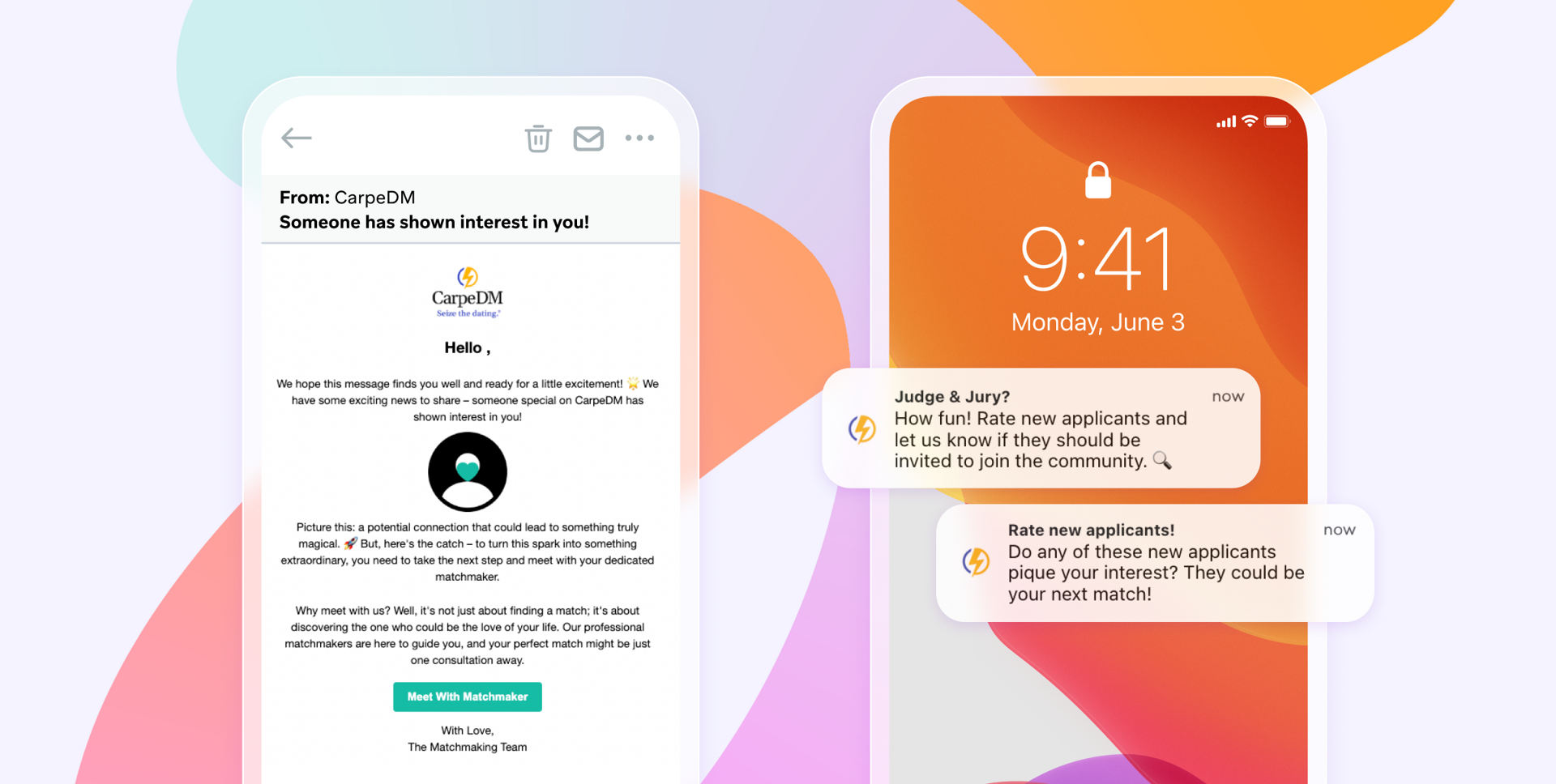
Custom events tracked where each person was, so a message only landed when their profile had been reviewed or a consultation was due, and frequency caps kept anyone who got several likes in a day from being buried. Push ran alongside, nudging existing members to review new applicants. Profile reviews hit 84% engagement, and 15% of new customers converted to paid membership.
Promotions
The email lays out the offer in full: the products, the terms, the visuals. The reminder text comes later, in the final hours before it ends, when the deadline does the work. Send both at once and the text adds nothing; hold it back until the offer's about to close and it pulls its weight.
Two common setups:
- A clothing brand emails the weekend sale in full, then fires a last-call text a few hours before it closes.
- A meal-kit service emails a week-long discount code, and texts a single reminder only to people who haven't used it by Friday.
Real-life example: KFC India
KFC India built its gamified "Bucket It" campaign as one flow across email, SMS, push, and in-app messages, not four separate blasts.
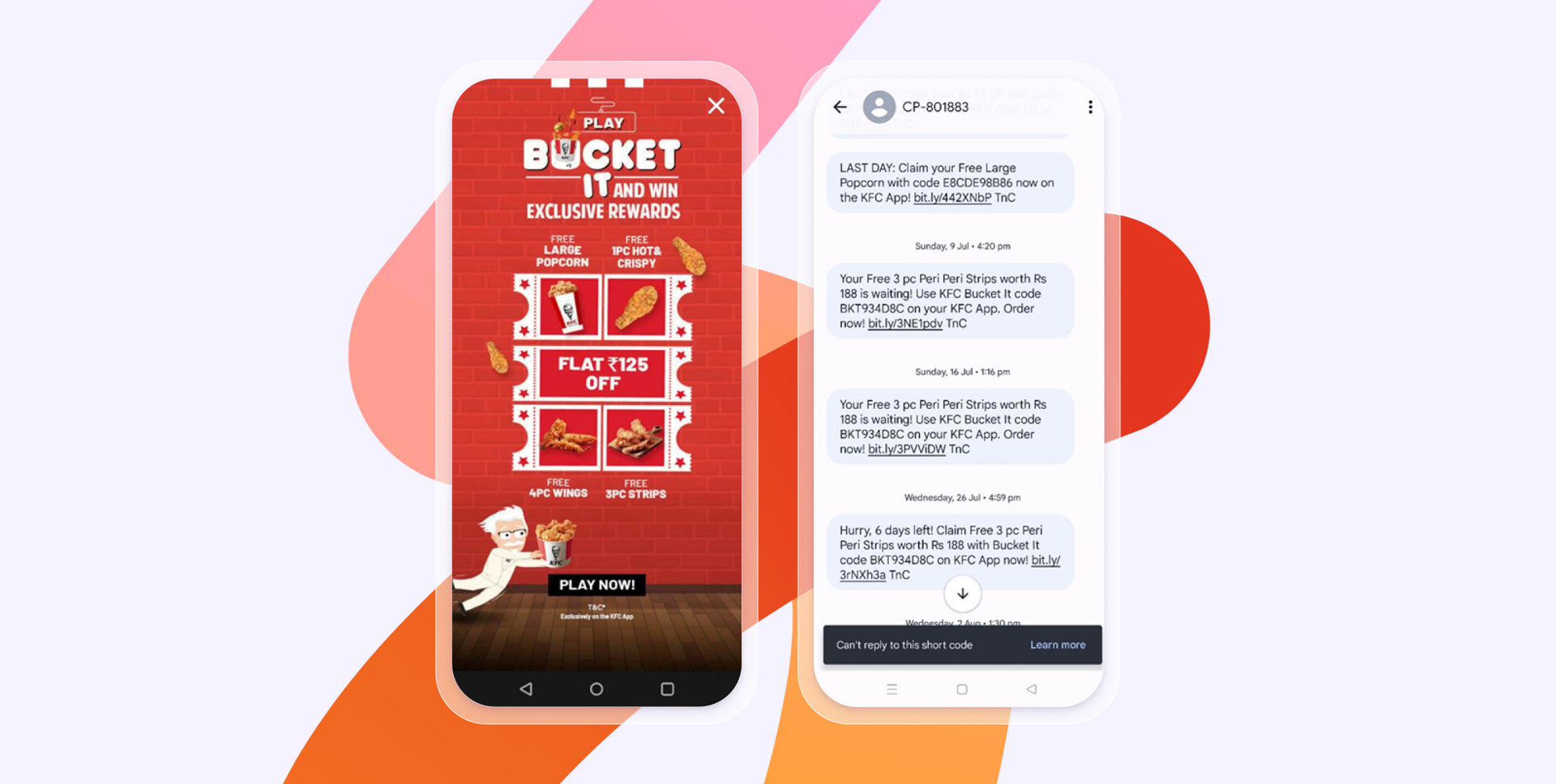
Email went out regularly to people who hadn't claimed their reward, and SMS did double duty: reaching likely buyers and nudging anyone who'd gone seven days without responding. Average daily orders per store rose 22%, and repeat orders grew 27%.
Cart and re-engagement
Cart and re-engagement work best when the next message depends on the last one. Start with an email reminder. If it goes unopened, send a text the next day. If that's ignored too, ease off rather than pile on. You're responding to what they do instead of blasting both and hoping.
Two contexts, same logic:
- Cart abandonment: an online store emails the items left behind, and only texts the next day if that email goes unread.
- Win-back: a streaming service emails a lapsed viewer a comeback offer, and saves the text for people who open it but still don't return.
Real-life example: Picklebet
Re-engagement isn't only about carts. Picklebet, the sports betting app focused on keeping users active and treated the channel mix as something to test rather than guess.
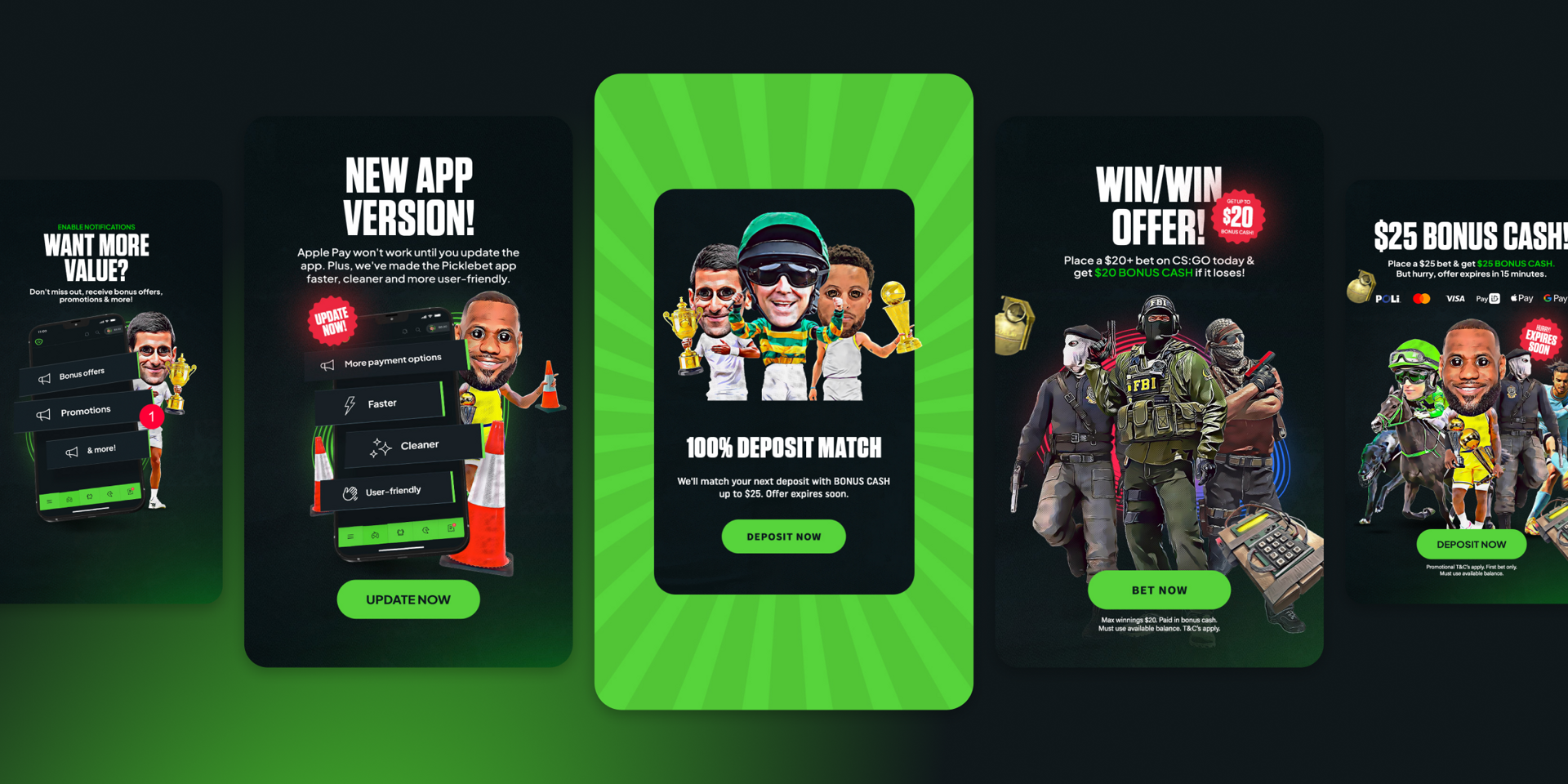
With Braze Canvas, its three-person team built cross-channel journeys, using SMS for time-sensitive prompts and email for longer-form messages, then tried different combinations to find what kept each user coming back. Personalizing that mix per user instead of leaning on blanket promotions lifted two-month retention 13% and more than doubled sessions per user, up 116%.
Transactional and alerts
A single event often needs both. The text fires the moment something happens: an order shipped, a code, a delivery on the way. The email follows with the receipt and full details to keep. One's for right now; the other's there when they need it.
What that looks like:
- A courier texts "out for delivery," and the full tracking and receipt arrive by email.
- An airline texts a gate change the second it happens, then emails the updated itinerary to keep.
Real-life example: Sonder
Sonder, the employee-care platform splits its channels by urgency. SMS carries the time-critical alerts: if there's a safety incident near a member, a text goes out right away to let them know support is there.
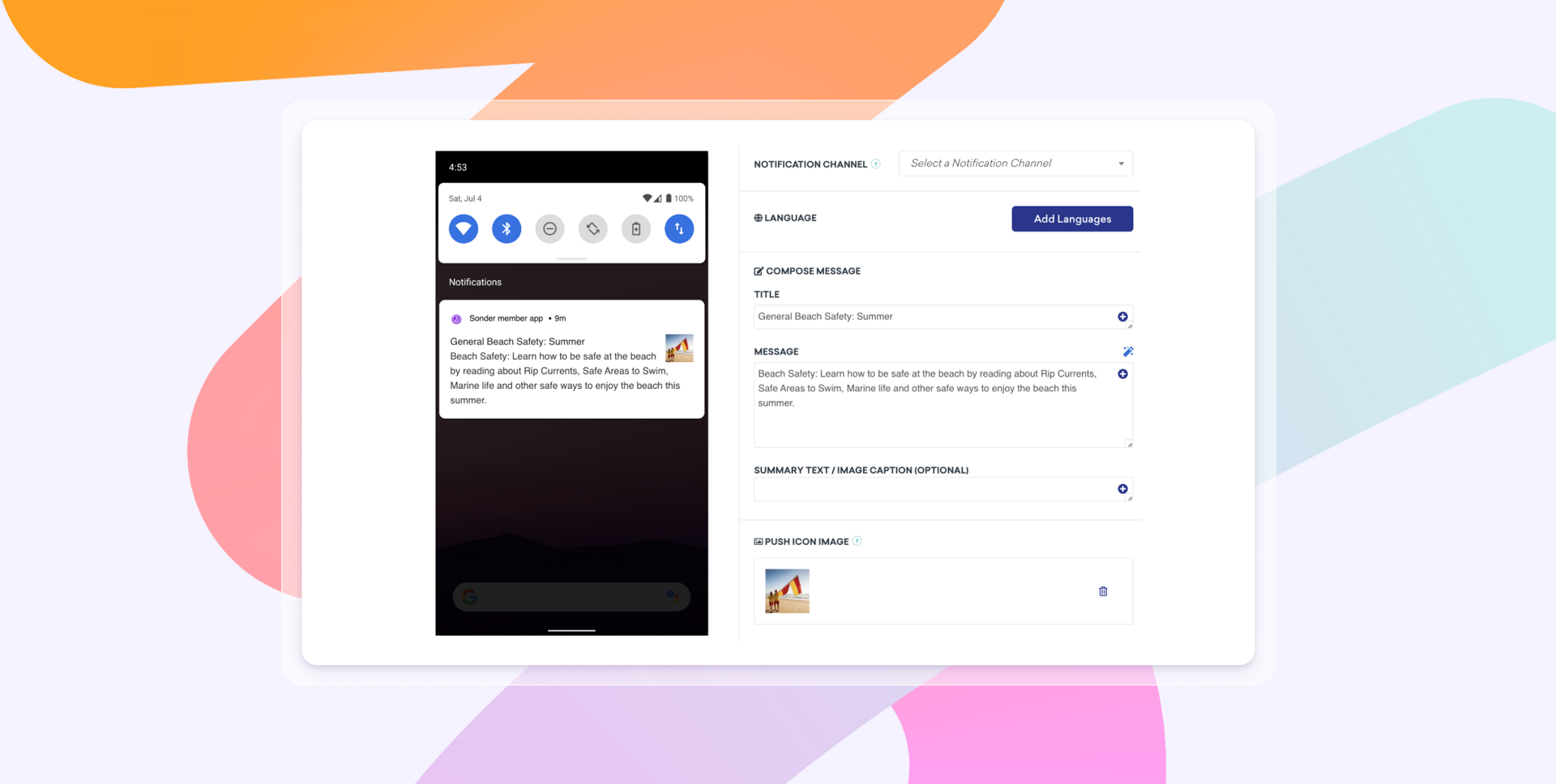
Email handles the in-depth side, walking new members through what Sonder offers, with an SMS reminder if someone opens an activation email but doesn't sign up. It pushed activations up 50% and retention up 43%.
How AI improves a combined email and SMS strategy
AI improves a combined email and SMS strategy by making the channel, frequency, and timing calls for each customer that no team could make by hand at scale. It takes the same decisions you'd map out manually and runs them for every individual, in real time.
Individual-level decisioning weighs each customer's preferences, their history, and the moment they're in, then picks email or SMS for that specific message. Run that across a whole customer base and you get channel orchestration no rules-based setup can match.
AI helps with cross-channel frequency management by counting how often someone hears from you across email and SMS together, so a heavy week on one automatically dials back the other. It tracks total contact rather than contact per channel.
Consistency comes from the data underneath. When email and SMS read from one customer profile, both see the same history and the same recent activity. A text knows what the last email said; an email knows whether the SMS reminder already went out. Nothing drifts out of sync.
For any team trying to run email and SMS as one, they’ll need to figure out what it takes to bring the data and the decisioning under a single roof.
How Braze runs email and SMS as one strategy
Braze runs email and SMS as one strategy by keeping the channels, the data, and the decisions in a single platform, rather than bolting separate tools together.
Email and SMS read from one customer profile. So an email and a text work off the same history: the same purchases, the same opens, even the support ticket from last week. Whatever one channel picks up about a person, the other already has.
Cross-channel orchestration is where you design the flow. You map one journey that crosses both channels: open with an email, wait, send a text if they don't act, then branch on what they do next. You're building a single path through both, not two flows you hope line up.
The moment-to-moment calls run on BrazeAI Decisioning Studio. It uses reinforcement learning to work out the best channel, message, timing, and frequency for each person, learns from how they respond, and keeps adapting toward whatever goal you've set, from conversions to revenue.
Put it together and email and SMS stop being two programs. They're one conversation with the customer.
Related Tags
Releated Content
View the Blog
AI marketing use cases: Eight ways brands put AI to work

Team Braze
AI-driven marketing strategies: How leading brands use AI to scale 1:1 customer relationships
July 09, 2026Email and SMS marketing: How to build a combined cross-channel strategy