
Customer engagement for enterprise: How large organizations can scale AI, data, and collaboration
Published on January 23, 2026/Last edited on January 23, 2026/11 min read


Team Braze
Customer engagement for enterprise is challenging and that pressure is often felt by enterprise teams first. Scale brings more channels, more systems, more stakeholders, and more approvals—so even small decisions can take longer than the moment you’re trying to respond to.
This guide breaks down what changes at enterprise scale, where the bottlenecks show up most often, and how AI, customer data orchestration, and cross-functional collaboration can help large organizations move faster, with more control.
Enterprise customer engagement: Where scale meets complexity
85% of marketing executives are concerned their messages aren’t hitting home. When you’re operating at enterprise scale, customer engagement becomes a coordination problem as much as a marketing one.
That combination explains why enterprise programs can feel slower than they “should.” Data lives in too many places, teams optimize locally, and every new channel adds another handoff. That means more silos, longer feedback loops, and fewer chances to iterate before the moment passes.
With data coming from so many places, a unified engagement platform and unified profiles help because they reduce translation work between tools and teams. However, only 50% of brands use a unified platform for cross-channel engagement. Fewer systems means fewer inconsistencies, faster launches, clearer measurement, and less time spent reconciling what happened across channels.
Common challenges in large-scale customer engagement
Large-scale customer engagement breaks down in familiar ways. The difference in enterprise environments is how quickly small disconnects turn into slow launches, inconsistent experiences, and missed opportunities for real-time, 1:1 engagement. Here are five challenges that show up most often, and practical fixes that support customer journey orchestration at scale.
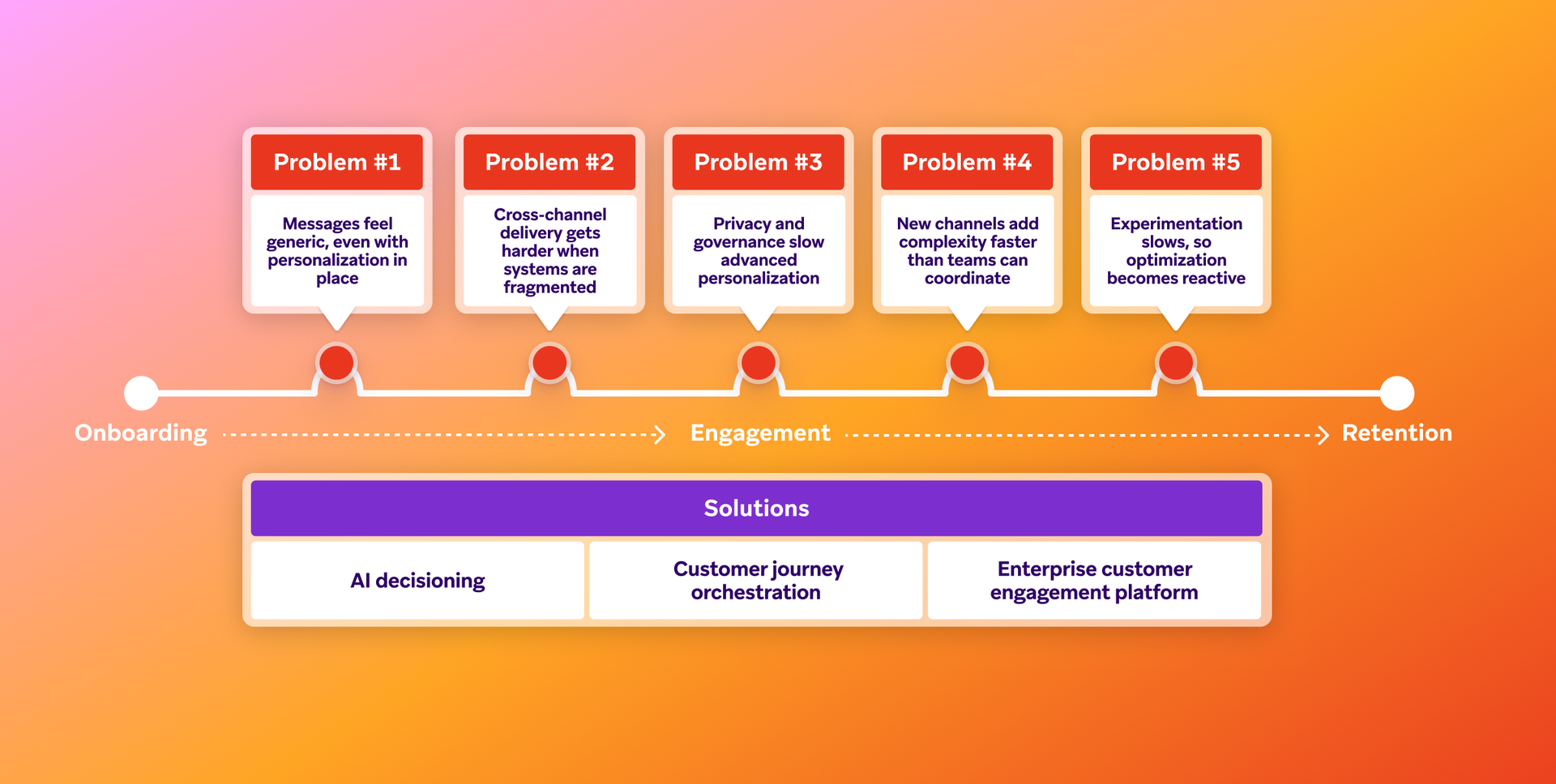
1. Messages feel generic, even with personalization in place
Problem
Enterprise teams can deliver personalized messaging at scale and still worry it isn’t landing. 85% of marketing executives are concerned their messages aren’t hitting home, and 54% are very or extremely concerned.
Solution
Treat relevance as a customer experience management priority, not a channel task.
- Use customer context to guide what happens next across channels
- Keep language and creative direction consistent, even when automation drives delivery
- Let engagement signals shape the next step in the journey, not just the next send
2. Cross-channel delivery gets harder when systems are fragmented
Problem
When different teams run different tools, orchestration slows and experiences drift. Only 50% of brands use a unified platform for cross-channel engagement.
Solution
Reduce tool sprawl so teams can move in sync.
- Standardize how journeys are built and measured across teams
- Centralize orchestration so real-time engagement works across channels
- Make it easier to reuse what works, instead of rebuilding the same logic repeatedly
3. Privacy and governance slow advanced personalization
Problem
Personalization ambitions collide with privacy expectations and internal controls. 99% say privacy concerns have impacted plans to use advanced personalization.
Solution
Build trust into the experience, and make governance workable for teams.
- Treat consent and preferences as core inputs for decisioning
- Align marketing, data, legal, and security on clear rules for access and activation
- Keep customer journey orchestration flexible without creating risk
4. New channels add complexity faster than teams can coordinate
Problem
Channel expansion creates more opportunities to connect, and more chances for experiences to fragment. 43% are using or planning to use messaging apps in 2025.
Solution
Define the job of each channel, then connect them through orchestration.
- Use real-time engagement signals to coordinate timing and next steps
- Balance outbound channels with in-product experiences where customer context is strongest
- Keep decision logic consistent across touchpoints
5. Experimentation slows, so optimization becomes reactive
Problem
Enterprise teams often have ideas to test, but limited bandwidth to run experiments and analyze outcomes. 32% say they don’t test customer engagement efforts due to resource constraints.
Solution
Make learning easier to run, and easier to scale.
- Focus tests on high-impact variables tied to customer journey orchestration
- Use AI decisioning and predictive engagement to support faster iteration based on outcomes
- Share results across teams so improvements carry across channels, not just one program
How AI is changing enterprise engagement
AI customer engagement is changing how enterprise teams plan, build, and optimize experiences. It helps teams respond faster to real-time engagement signals, reduce manual work across channels, and keep personalization consistent across regions and business units.
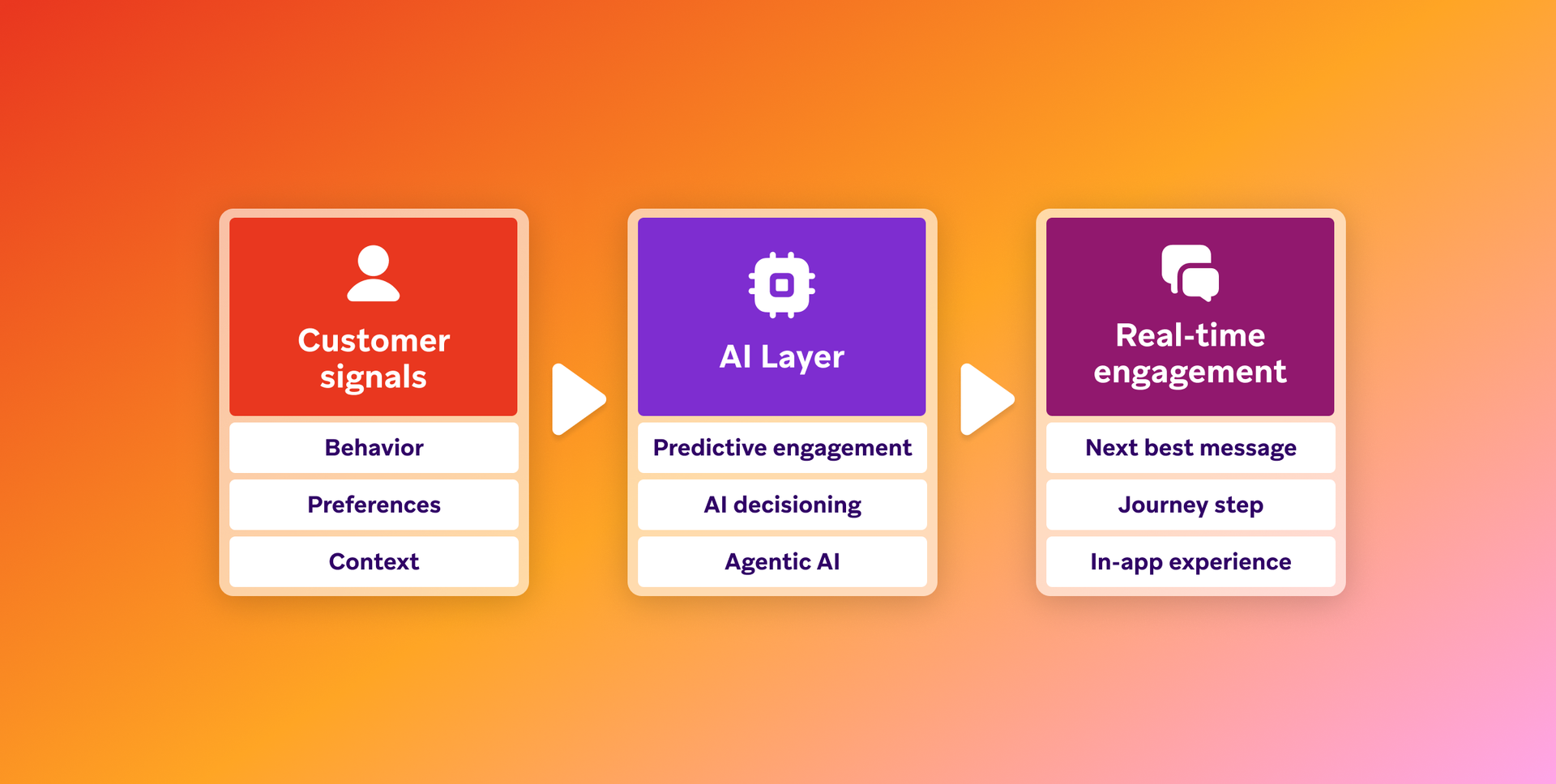
AI customer engagement
AI helps enterprise teams turn data into usable direction for creative and messaging. It can spot patterns in behavior and performance, then feed those insights back into customer journey orchestration, so teams can personalize with more confidence. It can also automate repetitive work and provide real-time performance signals, giving creative teams more time to focus on concepts, voice, and variation.
AI decisioning
AI decisioning uses reinforcement learning to support next-best-everything choices at the individual level. It can evaluate context, eligibility, and predicted impact. It learns from outcomes and selects the best combination of message, offer, channel, timing, and frequency for each individual, tied to the business metric your team cares about.
Top-performing brands are 39% more likely to use AI to adjust messages based on engagement, moving from rules, segments and predictive capabilities toward decisioning that adapts as behavior changes.
For example, send messages based on whether they’re more likely to respond to a specific discount, which product recommendation a customer would prefer, or what they are looking for in a re-engagement touchpoint. This is the kind of 1:1 personalization that AI decisioning makes possible.
Predictive analytics
Predictive analytics help enterprise teams shift from reactive programs to predictive engagement. That includes forecasting churn risk, likelihood to engage, and probability to purchase, then using those predictions to prioritize audiences and tailor journeys.
Predictive analytics estimates what’s likely to happen next. AI decisioning uses those signals, plus real-time context, to decide what experience to deliver.
Top-performing brands are 30% more likely to use AI-powered predictive analytics, such as identifying churn risk. That makes it easier to focus time and budget where it matters most, especially when teams are stretched.
Agentic AI
Agentic AI is a type of AI system that can read what’s happening, make decisions, and take action on its own to reach a goal you set, like improving retention or engagement.
For enterprise customer engagement, that shows up as orchestration that can adapt as customers change, without waiting for a team to manually rewrite the journey. Agentic AI can choose a better send moment, shift the journey based on behavior, and run tests and iterate autonomously, within the strategy and guardrails set by the marketer.
In practical terms, agentic AI can help with:
- Journey optimization by adapting the path based on individual behavior and context
- Faster experimentation by testing variations, learning from outcomes, and routing people to better-performing experiences
- Better timing by making decisions in the moment, based on live signals
This reduces handoffs across teams because journeys can stay current without a backlog of manual updates. It also supports cross-functional collaboration because governance can be built into guardrails, like approved content, frequency limits, and privacy rules, while the system handles day-to-day optimization.
Enterprise customer engagement strategies: From fragmented to unified
Enterprise customer engagement strategies depend on data unification. For large-scale customer engagement, fragmented data doesn’t just slow execution, it undermines real-time decisioning and orchestration. When customer context is split across systems, teams lose time stitching it together, and real-time engagement turns into delayed, channel-by-channel execution.
AI can reduce that friction by speeding up the work that usually slows enterprise teams down, like cleaning inputs, matching identities, and turning raw events into something teams can use in journeys.
1. Unify data so it can be used in the moment
The strongest enterprise customer engagement strategies treat data as a shared asset across teams, not a channel-by-channel dependency. That includes first-party events, product signals, and business context that changes how messaging should work.
Among Braze customers, top-maturity brands are 53% more likely to import non-customer data into messaging tools to power personalization. They’re also 31% more likely to use AI to support segmentation.
2. Move from static segments to real-time engagement
This is where enterprise teams often feel fragmentation most directly. Teams can’t execute quickly if audiences are rebuilt manually, refreshed too slowly, or defined differently by every channel owner.
Top-maturity brands are 54% more likely to segment customers in real time, which is 2.1x more than lower-maturity brands. That kind of real-time segmentation supports AI decisioning across channels, not just within one campaign.
3. Turn data into triggers across the full journey
Enterprise teams often have the data they need. The challenge is moving it into customer journey orchestration without weeks of engineering time or a separate process for every channel.
Braze integrates with enterprise CDPs and data lakes, then turns complex datasets into actionable triggers for real-time engagement. That means customer data orchestration can support consistent execution across channels, while teams keep governance and measurement aligned.
Personalization and emotional resonance at scale
Enterprise teams have automated a lot of personalization. The harder part is keeping those experiences emotionally consistent across channels, regions, and lifecycle moments, especially when customer context changes quickly.
What automation covers well
Most teams lean on a familiar set of personalization tactics because they scale reliably across large programs. In the 2025 Global Customer Engagement Review findings, 37% of respondents say they use send-time optimization or countdown timers, while 36% use customer data and preferences, and 36% tailor messages around achievements or special occasions.
Those inputs support relevance and timing. They can also start to feel repetitive if creative direction, voice, and sequencing are not managed across the full journey.
Where AI supports real-time personalization
AI customer engagement can help enterprises respond to engagement signals as they come in, rather than relying on static rules and fixed schedules. That’s reflected in how top-performing brands use AI.
- Top-performing brands are 39% more likely to use AI to adjust messages based on engagement
- They’re also 19% more likely to use AI for personalized item recommendations
How to blend automation and human direction
The most scalable approach is clear ownership across teams.
- AI decisioning supports next-best-everything, based on 1:1 signals
- Human teams set the creative direction, voice, and emotional tone, then design modular content that can flex across channels
- Customer experience management keeps journeys coherent, so connection feels personalized rather than pieced together
This mix in elements supports customer journey orchestration that can scale across a large organization, while keeping experiences recognizable and on-brand. AI handles scale, speed, and optimization—humans deliver story, empathy, and creativity. The future of enterprise engagement depends on both.
Experimentation and measurement: Scaling what works
Enterprise teams improve faster when learning is built into execution, but the way that happens varies by organization structure, resources, and risk tolerance.
A/B testing and multivariate testing support controlled learning. They’re useful for validating changes to creative, offers, timing, and journey paths, and for sharing results across teams and stakeholders.
AI decisioning supports a different kind of learning. It runs continuously in the background, learning from customer profiles, past interactions, and real-time engagement signals. Instead of waiting for a test cycle to complete, it keeps adjusting what happens next on a 1:1 basis.
That always-on intelligence can optimize across elements like:
- next best offer or message
- channel selection
- send time, day of week, and frequency
- sequencing and creative variation across the journey
AI can also shorten the optimization loop at the program level. It can automatically adjust in-progress campaigns, shift more audience volume toward top-performing variants, and flag underperforming audiences or journeys for review. Rather than replacing formal testing programs, AI-supported optimization can complement your existing efforts.
Breaking down enterprise silos: Structure for synchronization
Silos are one of the fastest ways to lose momentum in large-scale customer engagement. When teams plan and execute separately, customers feel the seams across channels, and measurement gets harder to trust.
What synchronization looks like in enterprise teams
Cross-functional collaboration works best when teams share a few fundamentals that hold up across channels and regions.
- Shared lifecycle goals and definitions across marketing, product, analytics, and customer teams
- A shared measurement model, so performance means the same thing everywhere
- Feedback loops that connect customer signals to changes in journeys
- Governance that supports speed, privacy, and consistency
How AI orchestration helps teams move in sync
AI orchestration can take work off teams by centralizing decision logic across the journey. With AI decisioning and predictive engagement signals, teams can align on what should happen next for each customer, rather than optimizing one channel at a time.
This supports 1:1 engagement across the full customer journey orchestration layer, while keeping customer experience management consistent across touchpoints.
Why a unified customer engagement platform matters
An enterprise customer engagement platform supports synchronization by giving teams one place to build, coordinate, and measure experiences across channels. It reduces duplicated work, reduces handoffs between tools, and makes it easier to apply shared rules around messaging, timing, frequency, and compliance.
Final thoughts: Building intelligent, scalable engagement
Enterprise customer engagement improves when teams treat it as a shared system across channels, teams, and regions. Data unification supports real-time engagement. Customer journey orchestration keeps experiences consistent across touchpoints. Cross-functional collaboration turns what you learn into changes you can actually ship.
AI can help reduce the friction that slows large organizations down, but it’s worth being specific about how it fits.
- AI decisioning supports continuous, always-on learning and optimization. It uses customer profiles, past interactions, and real-time signals to adjust journeys and experiences on a 1:1 basis, within the rules and goals your teams define.
- Predictive engagement helps teams prioritize by forecasting outcomes like churn risk, likelihood to engage, or purchase intent.
- Orchestration connects those inputs to cross-channel execution, so teams don’t have to rebuild the same logic in disconnected tools.
The brands that scale customer experience management successfully are the ones that keep tightening the loop between signal and action. Shared data, shared measurement, and an enterprise customer engagement platform that can respond in the moment make it easier to stay relevant as customers change.
Related Tags
Releated Content
View the BlogCustomer engagement for enterprise: How large organizations can scale AI, data, and collaboration
Team Braze

Omnichannel marketing: What it really means for customers (and how brands can deliver in 2026)
Team Braze
Customer engagement for SMBs: Strategies to compete, convert, and retain without the enterprise budget