
Content Optimizer is here, and your boldest ideas are invited
Published on October 22, 2026/Last edited on October 22, 2026/5 min read

Aparna Prasad
Senior Product Marketing Manager at BrazeThe rise of generative AI has made content creation easier than ever, allowing marketers to draft dozens of subject lines, headlines, and copy variations in minutes. But the way most teams test that content hasn’t kept up. Carrying out traditional A/B testing still requires setup, QA, a slice of your audience, and weeks of waiting. The upshot? Only a few ideas ever get tested. The rest, often the boldest ones, sit in a doc and never reach a customer.
Content Optimizer, now generally available from Braze, is built for those bold ideas. By leveraging this powerful tool, marketers can deepen their testing programs and bring more exceptional personalized experiences to life.
What is Braze Content Optimizer?
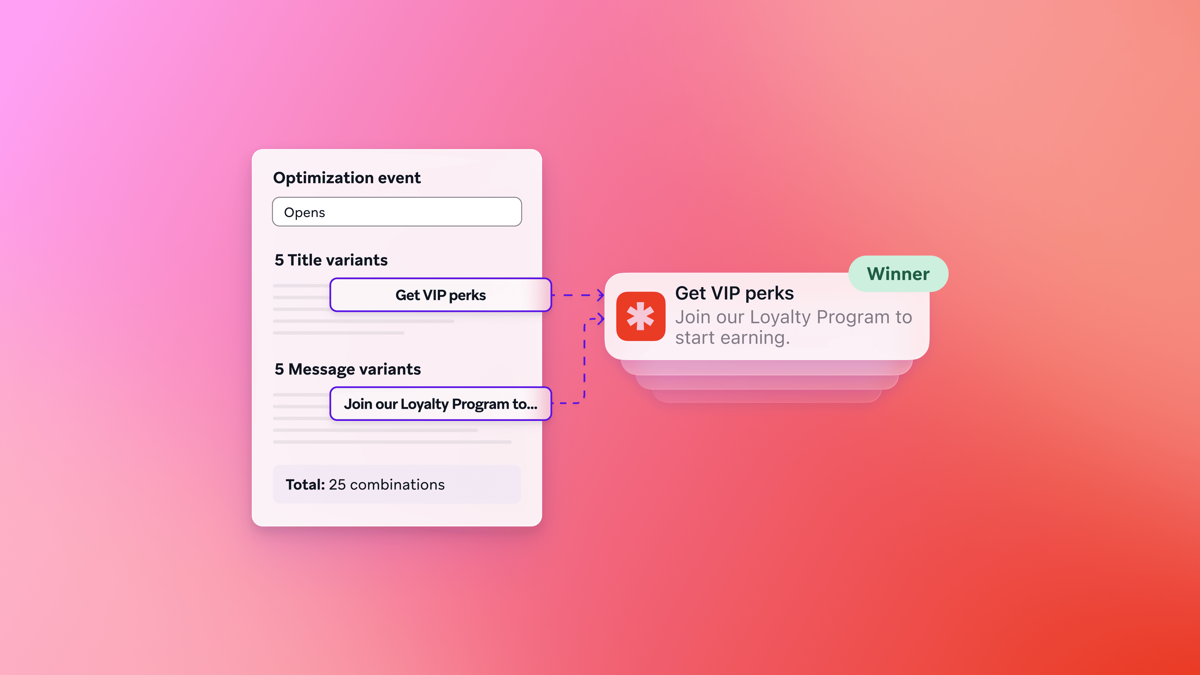
Content Optimizer is a Canvas step that continuously experiments with hundreds of combinations of message elements and automatically shifts send volume toward the top-performing variants as results come in. You can test more variations at once, see how each one performs over time, and let the winners rise on their own, without taking on more work to try out every new idea.
Content Optimizer can also flag when a step isn’t converging on a single winner. In that case, it will recommend new variants or improvements to try next. It fits almost anywhere in a Canvas, including real-time journeys, and because there’s no incremental cost to experiment, teams can run 20 or 30 Content Optimizer steps in a single complex Canvas. The customer journey that your team never had time to revive can finally get tested, without spending hours on setup.
How Content Optimizer takes A/B testing further
A/B testing gave a generation of marketers a taste of experimentation. But this type of classic test is manual to set up, assesses only one variable, splits traffic evenly until it reaches significance, and then requires someone to pick a winner and set up the next round. Half the audience sees the weaker version the whole time, and marketers only learn about what they thought to test.
Content Optimizer changes three things:
- It tests combinations (e.g. subject lines, copy, CTA buttons for email, push notifications, and SMS/MMS/RCS), not just a single variable, so you learn how message elements work together, instead of in isolation.
- It automatically moves traffic toward winners while the test is still running, so fewer people receive the weaker versions.
- It doesn’t end when a winner is found, because the step continues to adjust week over week.
Klover, a financial services company that offers cash advances to those who need them before a payday, spent three years trying to beat the control on a weekly push that alerts users when demand for cash advances is high. They decided to try something new this year by adding Content Optimizer to their campaign, and were able to test 25 combinations at once, and nine of those variants beat the control. After just a couple of weeks, the top variant lifted open rate by 22.7%, and the team learned the real issue was the body copy, not the title, something weekly manual testing never had the volume to reveal. On a second push, an early-week eligibility reminder, the top variant lifted opens by 47.3%.
It also surfaced something A/B testing rarely shows: Winners can change. Partway through Klover's test, a new body copy variant emerged and slowly took allocation from the earlier leader. A cohort of less-recently-engaged customers went from a near-flat 0.7% incremental revenue contribution to 6.92%. Brett Stewart, Klover's Director of Lifecycle Marketing, puts it this way: "It completely changes how and what we test."
How to optimize marketing campaigns using AI
When testing capacity is scarce, teams naturally default to low-risk ideas. Those tests tend to confirm what everyone believed, so the program gets steadier without getting smarter. The variants that could change it, like a new subject line or a CTA nobody would have picked, never reach an audience, and the team never finds out what it missed.
That matters more now than it did a few years ago. The Braze 2026 Global Customer Engagement Review found that more than half of consumers say most brands look the same. When anyone can generate a hundred subject lines in a minute or just use the same ideas over and over the advantage goes to the team that thinks outside of the box and quickly learns which kinds of messages its own customers respond to.
Experimentation also compounds. A winning insight improves every campaign that follows. Motorway's CRM team tested 125 combinations (five subject lines, five body copy variants, and five CTAs) on a monthly reactivation email against a static control, and saw a 114% lift in click volume and a 37% increase in valuations. Content Optimizer revealed that putting the vehicle model in the CTA beat a generic one, and when the team tested that insight against its previous top performer in an everyday campaign, it won by 30%. Early wins built the trust to expand across multiple campaigns on email, push, and SMS. As Rumi Hallingstad, Growth Marketing Director, says: "Now, we can run an always-on strategy of AI-driven experimentation."
Final thoughts
Once Content Optimizer is running in the background, the work shifts from setting up tests to deciding what to try next. That's a better problem for a marketer to have, and it's one you can start on today since each Braze workspace comes with one free Content Optimizer step. Pick one always-on Canvas with steady volume and a message that has plateaued, add five or so variants for two or three components, choose opens or clicks based on the job (opens for subject lines, clicks for traffic or conversion), and let it run.
Check out the Content Optimizer documentation covering setup, and reach out to your CSM for any further questions.
Related Tags
Releated Content
View the Blog
Grit, focus, and empathy: Life as an account executive at Braze in Berlin

Marissa Fuchs
October 2026 Bonfire Marketer of the Month: Martin Juglair
October 23, 2026Content Optimizer is here, and your boldest ideas are invited