What is retention marketing? The definitive guide
Published on March 30, 2026/Last edited on March 30, 2026/13 min read

Madison Tiemtoré
Content Marketing LeadAcquiring a new customer costs six to seven times more than keeping an existing one. And yet, most marketing budgets still tip toward acquisition.
Retention marketing is the discipline of sustaining and deepening relationships with customers a brand has already won—turning one-time buyers into regulars, and regulars into advocates. And as AI makes it possible to anticipate disengagement before it happens, what retention can achieve is expanding fast.
This guide covers the fundamentals, the frameworks, and the modern tactics that make retention one of the most powerful levers in a marketer's toolkit.
TL;DR
- Retention marketing is the practice of keeping existing customers engaged, loyal, and growing in value over time. It uses personalized messaging, lifecycle strategies, behavioral data, and increasingly AI tools to reduce churn, increase repeat engagement, and improve customer lifetime value.
Key Takeaways
- Retention marketing focuses on engaging and growing the value of existing customers through personalized, lifecycle-aware messaging and multi-channel strategies, which is more cost-effective than acquiring new customers and drives sustainable revenue growth.
- AI-powered retention marketing enhances traditional methods by predicting churn risk before disengagement, recommending next-best everything for individual customers, and prioritizing outreach based on customer value and behavior.
- Measuring retention success requires tracking metrics like retention and churn rates, repeat engagement, customer lifetime value, and behavioral indicators (e.g., feature adoption), with continuous testing and iteration to optimize campaigns and deepen customer relationships over time.
What is retention marketing?
Retention marketing is the ongoing practice of engaging existing customers to keep them active, loyal, and growing in value. Rather than focusing on bringing new audiences in, it deepens the relationships a brand has already built—sustaining them through relevant, personalized engagement across the customer lifecycle.
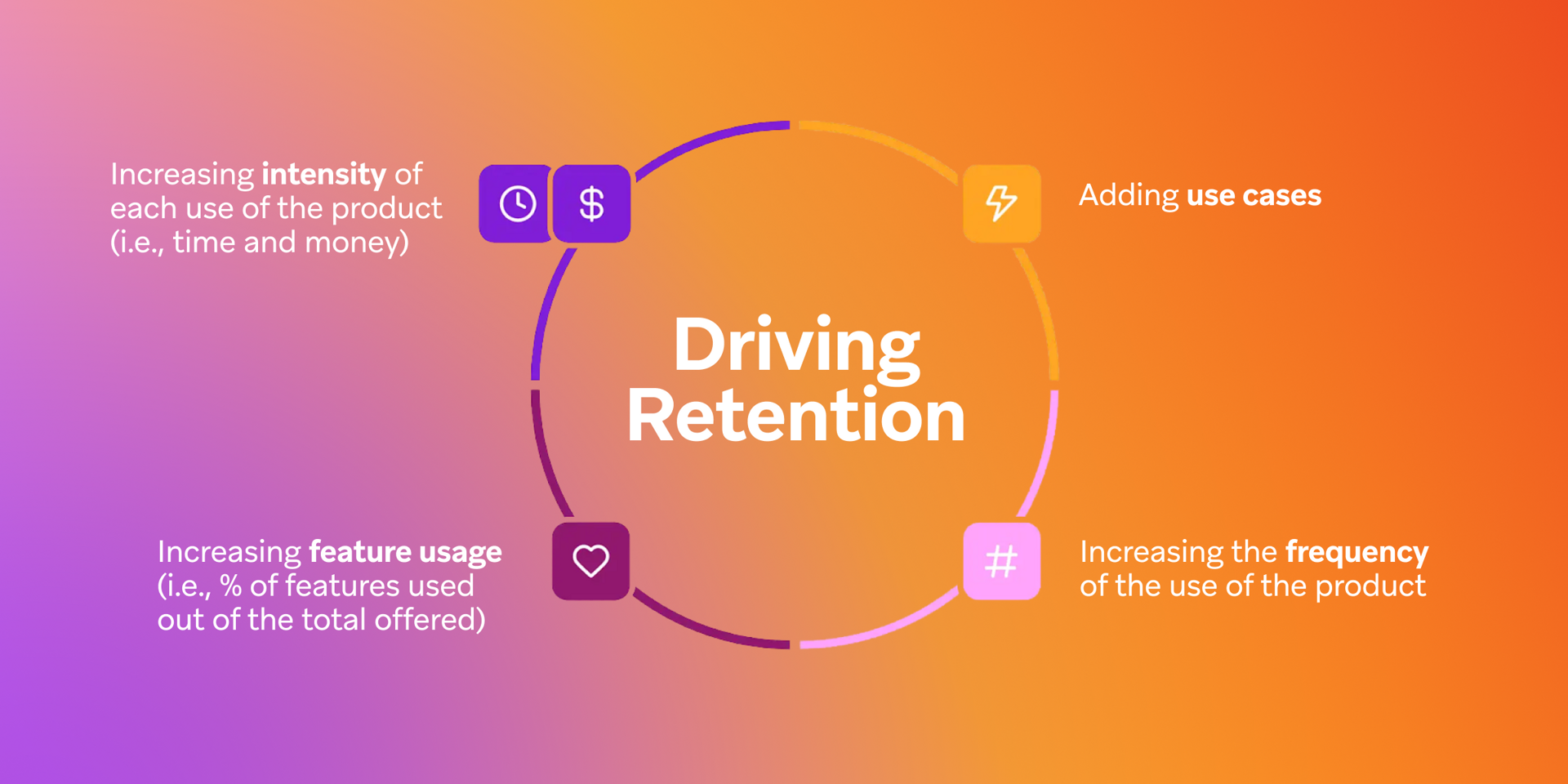
It's a discipline that's often underestimated. Retention marketing is frequently treated as a reactive measure—something to activate when churn ticks up. But the compounding effect of keeping customers engaged longer, spending more, and returning more frequently makes it one of the most powerful growth levers available to a marketing team.
Why retention marketing matters
The financial case for retention is straightforward. Existing customers spend an estimated 67% more than new ones, convert at higher rates, and require less persuasion. That has a direct bearing on customer lifetime value—and as CLV rises relative to customer acquisition cost, profitability follows. A CAC:CLV ratio of 1:3 is widely regarded as the benchmark for a financially sustainable growth model.
There is also a compounding effect that makes retention one of the highest-leverage investments a marketing team can make. The Braze 2024 Retention Guide found that brands see an average 56% uplift in 90-day retention for each new channel added to their marketing mix, up to six channels. Each investment builds on the last—stronger engagement leads to longer relationships, longer relationships increase lifetime value, and higher lifetime value improves the economics of the entire business over time.
The 2025 Global Customer Engagement Review found that 42% of marketing leaders now spend the majority of their budget on retention.
Retention marketing vs. acquisition marketing
Acquisition marketing focuses on attracting new customers. Its job is to grow the customer base, generate first-time conversions, and build awareness among audiences who don't yet know the brand. Success is measured by cost per acquisition, conversion rate, and new customer volume.
Retention marketing focuses on the customers a brand already has. Its metrics are different—retention rate, churn rate, repeat purchase rate, and customer lifetime value. Where acquisition is about reach, retention is about depth and sustainability.
The two disciplines complement each other, but the balance is important. Acquisition fuels the top of the funnel; retention determines what grows from it. A brand can run outstanding acquisition campaigns and still struggle if it cannot hold onto the customers it wins. Without retention, acquisition becomes a constant, expensive effort to replace the customers slipping away through the back door.
Most high-performing brands follow something close to the 80/20 rule—where around 20% of customers generate approximately 80% of revenue. Retention marketing's job is to identify, sustain, and grow that high-value segment.
Key components of a customer retention strategy
Effective retention marketing isn't a single campaign or a response to rising churn. It's a connected framework—one that runs continuously and adapts as customer relationships evolve. These are the five components of a customer retention strategy that hold it together.
Understanding customer behavior and signals: Every retention decision rests on knowing what customers are actually doing. App sessions, email opens, purchase frequency, feature usage—these signals reveal who is engaged, who is drifting, and what might bring them back. Without that visibility, campaigns are aimed at assumptions rather than reality.
Personalization and relevance at scale: Customers respond to communications that feel relevant to their specific situation—their preferences, their history, their stage in the relationship. Effective retention marketing uses first-party and zero-party data to tailor outreach at the individual level, not just the segment level.
Timing and lifecycle awareness: A message that works well for a new user often falls flat with a longtime customer. Retention marketing that performs consistently accounts for where customers are in their lifecycle and matches the message to the moment. The data tells you which phase a customer is in—the strategy should respond to it.
Consistency across channels: Customers engage across multiple touchpoints—inside your app, through email, via SMS, and through push notifications. A retention strategy that operates across these channels creates a more coherent experience and a stronger cumulative effect.
Measurement and iteration: Retention marketing is not static. Testing, measuring, and refining—through A/B testing, cohort analysis, and behavioral data—is what separates programs that plateau from those that keep improving.
Retention marketing across the customer lifecycle
Customer relationships don't stay the same—and neither should the marketing that supports them. The strategies that work for a brand new user look very different from those needed to re-engage someone who has been a customer for two years. Understanding where someone is in their lifecycle is what makes retention marketing precise rather than generic.
Early-stage retention: activation and habit formation
The first few weeks of a customer relationship carry disproportionate weight. Customers who complete key onboarding steps, use core product features, or make a second purchase within a defined window are significantly more likely to stick around long term.
Effective early-stage retention is about guiding new users toward the moments that demonstrate value—the features they'll rely on, the actions that form habits. Personalized onboarding sequences, triggered by specific user behavior, can have a dramatic effect on whether a customer stays or drifts after their first interaction.
Mid-lifecycle engagement: value reinforcement and usage growth
With established customers, the challenge shifts from activation to deepening engagement. The goal at this stage is to expand how much value customers get from the brand and reinforce why they chose it in the first place.
This is where retention overlaps with product adoption—surfacing features customers haven't yet explored, delivering personalized recommendations, and creating moments that strengthen their investment in the relationship. Customers who feel progressively more engaged are harder to lose.
Late-stage retention: churn risk and re-engagement
Not every customer will maintain high engagement indefinitely. Some will drift—reducing activity, skipping purchases, or disengaging from communications.
At this stage, retention marketing has two distinct jobs: identifying at-risk customers before they leave, and reconnecting with those who have already pulled back. The earlier a brand spots the signs, the more options it has—and the more likely that well-timed, relevant outreach will bring that customer back.
AI retention marketing
Traditional retention programs work from fixed rules. If a customer hasn't purchased in 30 days, send a discount. If they've stopped opening emails, move them to a lapsing sequence. Those rules have their place, but they respond to behaviors that have already happened.
Predicting churn risk before disengagement
AI-driven retention works earlier in the process. Predictive models—such as Braze Predictive Churn—analyze behavioral patterns to identify customers whose activity is beginning to diverge from those who typically stay.
Each user is assigned a churn risk score, giving marketing teams the ability to prioritize outreach before the decision to leave has been made. The campaign is earlier, the message is more relevant, and the window for action is wider.
Identifying next-best actions
Knowing who is at risk is only part of the picture. Next best action models take that signal further—analyzing behavior, channel preferences, and past responsiveness to recommend the most effective way to engage each individual, rather than applying the same outreach to everyone in a risk segment.
The most advanced version of this is AI decisioning, which simultaneously optimizes every variable in a customer interaction—offer, channel, message, timing, and frequency—learning continuously from real interactions rather than relying on static rules.
Prioritizing engagement efforts
Not every at-risk customer represents the same opportunity. AI helps prioritize retention investment by combining churn risk with customer value—focusing the most intensive re-engagement efforts on high-value users at moderate risk, and applying lighter-touch automation elsewhere. That allows teams to make smarter decisions about where to concentrate time, budget, and attention.
Reducing reliance on static segments and rules
Static segmentation divides audiences into fixed groups and applies the same rules across each. The problem is that customers don't behave in fixed ways. A customer who was highly engaged last month may slow down this month—and a static rule set will either miss that or respond too late. AI-driven approaches adapt continuously, adjusting engagement based on how a customer's behavior actually evolves, rather than which bucket they were placed in at the start.
Customer retention marketing examples
The strategies covered in this guide play out differently depending on the product, the audience, and what retention actually means for the business. The following three retention marketing examples show what becomes possible when lifecycle thinking, personalization, and data work together.
Tonies scores a 117% conversion lift by rewriting the onboarding story
Tonies makes the Toniebox—a screen-free audio speaker for children paired with collectible figurines called Tonies. When a child places a Tonie on top of their Toniebox, it plays stories, songs, or personal recordings. Kids average 268 minutes of playtime a week, and most families accumulate around 20 Tonies over 4.5 years. In Q1 2024 alone, the brand sold over 5.8 million Tonies.
The challenge
Tonies needed to activate new users faster, convert them from free to paid content, and upsell existing customers with relevant purchases over time. Their legacy system didn't have the segmentation, personalization, or cross-channel capabilities to make that happen. Results had plateaued—stable, but not growing.
The strategy
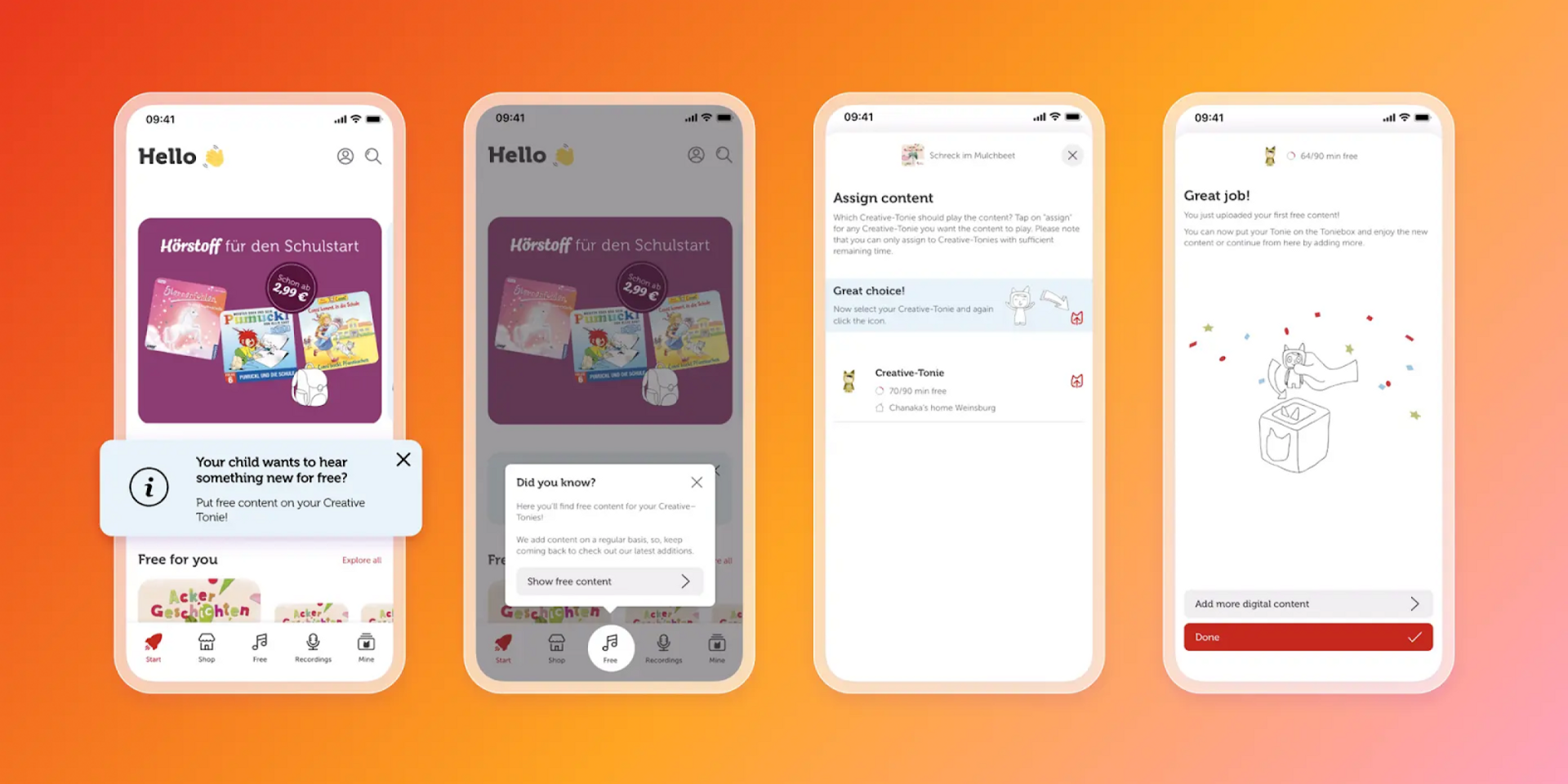
Tonies rebuilt their onboarding flow using Braze Content Cards and in-app messages to guide new users toward free content—treating it as the key retention action that drives long-term purchasing behavior.
For existing customers, real-time behavioral triggers determined when and how to upsell: a user engaging with Paw Patrol content but making no purchase within 30 days would receive a targeted push notification, then a discount offer after a further week of inactivity. Braze Intelligent Channel automatically routed each message to whichever channel was most likely to get a response.
The wins
- 117% increase in free-to-paid content conversion rate year-over-year from 2023 to 2024
Panera's menu makeover: A recipe for retention and 2X conversions
Panera Bread is a leading fast casual restaurant with more than 2,200 locations across North America, built on a reputation for wholesome food and a welcoming café environment.
The challenge
In April 2024, Panera launched the largest menu transformation in its history—more than 20 updates, including nine new items. The challenge wasn't just launching a new menu; it was holding onto loyal guests and re-engaging those who had already lapsed during a period of significant change.

The strategy
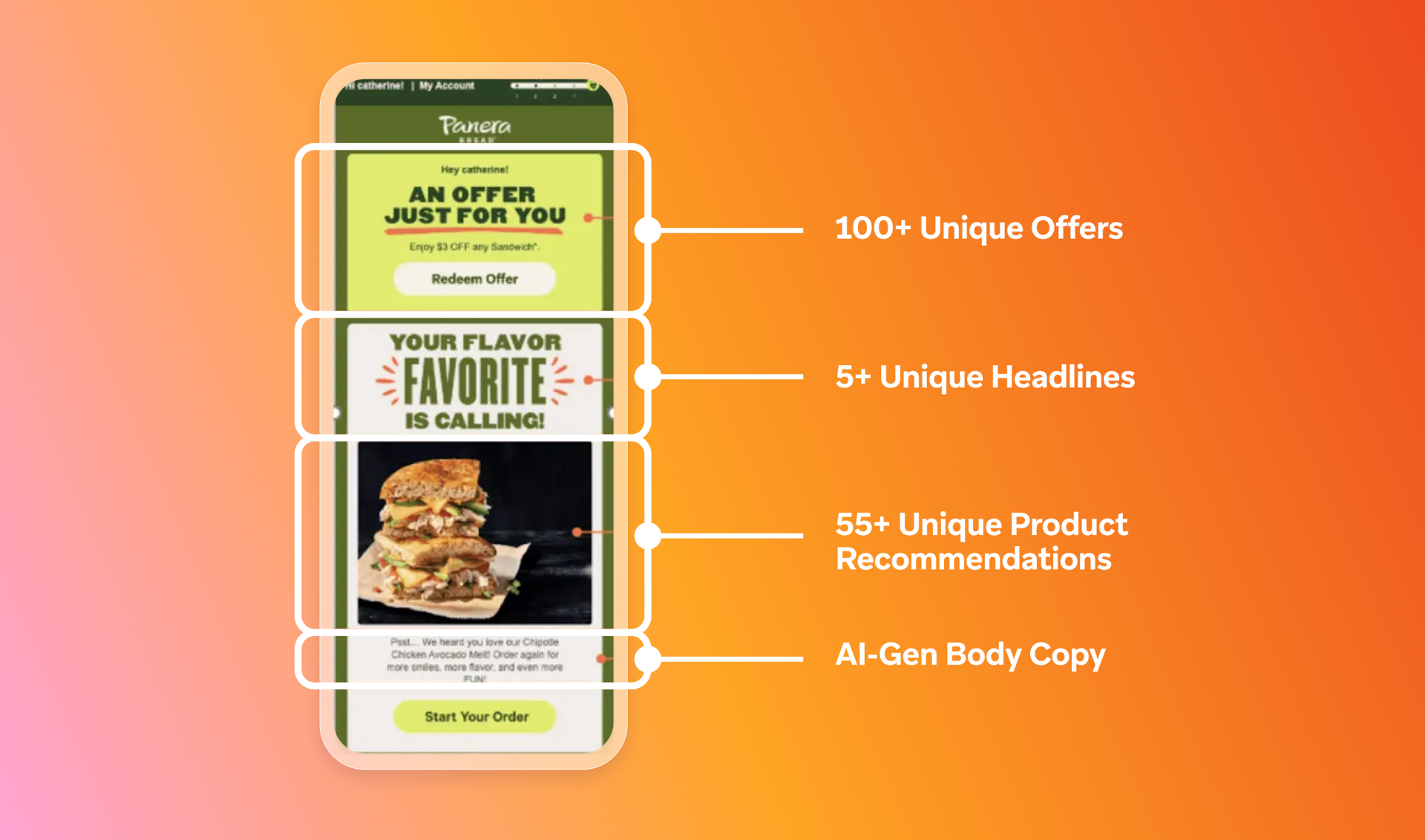
Panera used AI-powered decisioning integrated with Braze to identify at-risk guests early and reach them with over 4,000 unique combinations of personalized offers across email, app, and web.
A pre-launch voting campaign engaged MyPanera members and generated over 400,000 votes, with the resulting data used to personalize reward offers and maintain loyalty momentum. Guests who browsed new menu items but didn't purchase were retargeted via follow-up push and email—a direct retention tactic aimed at recovering guests on the verge of lapsing.
The wins
- 5% retention lift among at-risk guests
- 2X loyalty offer redemptions
- 2X purchase conversions from abandoned order follow-ups
- 50+ hours of manual work saved through automated content creation and streamlined campaign management
Too Good To Go bags a 135% purchase lift with smarter personalization
Too Good To Go is a food waste platform launched in 2016, connecting users with unsold surplus food from restaurants and grocery stores through discounted Surprise Bags. Since launch, the platform has helped save over 300 million meals from going to waste.
The challenge
Too Good To Go was successfully driving users to the app—but engagement wasn't converting to purchases. After surveying their audience, the team found that the primary reason users weren't buying was that they couldn't find what they were looking for. Generic messaging created fatigue and, ultimately, churn.
The strategy
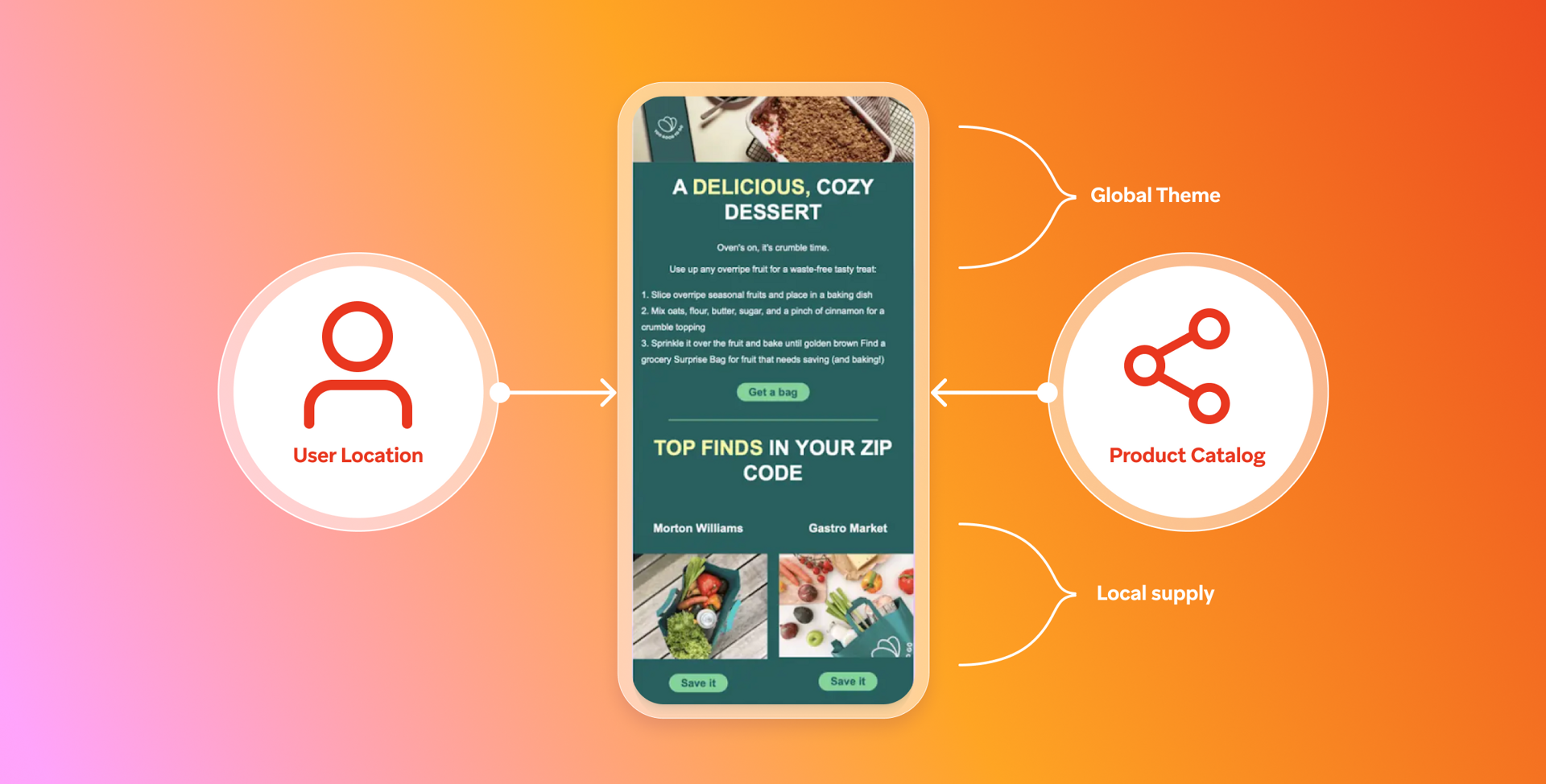
Too Good To Go used Braze Catalogs to build behaviorally driven campaigns, segmenting users by app sessions, Bags viewed, Bags favorited, and Bags purchased—then triggering alerts when relevant stock became available nearby.
To tackle churn directly, a drop in engagement score automatically triggered a Connected Content message pulling in available Surprise Bags within the user's geographic area, keeping the outreach relevant and timely rather than generic.
The wins
- 135% increase in purchases attributed to CRM
- 2X increase in message conversion rate
- Improved cost efficiency across CRM campaigns
Measuring retention marketing success
Retention marketing generates a lot of activity—campaigns, journeys, tests, personalization at scale. But activity isn't the same as progress. The metrics that actually matter are the ones that tell you whether customers are staying, spending, and finding ongoing value. Here's what to track, and what each signal is really telling you.
Retention and churn rates
These are the foundational measures. Your retention rate tells you what percentage of customers remain active over a given period; your churn rate tells you how many are leaving.
Neither number means much in isolation—what matters is the trend over time and how both rates shift in response to specific campaigns or lifecycle changes.
A retention rate that holds steady while you're growing your customer base is a strong signal. One that's declining while acquisition accelerates is a warning that the economics are moving in the wrong direction.
Repeat engagement and usage patterns
Single purchases or one-time app opens don't build a sustainable business. Repeat engagement—return visits, second purchases, regular feature usage—is what indicates a customer has found genuine value and built a habit around your product.
Tracking patterns like purchase frequency, session depth, and active days per month gives you a clearer picture of which customers are deepening their relationship with your brand and which ones are drifting.
Customer lifetime value
CLV is the long-term measure of whether retention efforts are compounding. A customer who returns regularly, spends more over time, and resists churning is worth considerably more than their first transaction suggests.
Tracking CLV by cohort—grouping customers by when they first converted and watching how their value evolves—reveals which acquisition periods, onboarding approaches, or engagement strategies are producing the most durable relationships.
Behavioral indicators of long-term health
Some of the most useful retention signals aren't purchase-based at all. Feature adoption rates, content engagement, loyalty program participation, and referral activity all indicate how invested a customer is in your brand beyond the transaction.
These behavioral indicators often move before purchase patterns do—making them valuable early signals of both strong retention and emerging risk. A customer who stops engaging with your content or logging in regularly may still be making occasional purchases, but the trajectory is worth paying attention to.
Taken together, these metrics give retention marketing a clear evaluation framework—one that connects day-to-day campaign performance to the longer-term health of your customer relationships.