
Decisioning engines: How AI powers customer engagement
Published on March 27, 2026/Last edited on March 27, 2026/11 min read

Team Braze
Customers don’t experience your marketing as campaigns. They experience moments—a price drop, a checkout reminder, a loyalty perk, a support update, a product tip, a reactivation nudge. In customer engagement, decisioning engines often use AI techniques—commonly referred to as AI decisioning—to evaluate options, learn from outcomes, and optimize experiences over time. A decisioning engine is what helps those moments resonate with the right timing, context, and channel choice, even as behavior changes minute to minute.
In customer engagement, decisioning engines are built to choose the next best experience across channels and across the lifecycle.
For customer engagement teams, decisioning has moved past “pick a segment, send a message.” The strongest programs run on real-time decisioning, using live signals, first-party data, and feedback from outcomes to keep journeys responsive.
This article breaks down what a decisioning engine is, how it works in marketing, how it differs from rules engines, and why next best experience thinking matters for customer journey orchestration.
What is a decisioning engine?
A decisioning engine is a system that evaluates customer context and determines the most relevant action or experience in real time, at scale, and across channels. In customer engagement, decisioning engines often use AI techniques—commonly referred to as AI decisioning—to evaluate options, learn from outcomes, and optimize experiences over time.
It connects three things:
- Signals (what’s happening right now, plus what’s known historically)
- Intent (what outcomes you care about, and guardrails like consent and frequency)
- Execution (the ability to take action in the channel where the customer is active)
In customer engagement, the strongest decisioning engines run inside live journeys, making and updating decisions continuously across channels.
Unlike static campaign logic or prebuilt segments, decisioning engines continuously reassess what to do next based on live signals and recent outcomes.
Why decisioning engines matter for modern customer engagement
Decisioning engines matter because customer behavior changes faster than most marketing plans can keep up with. People bounce between devices all the time. A weekly batch campaign can’t respond to a checkout that’s happening right now or a sudden spike in product interest. In omnichannel engagement, that gap becomes more noticeable, as customers switch channels mid-journey and expect the experience to stay consistent.
Static rules and manual decision-making tend to break down in the same places. Teams end up working in silos, so the experience feels disjointed as customers move between channels and segments lose accuracy quickly, because a label applied in the morning can be outdated by lunchtime. Nobody has time to hand-tune every combination of audience, timing, offer, and channel, so customers end up locked into paths that no longer match what they’re doing.
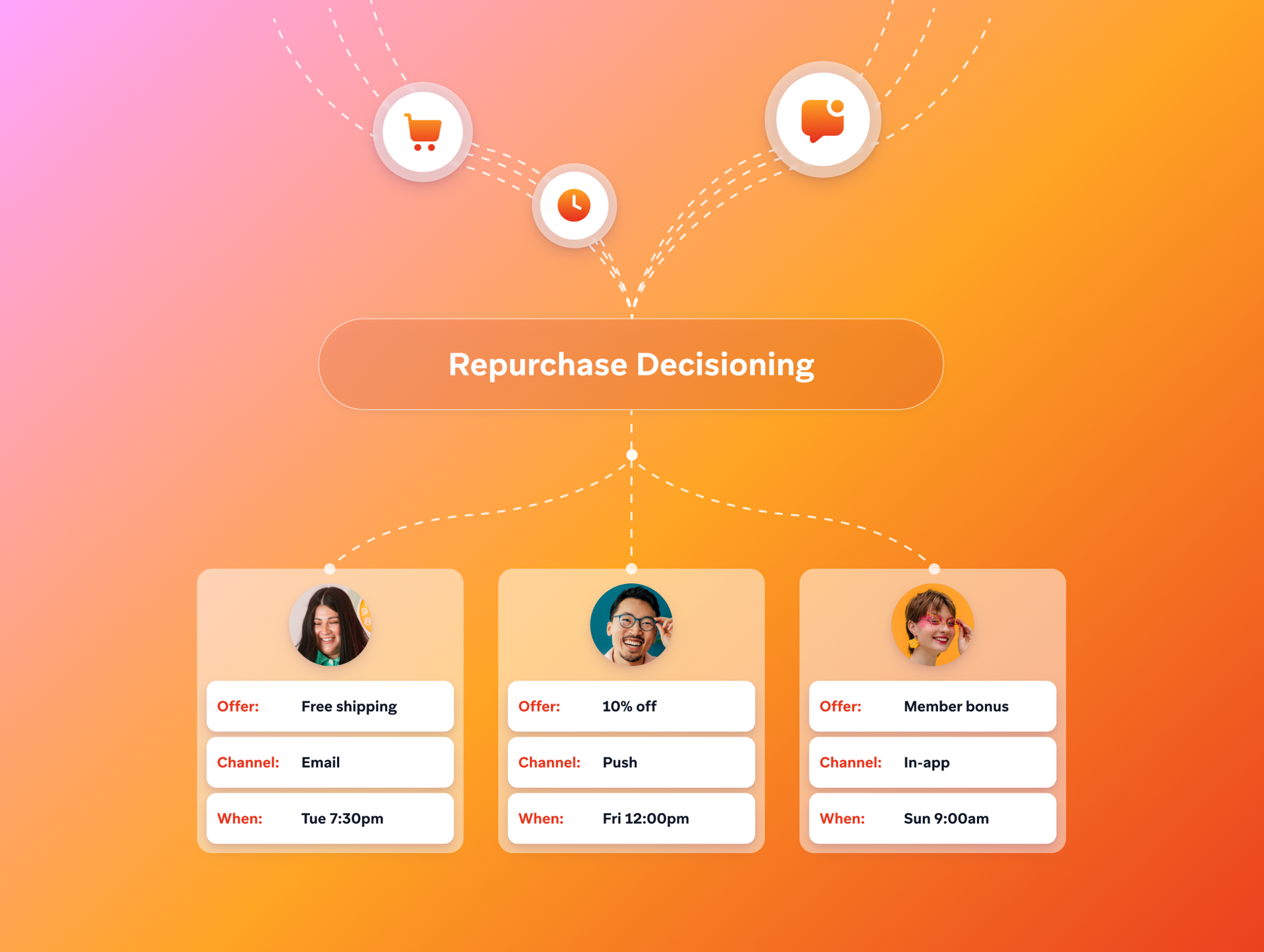
A decisioning engine keeps choices closer to the moment a customer takes action. It makes personalization possible at scale by using real-time signals, past behavior, and channel preferences to pick the experience that fits each person.
It also helps teams focus effort where it counts, prioritizing the actions most likely to drive impact across channels, while cutting down on manual work. And because it can respond as behavior shifts, it keeps journeys agile, bringing together signals and outcomes into a single, evolving view of each customer that gets sharper over time.
Decisioning engines vs. traditional rules engines and campaign logic
Decisioning engines and rules engines both make choices, but they’re built for different kinds of decisions.
Rules engines follow logic you define in advance. They’re useful for things like consent, eligibility, suppression, and frequency limits, where you want consistent answers.
A lot of marketing campaigns also rely on simple logic tied to segments, like “send this message to this group.” That can work for straightforward programs, but it gets harder to manage when customers are doing lots of different things across channels. A segment can tell you something broad about someone, but it often won’t reflect what they’re doing right now. And once someone is in a prebuilt journey path, changing course based on new behavior usually means adding more branches and more upkeep.
Decisioning engines look at what’s happening in the moment, taking into account historical data and context and choose between the valid options.
Most teams use both together—rules to set the boundaries, and decisioning to pick the next best experience within those boundaries.
How does decisioning engine software work in marketing?
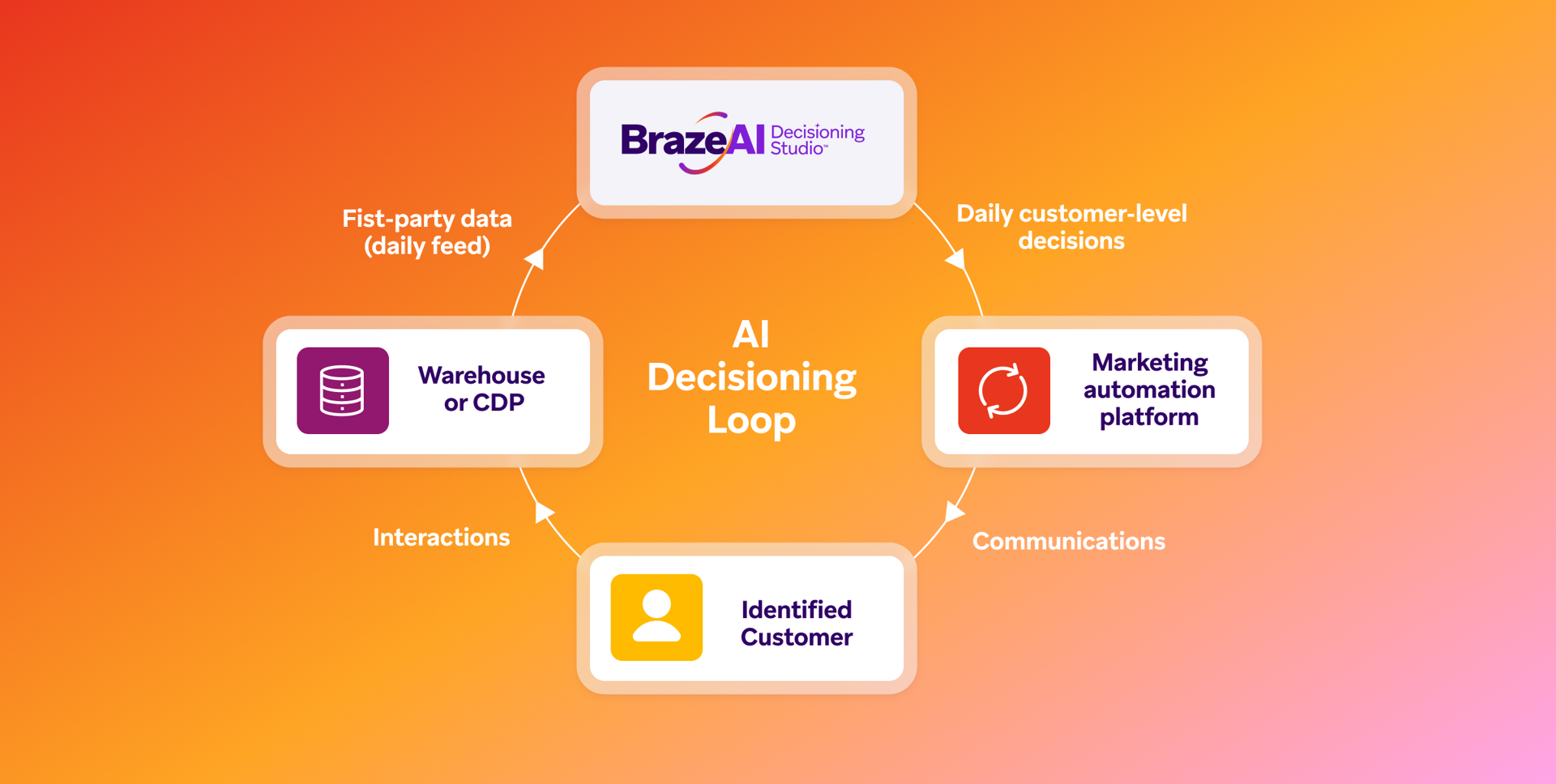
Decisioning engines work by turning customer signals into a decision that can be acted on inside a journey, then improving those decisions over time based on results. In customer engagement, the decision is rarely just “send or don’t send.” It can include channel, timing, frequency, and which version of a message or offer someone receives.
1. Signal intake
The engine takes in customer data from the places they interact with you—events, preferences, profile attributes, and journey behavior across channels.
2. Data readiness
It organizes and standardizes those inputs so they can be used together, even when they come from different systems or arrive at different times.
3. Context evaluation
It looks at what’s true right now for that person—recent actions, journey stage, permissions, and what they’ve already received.
4. Option set
It builds the list of valid next steps based on the guardrails your team sets, like consent, eligibility, content availability, and frequency limits.
5. Prioritization
It decides which option is most likely to drive the outcome you care about. Depending on how it’s configured, this can include AI agents that test different combinations and learn which ones perform best for different customers.
6. Activation
It sends the decision back into the journey so it can be executed in the right channel, at the right moment.
7. Learning and visibility
It tracks what happened, measures impact against the goal, and uses that feedback to improve future decisions. Strong decisioning setups also make decisions explainable, so teams can understand why a choice was made and spot changes in performance over time.
From next best action to next best experience with AI decisioning
“Next best action” often means picking a single move, like which product or offer to put in front of someone. For customer engagement, that’s rarely enough. Every touchpoint comes with a bundle of choices—what to say, where to reach them, and when. Those choices affect each other, so a strong offer sent at the wrong time, on the wrong channel, or too frequently can still fall flat.
Decisioning engines go further by optimizing for the next best experience. The “best” choice accounts for timing, channel, and message pressure across journeys, while also considering the longer-term impact on engagement and retention.
It also helps teams guide customers toward the next step in their journey, based on intent and context, rather than simply reacting to the last thing they did. AI-powered decisioning can weigh first-party signals, like recent behavior and what someone has already seen, so the experience fits the individual instead of a broad segment.
Decisioning engines inside customer journeys
Decisioning engines belong inside customer journeys because that’s where customer engagement actually happens. Rather than acting as a separate “decision hub,” embedded decisioning can run continuously inside live journeys, using real-time data to keep choices current.
As customers move across channels, take new actions, or go quiet, the adaptive journey can re-evaluate what should happen next and execute that decision immediately, or when the time is right for the customer.
With real-time re-decisioning, the journey can keep checking what should happen next as behavior changes. If someone starts browsing, completes a purchase, goes quiet, switches channels, or updates preferences, the journey can respond by changing the content, switching the channel, pausing to reduce message pressure, or moving them to a different path.
For teams, this keeps journeys flexible and omnichannel engagement consistent, without turning the journeys into a tangle of branches. For customers, it creates experiences that feel made for them.
Types of decisioning engines
Decisioning engines usually fall into two camps—composable systems and end-to-end systems. The difference is how much work it takes to turn a decision into a real customer experience across channels.
Composable decisioning engines
Composable decisioning engines are modular. Teams pick different tools for different parts of the job, then connect them to the places where customers actually get an experience, like email, push, in-app, SMS, and web.
This can suit organizations with strong engineering and data science support, especially if they want tight control over each piece. The downside is the ongoing work. Connecting tools takes time, updates often need changes across multiple systems, and the setup can get messy as journeys and channels grow.
End-to-end decisioning engines
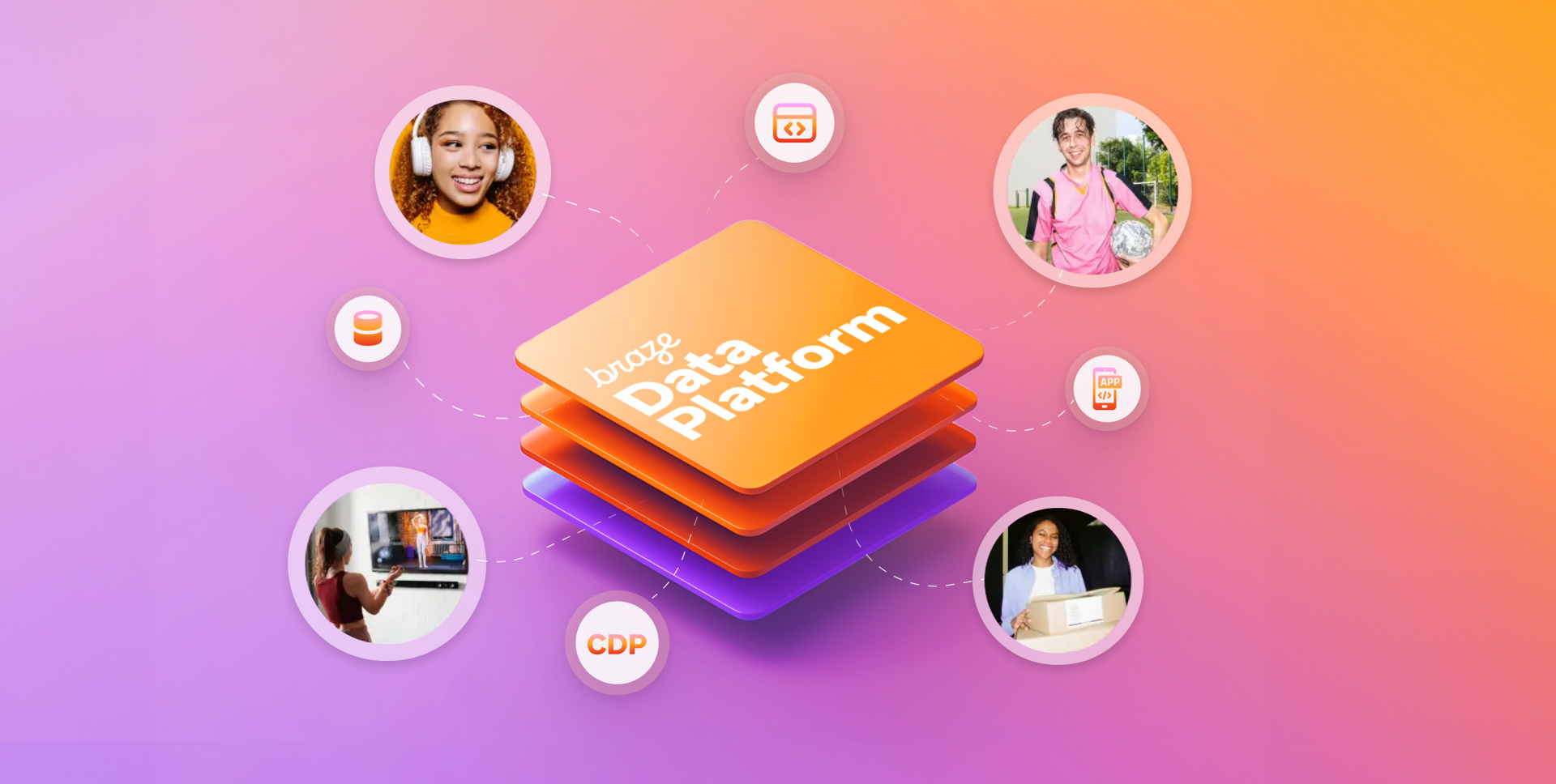
End-to-end decisioning engines bring the full flow into one system, from data coming in to actions going out. They connect decisioning directly to customer journeys, so decisions can be made with the right context and then executed where they matter.
For marketing and CX teams, a unified approach can mean less complexity because decisions don’t need to be recreated for each channel, journey context is available at decision time, and results can be measured across the journey rather than only at the message level.
Real-time re-decisioning and learning loops
Re-decisioning is the ability to update what happens next based on new signals, outcomes, and changing context. In customer engagement, it means a journey can revisit the decision repeatedly, rather than treating the first decision as final.
Say a customer enters a trial onboarding journey. Halfway through, their activity spikes, indicating strong intent. A re-decisioning-capable journey can reduce educational nudges and move them toward activation and upgrade prompts. If activity drops two days later, the journey can pivot again.
Learning loops are what make re-decisioning get smarter over time. Instead of treating each touchpoint as a one-off, the system learns:
- Which choices tend to drive the outcomes you care about
- Which choices tend to cause fatigue or disengagement
- How different customer contexts respond to different experiences
This is also where experimentation fits naturally. Testing isn’t a separate phase. It becomes part of how the engine learns which experiences work for which contexts.
Measuring the impact of decisioning engines
A decisioning engine should be judged by what customers do next, and what that adds up to over time. Speed and efficiency matter, but they’re not the point. The point is whether decisions improve engagement, move customers toward key moments faster, and strengthen retention across the lifecycle.
Some of the metrics to track include:
- Engagement lift: Changes in opens, clicks, in-app interactions, session starts, and content consumption.
- Conversion velocity: Time to first purchase, time to activation, time to upgrade, and completion rates for key steps.
- Retention and churn signals: Repeat purchase, subscription renewal, continued usage, and reactivation rates.
- Lifetime value: Revenue per customer over time, and whether you’re relying less on discounts to drive action.
- Journey-level performance: Step completion, drop-off points, and how different paths perform across the full journey.
Measurement should also account for tradeoffs. A decision that boosts short-term conversion can raise unsubscribes, complaints, or fatigue. Looking at performance across the whole journey helps teams make decisions that hold up over time.
Common misconceptions about decisioning engines
Decisioning engines can sound abstract, which makes it easy for teams to dismiss them as “too complex,” “too technical,” or “not for marketing.” A few common misconceptions come up again and again, and they’re worth clearing up early.
Myth 1: A decisioning engine replaces strategy
A decisioning engine doesn’t set your strategy. Your team still decides what matters—the outcomes you’re aiming for, the audiences you want to reach, what value you’re offering, and the guardrails that protect the customer experience. A decisioning engine helps carry a customer engagement strategy into the journey by choosing the next best experience within the boundaries you set.
Myth 2: Decisioning requires heavy technical ownership
Some setups do, especially when teams build a composable stack from multiple tools. But many engagement use cases don’t need that kind of lift to get started. Teams can begin with decisioning built into journey tooling, test and learn, then expand as needs grow.
Myth 3: Decisioning is only for finance, fraud, or risk
Finance, fraud or risk use cases are well-known, but customer engagement is important across all industries. You’re deciding what to say, where to say it, and when, across channels and across time, based on real-time customer behavior. That’s decisioning, too.
Myth 4: Decisioning means handing everything to AI
Decisioning still needs human guardrails. Consent, brand voice, eligibility rules, and success metrics come from your team. AI can help with prioritization and learning, but it’s working within the boundaries you define.
A useful gut-check for any decisioning setup
Look at where decisions are made. If decisions happen outside the journey and then have to be rebuilt across channels, teams spend more time translating logic than improving the experience.
Related Tags
Releated Content
View the BlogDecisioning engines: How AI powers customer engagement
Team Braze

What is frequency capping? Managing message volume across channels
Team Braze

Explore vs. exploit: The safe bet for AI decisioning isn’t always the right one