
AI recommendation engine: How machine learning delivers personalized suggestions at scale
Published on July 01, 2026/Last edited on July 01, 2026/12 min read

Team Braze
You've probably been on the receiving end of a message powered by an AI recommendation engine more often than you’ve realized. The product mention in an email that felt oddly well-timed, or the in-app suggestion that reflected what you'd done a few minutes earlier.
Recommendation engines are doing a significant amount of the work in modern marketing, across channels and industries, and the entire customer lifecycle.
Knowing how they work and the tools you need to implement them, means you can make better decisions about how to apply them for your customers.
TL;DR
- An AI recommendation engine analyzes behavioral signals, item attributes, and user data to generate personalized, ranked predictions for each individual, updating automatically as new data arrives.
- AI recommendation engines build individual-level understanding from actual behavioral data, which is what sets them apart from rules-based recommendations and basic personalization tactics like segment-based content.
- The four main algorithm types are content-based filtering, collaborative filtering, hybrid models, and deep learning, with most modern systems combining more than one approach.
- Recommendation engines work across every marketing channel, including email, push, SMS, in-app messages, Content Cards, and web, following the customer throughout their journey.
- Real-world applications span retail, media, travel, financial services, and QSR, with the logic adapting to each industry's catalog and customer behavior.
- BrazeAI™ Item Recommendations uses deep learning models built natively into the engagement platform, so marketers can deploy recommendations across any channel without a data science team.
What is an AI recommendation engine?
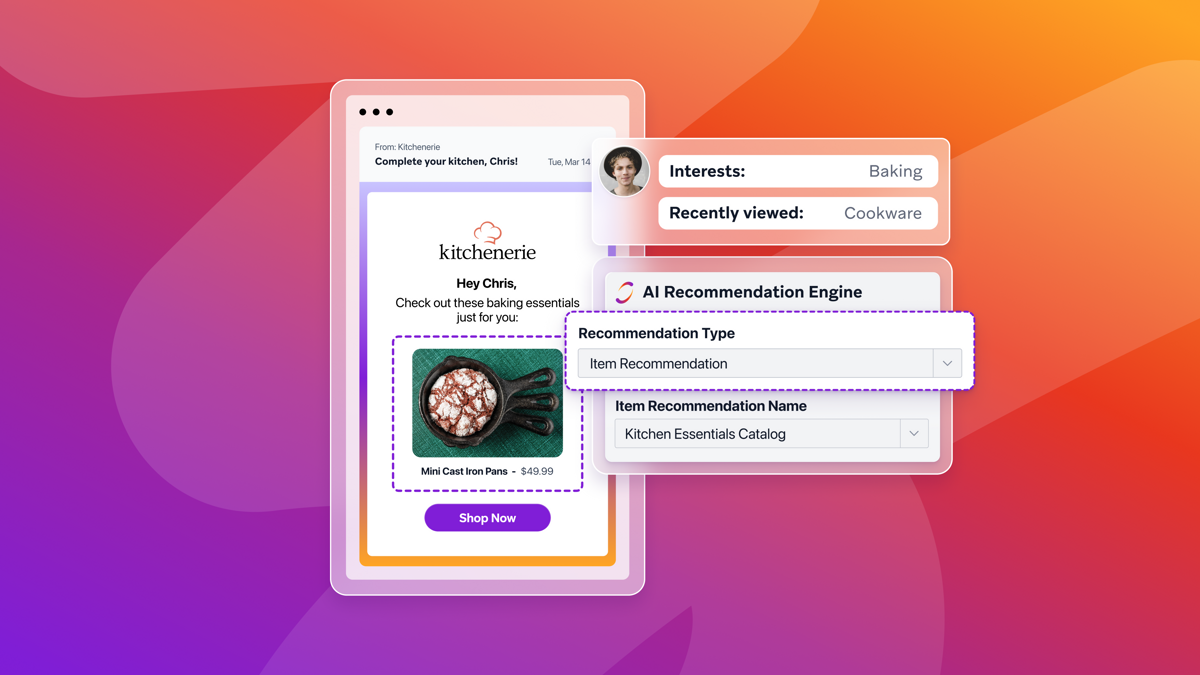
An AI recommendation engine is a machine learning system that analyzes user behavior, purchase history, and item attributes to predict and suggest the most relevant products, content, or experiences for each individual customer. Unlike static rules-based suggestions, AI recommendation engines continuously learn and adapt as user preferences evolve.
Rules-based recommendations, like bestseller lists or manual merchandising, tell everyone broadly the same thing. Basic personalization tactics, like first-name insertion or segment-based content, add a personal feel but still work from static attributes or broad groupings rather than individual behavior. In comparison, an AI recommendation engine generates truly personalized recommendations by building a behavioral understanding of each user from their own behavioral signals and interactions. Predictions are updated automatically as preferences change.
The global AI-based recommendation system market is projected to grow from $2.8 billion in 2023 to approximately $34.4 billion by 2033, according to Market.us. It's not hard to see why. Consumers expect to be shown things that are relevant to them, and the volume of products and content available has long since outgrown what any team can curate by hand. AI and machine learning have made individual-level prediction at scale possible, and as the technology has matured, customer expectations have moved with it.
How AI recommendation engines work
A recommendation engine works in a continuous cycle: Collecting data, training on patterns within it, generating ranked predictions for each user, and refining those predictions based on how people respond. Each stage feeds the next.
Data collection
The engine draws on three types of data to build its understanding of each user:
- Behavioral signals: Views, clicks, searches, purchases, and time spent
- Item attributes: Category, price, tags, and metadata from the catalog
- User attributes: Demographics, preferences, and engagement history
The richer and more current that data is, the more precise the predictions it can generate.
Model training
This is where patterns in the data become actionable intelligence. Algorithms analyze historical interactions to identify which items show item-to-item similarity in browsing and purchase behavior, which user behaviors most reliably predict future interest, and which item attributes consistently drive engagement.
Prediction and ranking
Once trained, the engine utilizes user-to-item matching to score every item in the catalog by predicted relevance for each individual user, then presents the highest-ranked results as a selection built from that person's own behavioral patterns.
Real-time adaptation
Modern engines update predictions as new behavioral signals arrive, adjusting mid-session and carrying those updates through to subsequent messages across email, push, in-app, and other channels.
The feedback loop
Every interaction with a recommendation feeds back into the model as a signal. Clicks, conversions, and dismissals all inform future predictions, improving accuracy over time and making each recommendation more relevant than the last. The type of algorithm doing that work varies significantly across different systems, and that variation matters more than most people expect.
Types of recommendation algorithms
There are various types of recommendation algorithms, each taking a different approach to finding relevant items. The right one for any given situation depends on how much data is available, how large the catalog is, and what kind of recommendations you're trying to produce.
Content-based filtering
Content-based filtering recommends items based on what those items are and how closely they match what a user has already engaged with. If someone regularly buys running shoes, the engine looks for similar items: Same category, similar price range, related materials. It works well when you don't have much data on a user yet, making it useful early in a customer relationship, though recommending more of the same over time can gradually narrow what a user gets shown and potentially reduce engagement.
Collaborative filtering
Collaborative filtering recommends items based on what users with similar habits have liked. It can work user-to-user, finding people with comparable tastes and recommending what they engaged with, or item-to-item, identifying items that are frequently bought or browsed alongside ones a user already likes. It needs more data to work well, but its real strength is in helping people discover things they wouldn't have found on their own.
Hybrid recommendation models
Hybrid recommendation models combine content-based and collaborative filtering to get the best of both. Content-based filtering covers situations where there isn't much data on a user yet; collaborative filtering adds range when there's more history to work with. Most modern systems use a hybrid approach, and the improvement in recommendation quality over the past few years largely comes down to that combination.
Deep learning recommendations
Deep learning recommendations use neural networks to work with far more complex data than earlier methods could handle. Content-based filtering works from item attributes; collaborative filtering works from shared user behavior. Deep learning processes both, alongside unstructured inputs like images and text, learning complex relationships that simpler models aren't designed to detect. These models also pick up on sequential patterns, such as what a user tends to buy in what order, which improves purchase prediction. They tend to produce the most accurate results, but need significantly more data and computing power to run effectively.
Dynamic weighting
Dynamic weighting is an emerging capability that changes the algorithm used in real time based on context. A user browsing without much direction might get recommendations designed to introduce new items; a user showing clear signs they're ready to buy gets recommendations more likely to lead to a purchase. The engine reads each interaction and picks the approach most likely to produce the right outcome in that moment.
AI recommendation engine use cases across industries
Whether you work in retail, media, travel, finance, or food, recommendation engines are already shaping how companies in your space engage customers. Here are some use cases and real life examples of how they’re applied across each one.
Retail, eCommerce and product recommendation engines
In retail, recommendation engines touch almost every stage of the shopping journey. Personalized product suggestions drive discovery. "Frequently bought together" prompts increased basket size at the point of purchase. Post-purchase cross-sell emails extend the relationship after the transaction. And for the significant share of shoppers who browse without buying, abandoned cart recovery campaigns populated with relevant alternatives can bring them back when their interest is still warm.
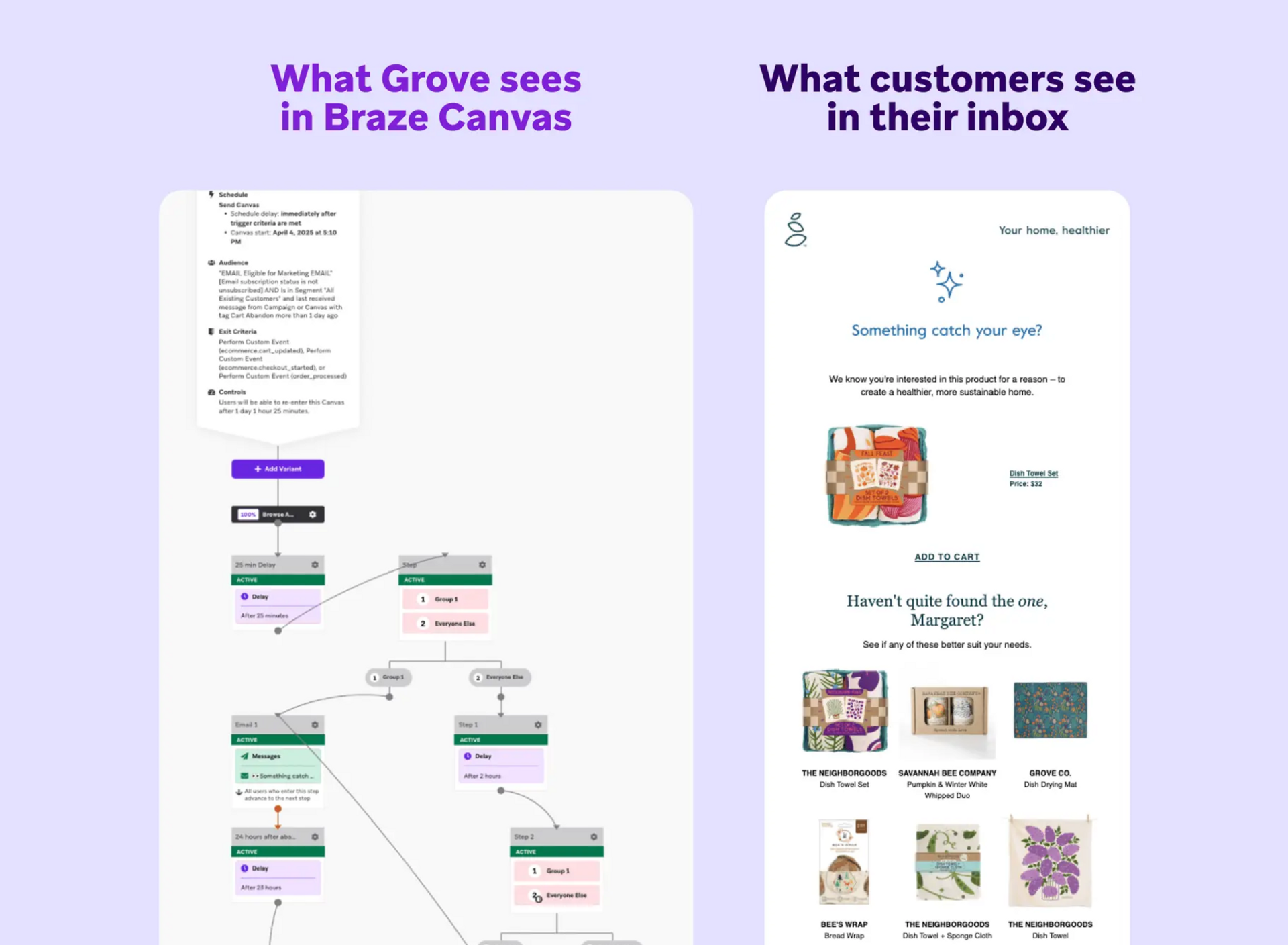
For example, Grove Collaborative, a sustainable home and wellness retailer, built a browse abandonment campaign using Braze Catalogs and Constructor.io to serve personalized product suggestions based on each customer's last viewed item, alongside relevant alternatives. The campaign delivered a 10% checkout rate and a 41% add-to-cart rate.
Media and entertainment
For media and entertainment platforms, the recommendation engine works as editorial intelligence at scale. Whether it's identifying the next episode most likely to keep a viewer watching, suggesting articles based on reading history, or building personalized playlists, the aim is to reduce the effort required to find something worth engaging with. Recommendations also help introduce fresh and varied content to users who might otherwise return to familiar titles repeatedly, drawing more of the catalog data into active use.

For example, Tapas, a digital publishing platform for webcomics and novels, used Amplitude data to identify which content titles drove the highest conversion from free to paid users, then promoted those titles to users who hadn't yet accessed them. The approach drove a 100% increase in new user retention and a 28% increase in in-app currency purchases.
Travel and hospitality
Travel recommendation engines work best when they're grounded in personal history. A traveler's past bookings, preferred destinations, and behavioral patterns provide strong signals for suggesting future trips, destination packages, and experiences that fit their individual preferences. Dynamic pricing recommendations add another layer, adapting offers based on travel timing and historical behavior to increase the likelihood of a booking.
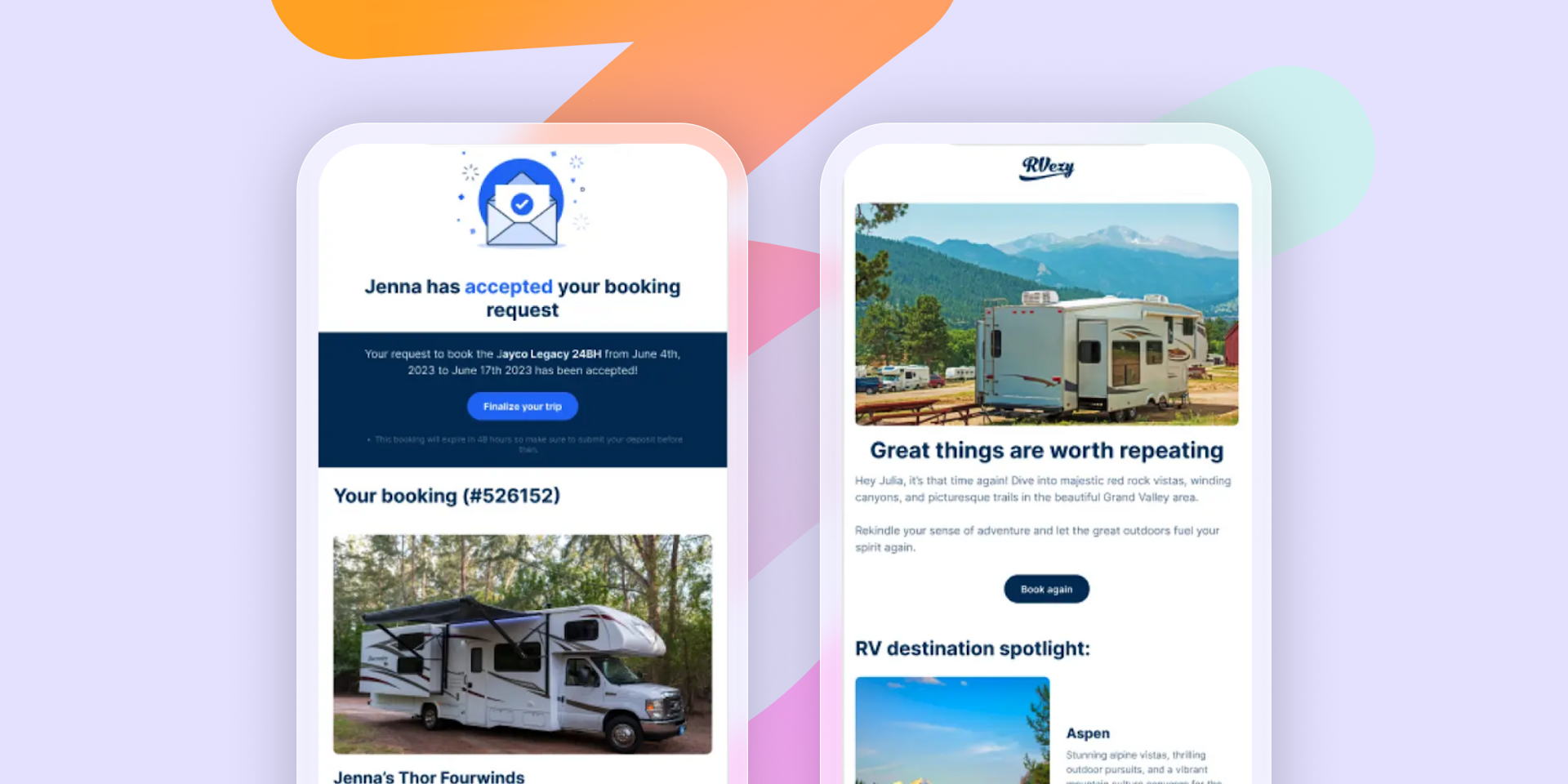
For example, RVezy, an RV rental marketplace, sends post-trip emails that automatically populate with destination spotlights tailored to each user's past booking history, giving customers a reason to plan their next adventure before they've started looking. Those emails achieved a 69.3% open rate.
Financial services
Financial services is one of the less obvious applications for recommendation engines, but the logic holds. Credit card recommendations, investment options, pension products, and insurance plans can all be matched to customers based on their financial behavior, product holdings, and life stage, making outreach more useful and more likely to convert than generic broadcast messaging.
For example, Legal & General, a UK-based financial services group, used Braze Content Cards to deliver dynamic financial content personalized by life stage, demographics, product holdings, and interaction behavior. A targeted message to eligible customers increased uptake of their pension consolidation journey by 17% compared to non-targeted messaging.
QSR and food delivery
In QSR and food delivery, the recommendation opportunity is highly time-sensitive. Order history, dietary preferences, time of day, and current menu availability all inform what a customer is most likely to order, and the window between opening an app and placing an order is short. Seasonal availability adds another dimension, with recommendation engines adapting suggestions to reflect what's freshest and most relevant at any given moment.
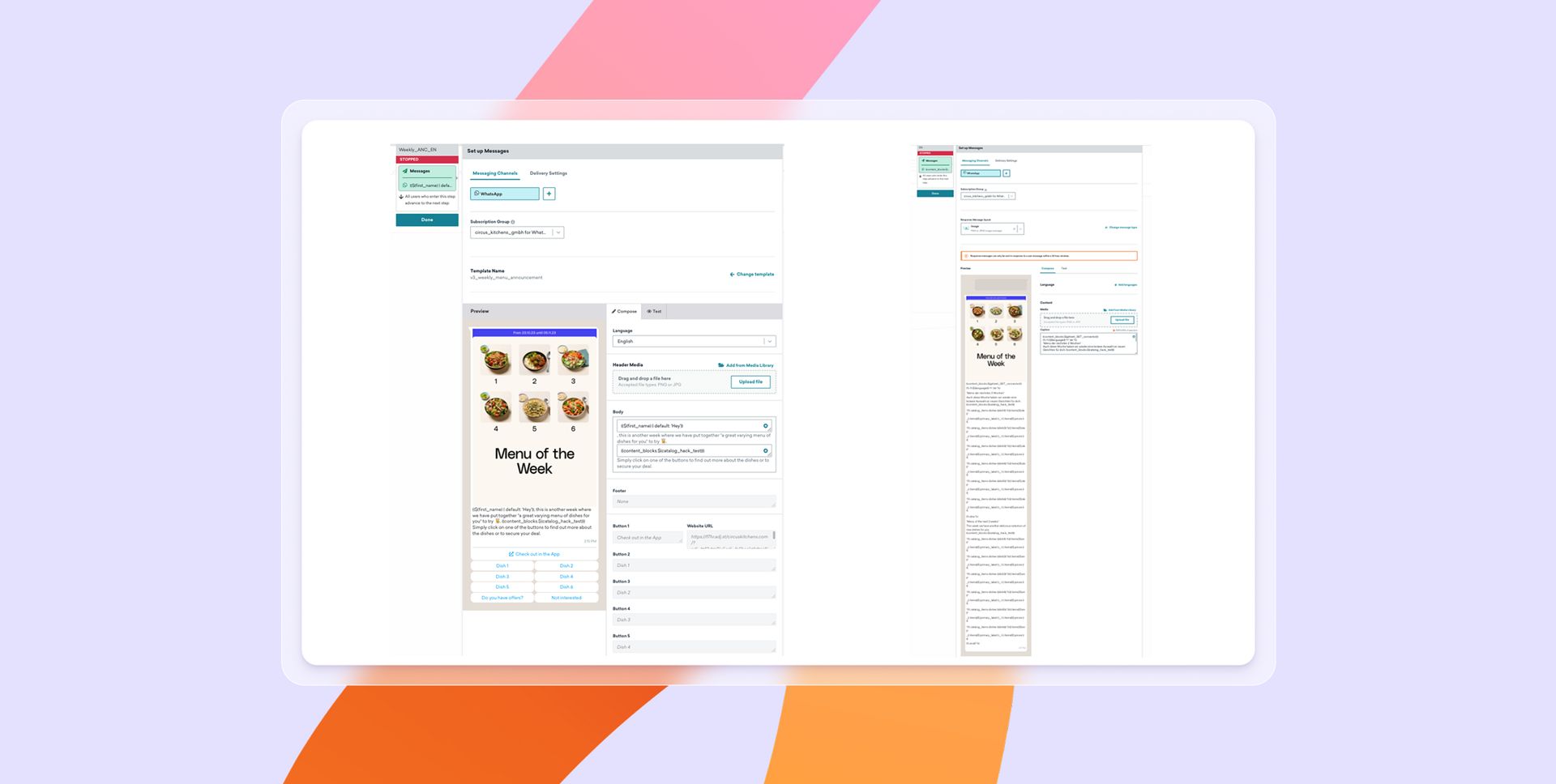
For example, Pazza Pasta, a food delivery brand operated by Circus Group in Germany, used BrazeAI™ Item Recommendations to send personalized dish suggestions via WhatsApp and push notifications. Their weekly menu campaign drove purchase rates 6X higher than the same campaign sent by email.
AI-powered recommendations beyond the storefront: Cross-channel activation
Recommendation engines work across every channel a customer interacts with, from email to push to in-app and web. The recommendation logic follows the customer, adapting across channels and touchpoints throughout their journey.
Personalized recommendations across every channel
Recommendation engines can be embedded across the full range of channels a marketing team uses:
- Email: Tailored product carousels and dynamic personalization in content blocks that update at open time, so the recommendations a customer sees reflect what's most relevant at the moment they read the message, not when it was sent.
- Push notifications: Triggered recommendation messages sent in response to specific behaviors, such as browsing a category or completing a purchase, reaching customers when their interest is most active.
- SMS/RCS: Concise, high-intent product suggestions for customers who engage primarily on mobile.
- In-app messages and Content Cards: Recommendations delivered within the app experience, informed by what the customer is doing in that session.
- Web messaging: On-site recommendation widgets and personalized banners that respond to browsing behavior in real time.
AI product recommendations in action: the cross-channel journey
Where recommendation engines have the most impact is when they feed into orchestrated, multi-step journeys, with each touchpoint building on the behavioral data from the last. For example, a customer views a product but doesn't actually buy it. An email goes out within the hour containing AI product recommendations based on what they viewed. If they open but don't convert, a push notification follows with a more focused suggestion. If they return to the app, a Content Card is waiting with a contextually relevant offer.
How Braze powers AI recommendations
BrazeAI™ includes AI Item Recommendations, out-of-the-box deep learning models that generate personalized item suggestions from Braze Catalogs. Four recommendation types are available: AI Personalized, Most Recent, Most Popular, and Trending, each serving a different purpose depending on available user data.
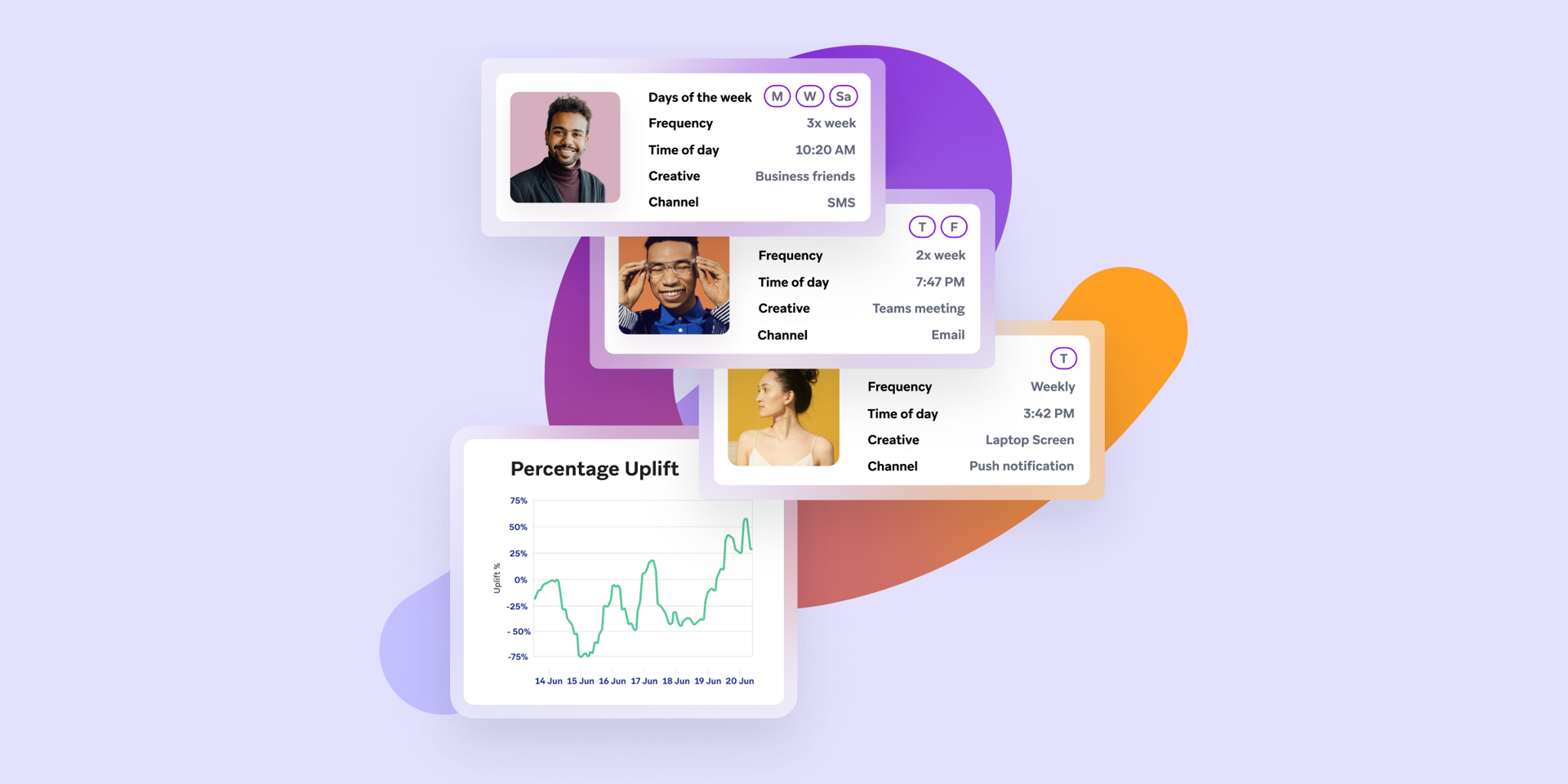
The model draws on the last six months of item interaction data, including purchases and custom events, to predict what each user is most likely to engage with next. It works best with catalogs of between a few hundred and 100,000 items and at least 30,000 users with interaction data.
Because AI Item Recommendations is native to Braze, it can be embedded into any messaging channel or Canvas journey, including email, push, in-app messages, Content Cards, SMS, and WhatsApp. The same platform that sends the message also generates the recommendation.
Marketers can create, customize, and deploy recommendation campaigns directly within Braze, without writing machine learning models or managing separate infrastructure, as part of a broader suite of BrazeAI™ capabilities.
BrazeAI Decisioning Studio™
BrazeAI Decisioning Studio™ extends recommendation logic into the broader question of how to reach each customer. AI Item Recommendations determines what to suggest. Decisioning Studio handles when, where, and how to deliver it, using all available first-party data to optimize channel, timing, offer, and frequency for each individual. For a deeper look at how this fits into the broader personalization layer, this guide to personalization engines covers how these capabilities connect.
Final thoughts on machine learning recommendation systems
Recommendation engines started on product pages. They now operate across the full customer lifecycle, powering email, push, in-app, SMS, and web as part of connected journeys that respond to individual behavior in real time.
The strongest strategies in 2026 combine deep learning models with real-time recommendations, behavioral adaptation and cross-channel delivery. For marketers evaluating recommendation tools, the most practical question is how the engine connects to the channels it's meant to power. A recommendation engine native to the engagement platform means predictions can move directly to activation.
First-party behavioral data powers the model. The model generates ranked predictions. Cross-channel orchestration puts those predictions in front of the right customer at the right moment. Each part depends on the others, which is why the infrastructure matters as much as the algorithm.
Related Tags
Releated Content
View the BlogAI recommendation engine: How machine learning delivers personalized suggestions at scale
Team Braze

The new Black Friday Cyber Monday consumer expectations

Meredith Mitchell

Predictive customer analytics: How to forecast behavior and drive proactive marketing