
AI decisioning cheat sheet: How to crawl/walk/run with BrazeAI Decisioning Studioᵀᴹ
Published on January 08, 2026/Last edited on January 08, 2026/6 min read

Team Braze
BrazeAI decisioning enables companies to create personalized marketing that’s dynamic and responsive to each individual customer’s activity, preferences, interests, and behavior, in the moment. Leading brands are using the Braze AI decisioning solution, BrazeAI Decisioning Studio™, to personalize experiences, presenting the best information, offers, and recommendations based on consumers’ unique behaviors and interests.
Companies that successfully implement our AI decisioning capabilities can deliver more impactful campaigns, reach the right customers with the right messages at the right time, and achieve sizable gains in their most important business KPIs.
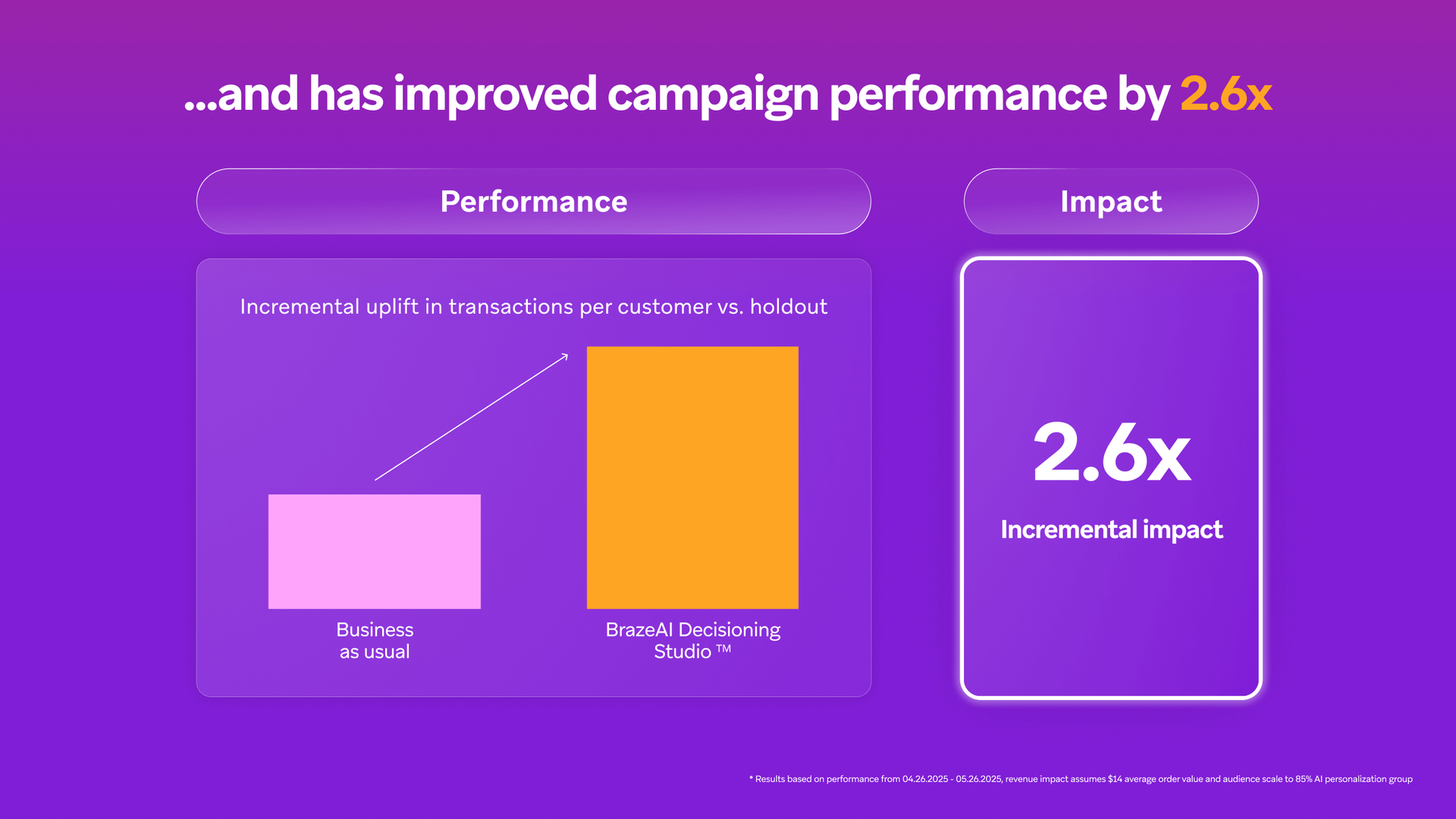
One global leader that’s been an early adopter of AI decisioning is Yum! Brands. It’s the world’s largest restaurant company with over 62,000 locations globally, whose iconic brands include KFC, Taco Bell, Pizza Hut and Habit Burger & Grill. This year alone, Yum! Brands has used AI decisioning across 200 million interactions and eight different marketing use cases, and the results speak for themselves: The company has seen up to a 2.6X uplift in incremental impact in transactions per customer since implementing BrazeAI Decisioning Studio.™
We’ll show you the crawl-walk-run approach that’s helping Yum! Brands and other organizations unlock success with AI decisioning. But first, let’s get a quick overview on how AI decisioning is reshaping marketing and how to prepare to use AI decisioning in your marketing efforts.
Understanding AI decisioning
AI decisioning uses a type of machine learning known as reinforcement learning to take the work out of personalization for marketers, improve the overall experience for customers at the 1:1 level, and deliver better results—specifically for the metrics you want to maximize.
It pulls data from your systems (e.g. data warehouses and CDPs) and uses these insights to automate the process of selecting the right marketing campaign variables for each individual recipient. For instance, the exact offer, image, copy, channel, send day, and send time that are most likely to influence a desired outcome, such as becoming a member, subscriber, or donor.
Preparing for AI decisioning
There are a few important steps brands need to take to be ready to use AI decisioning. Interested in digging a little deeper? Here are some tips for getting started from George Khachatryan, VP, Head of AI Decisioning at Braze; Cameron Davies, Chief Data Officer at Yum! Brands; and Nathaniel Rounds, Lead Product Marketing Manager, AI Suite, at Braze:
Find the right platform, one that includes expert support
An out-of-the-box solution isn’t likely to help, explains Khachatryan. That’s because AI decisioning requires a high level of customization to meet companies’ unique needs. Models need to be fine-tuned to deliver results in line with a brand’s given goals and business operations—allowing them to learn, for example, how to personalize QSR marketing campaigns based on what customers order and how to support financial services brands’ efforts based on the way consumers spend their money.
Not only that, specialized expertise is necessary to get reinforcement learning to work as intended. A lot can go wrong when marketers use self-serve AI decisioning systems. Without expert support and the proper guardrails in place, AI systems may do whatever it takes to help a company achieve a stated goal, even at the risk of eroding the brand’s profit margins.
That’s why BrazeAI Decisioning Studio™ includes a dedicated team that consists of a machine learning implementation engineer who’s an expert in configuring our capabilities, an engagement manager, and a customer success director to help teams get set up and use our platform on an ongoing basis.
Define what success looks like up front
Get everyone on the same page about what uplift should look like, advises Davies.
Be clear about the success metrics that matter. The AI will optimize for whatever specific goals your team sets, and misalignment between the AI's metrics and business objectives can lead to confusion, adds Rounds.
Have the right data ready
Getting data ready for AI decisioning is one of the most challenging and time-consuming aspects of adoption, notes Rounds. Inconsistencies and disconnected data sources can hinder AI performance.
“We invested hard and early in data,” says Davies. “We have our own internal database that crosses all four brands that represents over 140 million customers just in the U.S. alone. We put a serious amount of investment in that over the last couple of years to make ourselves ready.”
AI decisioning in practice: A crawl/walk/run approach
Crawl
Build a bold vision upfront, says Khachatryan. What is the AI decisioning opportunity for your brand? Where are all of the places you can apply AI decisioning?
Painting a big picture vision that connects AI decisioning to strategic organization-wide priorities will help excite stakeholders, adds Rounds.
At Yum! Brands, the team set three goals for AI-driven marketing:
- Serving the most relevant messages and offers to their customers
- Delivering revenue growth for their franchisees
- Supporting top-line and bottom-line financial performance for Yum! Brands
Walk
Start small with a high-value use case that’s easy to implement for a quick win, advises Khachatryan.
For instance, start with a single channel, such as marketing emails, or stage of the customer journey, such as onboarding.
While previous A/B testing revealed that the best time to send marketing emails to Taco Bell customers in the aggregate was in the morning, AI decisioning helped the team learn the best time of day for individual customers, uncovering a wide variety of nuances just for this one factor of up to 150+ potential factors for one given marketing channel.
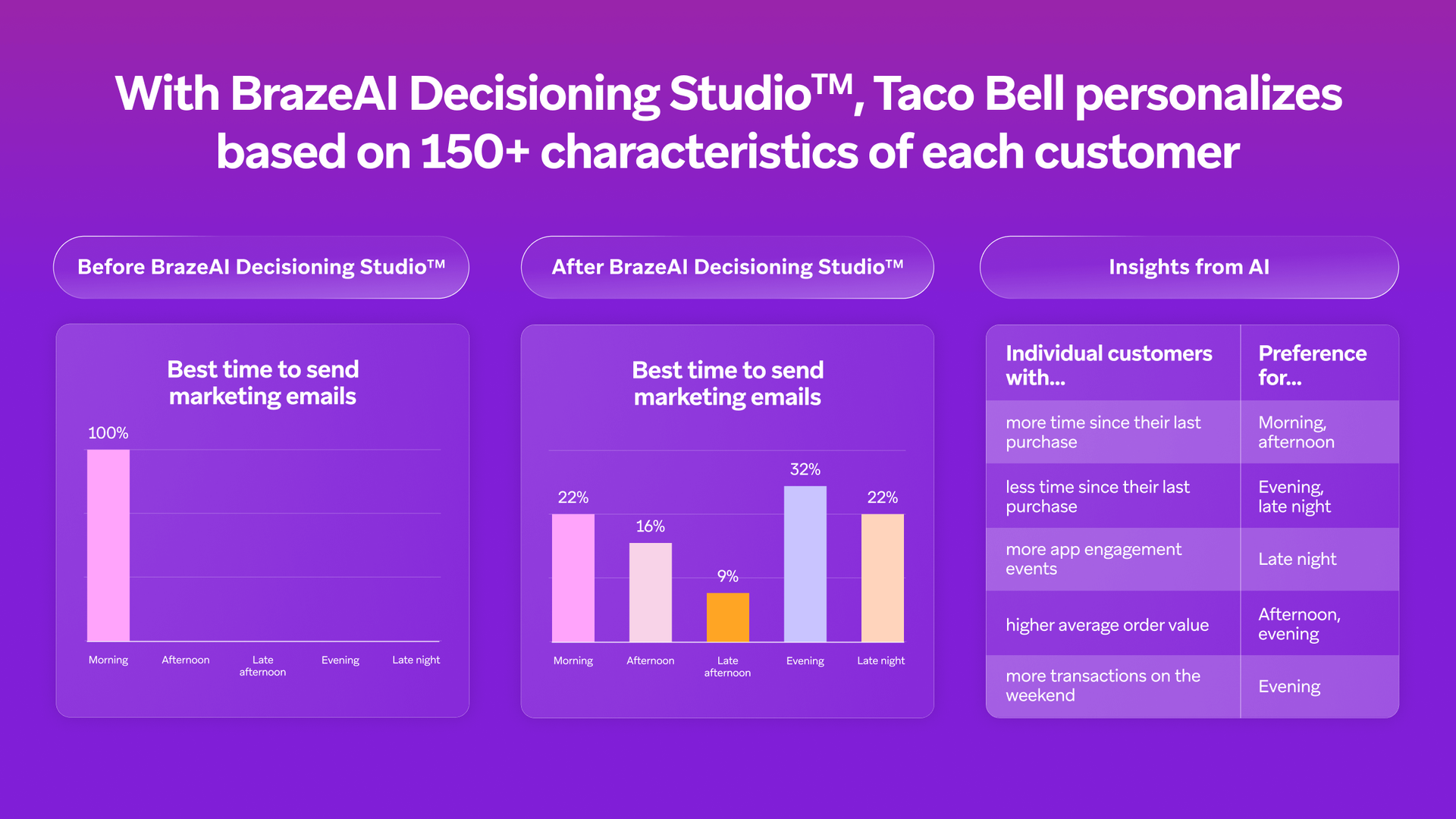
Today, Yum! Brands now has eight agentic AI-driven efforts operating across welcome journeys, churn campaigns, app product recommendations, at-risk customers, onboarding, offer optimizations, and more.
Run
Embrace AI decisioning across the enterprise, says Davies. Get sponsorship at the C-suite and board levels. Go all in and invest in the resources necessary to set yourselves up for success.
That’s what Yum! Brands has done.
“What we see across companies that have the most success with this is that if you’re doing AI decisioning right, it’s not just a marketing priority, it needs to be a CEO and board level priority,” explains Khachatryan. That’s because AI decisioning requires a cross-functional effort, an organization-wide commitment across IT, marketing, data science, finance, and more, to make it successful.
As Yum! Brands continues to roll out AI decisioning, the next steps include applying it across the board for traditional customer engagement channels, potentially expanding to kiosks and drive-thru, and growing the program globally.
This is part of the AI flywheel that drives adoption and implementation at Yum! Brands. The team’s hypothesis? The more they apply AI, the better data they will get, and the better their experiences will be. The better their experiences are, the more people will use their services. The more people that use those services, the better their data will be, and so on.
Let AI decisioning drive smarter decisions for your brand
Ready to put this crawl-walk-run approach for adopting AI decisioning into action? Get a demo of the BrazeAI Decisioning Studio™ today.
Related Tags
Releated Content
View the Blog
How AI Decisioning Transforms Marketing (A Complete Guide)
Team Braze
AI decisioning cheat sheet: How to crawl/walk/run with BrazeAI Decisioning Studioᵀᴹ
Team Braze

A day in the life of a data scientist on the BrazeAIᵀᴹ forward-deployed engineering team