
AI customer segmentation: Smarter targeting through predictive insights
Published on December 17, 2025/Last edited on December 17, 2025/14 min read

Team Braze
Customer segmentation is one of the strategies at the heart of personalization. Marketing teams already know their audience isn’t a single, uniform group and usually have some form of segmentation in place. The challenge is that customers and their behavior are always changing, and segmentation can be hard to scale if you don’t have the right solution in place. Manual rules and quarterly “segment refreshes” can’t keep up. This means high-value customers can slip through generic journeys, churn risks can hide in broad lists, and whole pockets of opportunity stay buried in the data.
AI customer segmentation is built to keep pace with that constant change. This guide looks at how it works in practice—and how brands use Braze to turn complex data into dynamic, predictive audience segments.
The evolution of customer segmentation
Customer segmentation began with static lists. Teams grouped customers into broad categories based on a few shared traits—location, age range, product line—and reused those lists across campaigns. The data moved slowly, campaigns were planned far in advance, and segments changed only a handful of times a year, so most customers in a group saw the same messages and offers.
As digital channels multiplied, segmentation became more sophisticated. Behavioral data, purchase histories, and early machine learning models started to inform which message, offer, or journey step a customer received next. Rules-based automation helped update segments more often, so brands could trigger basic personalization without rebuilding everything from scratch.
The challenge now is scale. Data flows in continuously, across more channels and touchpoints than a single team can manage by hand and customers can be in the millions. Marketers might have automated some updates, but they still spend time writing rules, syncing tools, and stitching together audiences for different campaigns.
The volume of customer data grows faster than the bandwidth available to act on it, which is why static segments and fixed rules are increasingly supported by more adaptive intelligence that can adjust to behavior in real time.
What is AI customer segmentation?
AI customer segmentation uses machine learning models to group customers based on how they behave, who they are, and what they’re likely to do next. Instead of hand-picking a few traits and building fixed lists, the models scan large volumes of data—clicks, purchases, sessions, and more—to find patterns that relate directly to customer engagement and revenue, so segmentation is grounded in real behavior rather than static assumptions.
Clustering
This starts with clustering. Clustering models look for customers who “move together” across signals like browsing behavior, campaign engagement, and product usage, even if they don’t share obvious demographic traits. One cluster might contain frequent, promotion-responsive buyers; another might be low-frequency, high-value customers who respond better to early access than discounts. These clusters update over time as people interact with your brand, so audiences stay aligned with current behavior.
Classification and predictive scoring
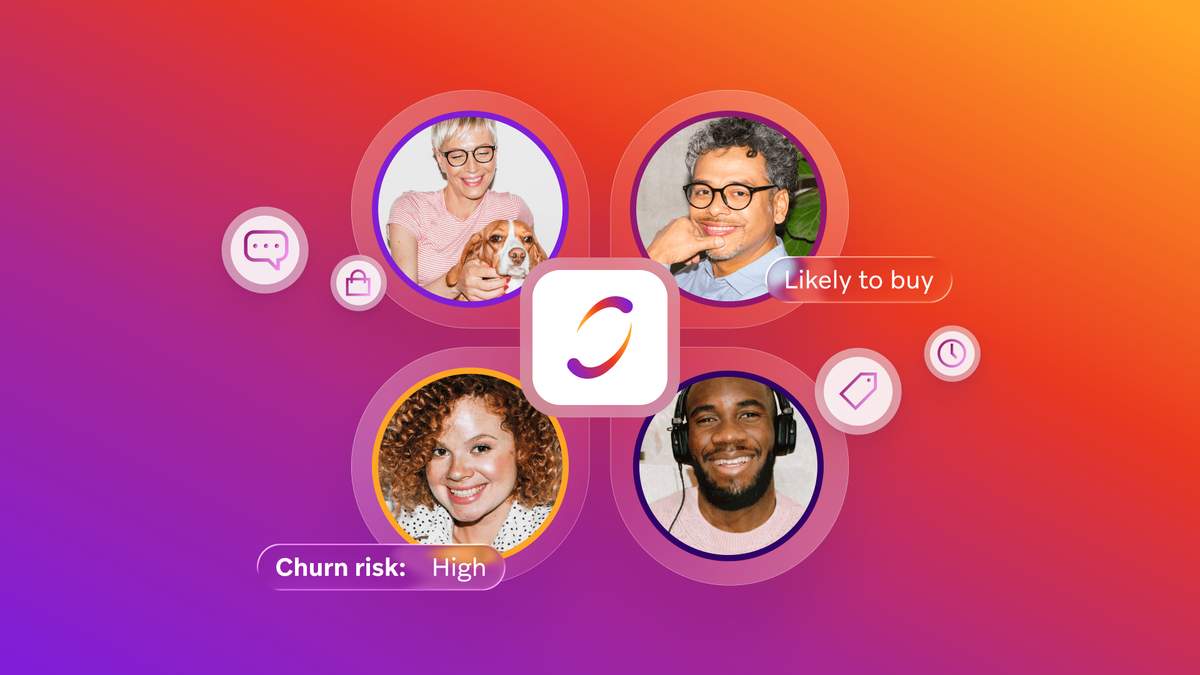
On top of clustering, classification, and predictive scoring add direction. Classification models answer yes/no questions, such as whether a customer belongs in a “high churn risk” or “likely to convert” segment.
Predictive scoring goes further by ranking customers on a scale—for example, their likelihood to complete a purchase, upgrade a plan, or lapse within a set window. The same approach also supports customer lifetime value prediction, helping teams see which customers are likely to deliver the most value over time.
Why does real-time segmentation matter?
Timing is a key part of AI segmentation. In a batch model, audiences update on a fixed schedule—often once a day or a few times a week. That can work for slower-moving programs, but it creates blind spots for moments that happen quickly, like cart recovery, onboarding steps, or early churn signals.
With real-time segmentation, new events flow into your system as they happen, and segments update off that live data. If someone abandons a cart, completes a key tutorial step, or suddenly drops their usage, that behavior can move them into a different audience straight away. Journeys and campaigns can then react in real time to that updated segment membership, instead of waiting for the next batch refresh.
Customer data analysis as the foundation of AI segmentation
AI customer segmentation depends on strong customer data analysis behind the scenes. Models need clean, connected signals about who customers are, what they’ve done, and what outcomes matter most to the business—whether that’s revenue, retention, or long-term engagement.
It means a cohesive approach, working with multiple data streams, departments and platforms to define the right inputs and outcomes, then using those insights to guide how segments are created and activated.
When data is unified and accessible, AI can find patterns and predict behavior, and teams can focus on turning those segments into campaigns, journeys, and experiments that support stronger engagement.
Why AI outperforms traditional segmentation
AI outperforms traditional segmentation by analyzing far more signals, updating segments continuously in real time, and predicting customer behavior with higher accuracy. This makes segmentation more precise, faster, and adaptive to customer changes.
Rule-based and manual segmentation can only go so far. As channels, products, and behaviors multiply, it becomes harder to keep track of every combination that matters for engagement and revenue.
AI customer segmentation helps by doing the pattern-finding work automatically, then updating those patterns as customers interact with your brand. Three advantages stand out: precision, speed, and adaptability.
Precision: Uncover hidden audience clusters humans can’t detect
Traditional segmentation often starts from a guess: “Let’s target everyone in this age range,” or “Let’s focus on recent purchasers.” It works for broad targeting, but misses nuance and isn’t as effective as real-time targeting.
Machine learning models (MLMs) analyze dozens or hundreds of signals at once—things like visit frequency, category mix, discount sensitivity, device type, and content preferences. They group customers based on how those signals interact, instead of just a few visible traits.
That makes it easier to spot high-value pockets of customers, such as:
- New users who behave like your best long-term customers
- Subscribers whose recent behavior matches past churn patterns
- Buyers who rarely respond to discounts but engage strongly with early access or content
These segments are harder to see in a spreadsheet, but AI can identify them quickly and keep them updated.
Speed: Automate segmentation for millions of users in real time
Even with solid rules and workflows, manual segmentation slows down as audiences grow. Every new campaign, test, or journey step needs another pass at the data, which means more filters, more exports, and more approvals before anything goes live.
AI-driven segmentation works at a different pace. Models can score and regroup millions of customers in minutes, not days, and apply those updates automatically as new data arrives. Instead of waiting for the next audience pull, marketing teams can:
- React quickly to fresh signals like browsing spikes or new product interest
- Launch campaigns that depend on up-to-the-minute engagement states
- Spend more time on creative and strategy instead of list-building
The operational burden of segmentation shrinks, even as the number of segments and experiments grows.
Adaptability: Models update continuously as customer data changes
Customer behavior never stays fixed. A high-intent browser can turn into a loyal customer in a week, a frequent buyer can go quiet after a bad experience, and a low-engagement user can suddenly reappear on a new device. Static segments struggle to keep up with those shifts in context.
AI customer segmentation adapts as new data comes in. Models re-score customers, move them between segments, and refresh predictions based on the most recent signals. That means:
- Churn-risk audiences shrink or grow as behavior changes
- High-potential prospects are promoted into priority segments when they show intent
- Lifecycle campaigns can respond when someone progresses faster—or slower—than expected
Marketers get segmentation that reflects what customers are doing now, not a snapshot of a past point in time, which sets a stronger foundation for predictive journeys and personalization across channels.
How does predictive segmentation work?
Predictive segmentation builds on AI customer segmentation by focusing on what customers are likely to do next. Instead of only looking at past behavior, models estimate churn risk, purchase intent, and lifecycle movement, then turn those predictions into segments you can activate across channels.
Three patterns show up most often.
Predictive churn: Flag customers likely to disengage
Predictive churn models estimate which customers are at risk of becoming inactive or canceling within a set timeframe. They use live behavioral and engagement signals to:
- Identify high-, medium-, and low-risk customers based on signals like declining sessions, fewer opens and clicks, or reduced usage of key features.
- Trigger targeted winback and retention journeys for high-risk, high-value customers, while using lighter-touch nudges for lower-risk groups.
- Refresh who qualifies as “at risk” as scores update, so people move out of churn segments when they re-engage.
Predictive events: Anticipate key actions like purchases or upgrades
Predictive event models focus on specific future actions such as completing a purchase, starting a subscription, or upgrading a plan. They assign each customer a likelihood score for that action and feed those scores into dynamic segments. Marketers typically use predictive events to:
- Build “likely to buy” or “likely to upgrade” audiences based on a probability score rather than just recent activity.
- Tailor offers by likelihood group, reserving deeper discounts or incentives for lower-intent users and lighter offers for high-intent users.
- Exclude very low-likelihood users from some campaigns to reduce noise and protect deliverability while focusing budget where it has more impact.
Lifecycle prediction: Tailor campaigns to stage-specific needs
Lifecycle prediction looks at where customers are in their relationship with your brand and how likely they are to progress to the next key milestone. Instead of one static journey for “new users” or “active customers,” lifecycle-focused teams:
- Identify the steps and message combinations that correlate with milestones like first purchase, second purchase, or renewal.
- Test multiple journey variants within one canvas to see which timing, channels, and content actually move people forward.
- Adjust journeys based on performance, adding extra education for users who stall or streamlining steps for those who move quickly.
With those three building blocks in place, it’s easier to see how predictive segmentation works in real life. The case studies below show how brands use Braze to apply these concepts to churn, purchase intent, and lifecycle journeys.
Connecting segmentation to personalization
AI customer segmentation and predictive models provide the “who,” but personalization depends on how that “who” connects to content, offers, and channels in real time.
Using AI insights to trigger personalized content and offers
AI segmentation gives you rich signals about intent, risk, and potential value. Those signals can drive concrete decisions in your campaigns, such as:
- Which offer a customer receives
- How frequently they’re contacted
- What narrative or creative angle they see
A high-intent browser might receive a lighter offer and more product education, while a medium-intent customer sees a stronger incentive or a social-proof message. Churn-risk users can be moved into journeys focused on reassurance, value reminders, and service improvements, rather than generic promotions.
How segmentation flows into Braze orchestration tools
In Braze, AI-driven segments don’t sit in isolation—they flow directly into orchestration. Canvas uses those audiences as entry, split, and decision points inside journeys, so you can:
- Start different paths for customers with different churn or purchase scores
- Branch experiences based on changes in predicted behavior mid-journey
- Mix channels—email, push, in-app, SMS—based on a customer’s engagement patterns
Features like Intelligent Channel help decide which channel to use for a given message based on past behavior, while Intelligent Timing can align sends with moments when each customer is most likely to respond. Predictive segmentation supplies the “who and when,” and Canvas coordinates the “how.”
Why predictive segmentation underpins omnichannel personalization
Omnichannel personalization depends on consistency. Customers move between app, web, email, and mobile messaging in the same day, and they expect those experiences to line up. Predictive segmentation creates a single view of audience intent and risk that can be applied across those touchpoints, so:
- A cart abandoner flagged as high-intent can receive coordinated nudges across email and push, not conflicting messages.
- A churn-risk user can see supportive, value-focused messaging in-app at the same time they receive a retention campaign in their inbox.
- High-potential customers can be prioritized for early access, loyalty programs, or higher-touch support wherever they interact.
How Braze makes AI segmentation and automated audience building actionable
AI customer segmentation only drives value if teams can use it without wrestling with infrastructure or writing their own models. Braze is built to make that part simpler.
Predictive Suite: Easy-to-activate AI models for marketers
Braze Predictive Suite gives marketers access to machine learning models without needing to brief a data science team for every new question. Out of the box, you can create predictive segments around things like purchase likelihood or churn risk by:
- Choosing the outcome you care about (for example, “complete a purchase in the next 14 days”).
- Letting Braze train a model on your first-party data, then assign each user a score or likelihood band.
- Turning those scores into dynamic segments that plug straight into Canvas, campaigns, and experiments.
Because these predictive segments live inside Braze, marketers can adjust thresholds, test new use cases, and build variants quickly.
Real-time data streaming: Enabling instant audience updates
Segmentation is only as good as the data behind it. Braze ingests events, attributes, and purchases in real time, so AI-driven segments can update as customers browse, buy, or disengage. That means:
- A user who crosses a purchase likelihood threshold can move into a high-intent segment immediately.
- Someone showing churn-risk signals can be picked up by a retention journey as soon as their behavior changes.
- Engagement with one channel (like push) can influence how often that person hears from you elsewhere.
Seamless integration with CRM and CDP systems
Most teams already have a broader data and engagement stack—CRM, CDP, analytics, and more. Braze is designed to sit within that ecosystem rather than replace it. Predictive and behavioral segments can:
- Use data synced from your CDP or warehouse as inputs, so models see the full customer picture.
- Send segment membership and engagement outcomes back to your CRM or data layer, closing the loop for reporting and additional analysis.
- Stay aligned across systems, so “high-intent,” “churn-risk,” or “VIP” mean the same thing wherever your teams are working.
AI customer segmentation doesn’t live in a silo. It becomes a shared, trusted layer that powers automated audience building and consistent experiences across channels and tools.
The future is now: Agentic and autonomous segmentation
As AI customer segmentation matures, the focus moves from building audiences by hand to designing systems that can learn, act, and improve with less day-to-day effort from marketers. Segments and scores start behaving more like agents that can propose actions, test ideas, and respond to performance.
From segmentation to personalization agents
Teams will be able to define guardrails and objectives, then let AI-powered agents handle the details.
Those agents could, for example:
- Select the right journey variant for a given customer based on their predicted behavior and past responses
- Recommend new audience splits when they spot patterns that matter for engagement or revenue
- Suggest creative or offer variants for specific segments, drawing on previous campaign learning
In that model, marketers concentrate on strategy, brand, and constraints, while agents handle matching customers, messages, and moments.
Continuous feedback loops between engagement and AI models
Agentic systems depend on tight feedback loops. Every send, click, purchase, or unsubscribe becomes another data point that can fine-tune both segmentation and messaging choices.
Over time, you get a loop that looks like this:
- Models generate segments and predictions
- Journeys and campaigns act on those predictions across channels
- Performance data flows back into the models
- Segments, scores, and recommendations update automatically based on what worked and what didn’t
With Braze, real-time event streaming and native experimentation already provide parts of this loop. As agentic patterns evolve, more of that learning can happen automatically in the background, while teams keep control over what’s allowed, what’s off-limits, and how aggressive the system can be.
Preparing for self-optimizing engagement systems
Moving toward self-optimizing engagement doesn’t require a complete reinvention. It starts with getting foundations in place now:
- Strong data quality and consent practices
- Clear definitions for key outcomes like retention, purchase, and long-term value
- Journeys built in tools like Canvas that are ready for more dynamic decisioning
From there, adding predictive segmentation, automated audience building, and AI recommendations becomes a series of steps. Each new layer adds more automation and intelligence while building on work that already exists.
Key takeaways on AI customer segmentation
AI customer segmentation gives marketing teams a way to keep pace with fast-moving customer behavior and turn data into decisions they can actually use.
- AI-powered customer segmentation underpins predictive personalization, giving you audiences built from real behavior, intent signals, and likely outcomes rather than one-off rules.
- Targeting moves from static lists to self-learning systems, where segments and scores update as people browse, buy, and disengage—and journeys adapt alongside them.
- With Braze, those AI insights sit inside the same platform you use for orchestration, testing, and messaging, so marketers can act on predictions in real time instead of treating them as separate analysis.
Related Tags
Releated Content
View the Blog
How AI Decisioning Transforms Marketing (A Complete Guide)
Team Braze
AI decisioning cheat sheet: How to crawl/walk/run with BrazeAI Decisioning Studioᵀᴹ
Team Braze

A day in the life of a data scientist on the BrazeAIᵀᴹ forward-deployed engineering team