
Made for this: How Braze is providing new ways to build, support, and extend your campaigns
Published on September 28, 2026/Last edited on September 28, 2026/13 min read

Christy Poulos
VP, Product MarketingMarketers are living through a time of seismic change. A year ago, it wasn't a given that every brand was using AI to power their customer journeys—but a year is a long time. AI models that felt state of the art twelve months ago now seem out of date, and it can seem like there's a new breakthrough in AI reasoning every few weeks. All that change can be intense, but it also offers you a once-in-a-career opportunity to leverage these new technologies to turn your most ambitious ideas into reality.
You’ve been building up to this moment. Remember when mobile marketing was the next big thing, and you had to design new strategies to reach always-on customers? Or when GDPR and CCPA changed how you were allowed to connect with consumers? You've already spent years innovating—adapting to new channels, new privacy rules, new technologies—and that experience is exactly why this moment is yours to take.
You were made for this. And Braze has been building alongside you this whole time, shaping the products we ship based on your real pain points and real customer journeys. Today, we're launching a new set of agentic capabilities designed to help you achieve your ambitions, along with key platform improvements that make it possible to trust more of your real work to AI.
Let’s get into it.
Put your best campaign forward, faster
Coming up with ideas for your campaigns was never the hard part. The real challenge was knowing which idea was the right one, and ensuring you could get it live before the moment passed. Today, we're launching key new features that shorten the path from idea to live campaign, allowing you to get the best version of your campaigns to market in hours instead of weeks.
Spend more time ideating, less time executing
When BrazeAI Operator™ launched at Forge 2025, it could support day-to-day work like writing Liquid personalization and providing guidance from user docs. But those core capabilities were just the beginning. Today, Operator can support the main workflows in Braze, including building and launching end-to-end customer journeys within our Canvas journey orchestration feature.
What can that look like? Imagine that you want to reach everyone who created an account but never made an initial purchase with a welcome flow: That is, an initial message, a timed delay, a follow-up incentive. Once you would have needed to manually build all of that step by step, but now you can simply describe it to Operator in plain language and watch as it identifies the audience, determines the timing, drafts the message, and builds it all into a working Canvas. You bring the ideas, Operator brings them to life.
Skip the A/B test, ship the winner
Once that Canvas is live, Content Optimizer (available now) can take over the testing. Content Optimizer is a new Canvas step that generates and tests hundreds of combinations of subject lines, copy, and CTAs across email, push, and SMS, then automatically shifts volume toward whatever version is actually winning, so you're not splitting traffic or picking a winner by hand.
The upshot? You get to test every possible version of your idea. Motorway used it to test five different subject lines, five body copy variants, and five possible CTAs—125 permutations of the same email—and saw a 114% lift in click volume and a 37% increase in new valuations over the control.
Bring 1:1 decisioning to every journey
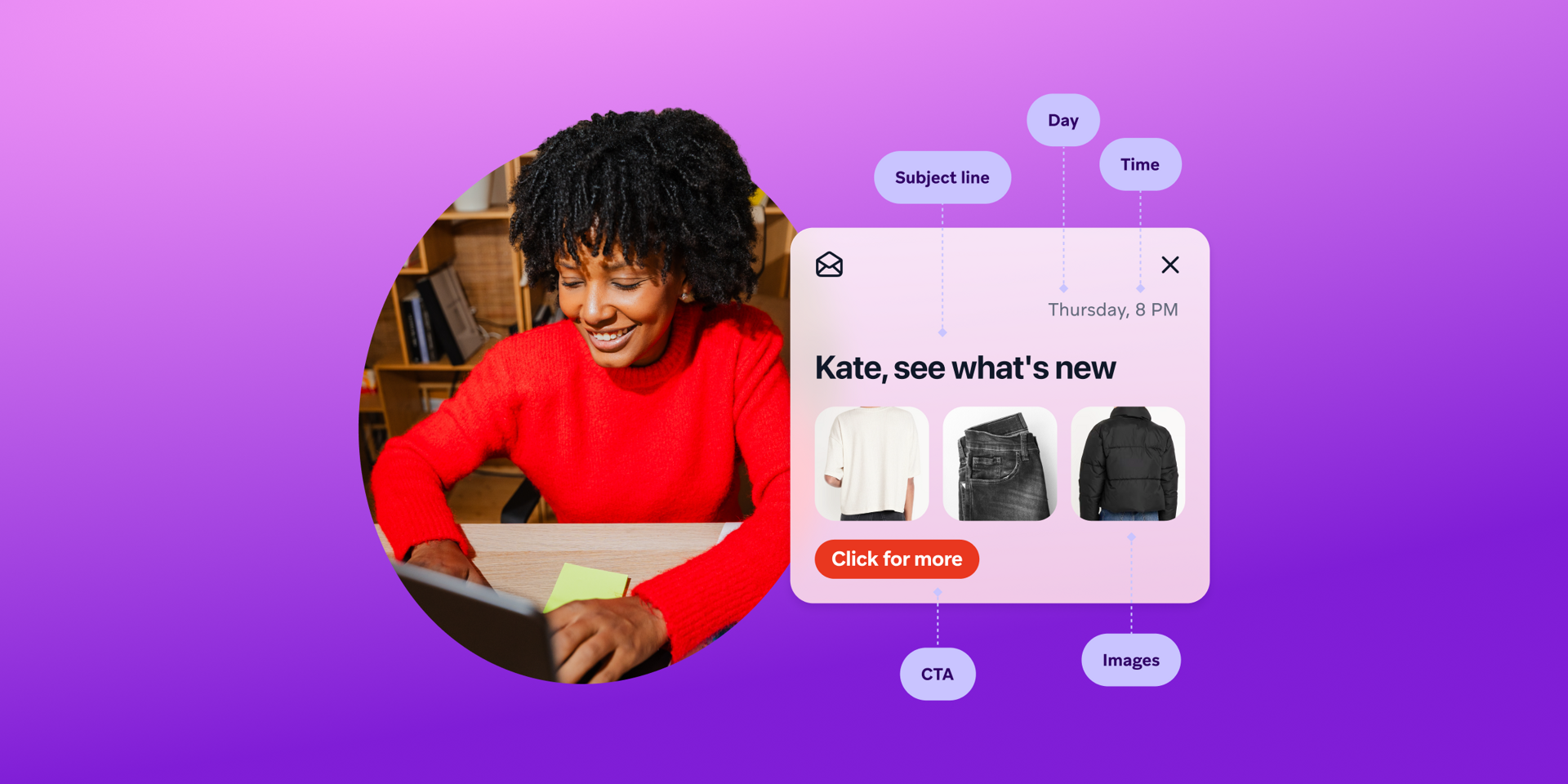
Last year, we launched BrazeAI Decisioning Studio™, a fundamentally different way to approach customer engagement. Instead of marketers using traditional segments to decide who gets which message, AI agents make that call for each individual customer using first-party data. They pick the channel, message, incentive, and timing needed to move the metrics that matter to your business. Decisioning Studio Go (in beta) now brings that same concept to every team in a more self-serve way.
With Decisioning Studio Go, you can replace manual testing and static rules with self-serve AI decisioning agents designed to optimize for engagement. These agents can autonomously select the best time of day (and day of the week) for sends—as well as the creative and message components—for each customer. What does that look like? A video streaming brand that's running an upsell journey can use an agent to decide that one customer should get a steady drip of benefit-focused messages over a few weeks, while another only needs a single recap email with everything they watched this month. All of that can be done without a data science team or a services engagement to set it up.
Have on-brand conversations that convert
Tailoring every journey to the individual recipient (and finding ways to shorten the path from idea to launch) gets better campaigns out the door faster. But what happens when a customer replies to one of those messages, or reaches out proactively on a channel like WhatsApp or RCS? Most of the time, automated, pre-scripted replies start to fall flat when customers ask real questions.
It doesn't have to be that way. Conversational Agents (in beta) will change how you interact across WhatsApp, SMS, RCS, and web, allowing marketers to replace basic keyword matching with intelligent, on-brand dialogue. These agents can interpret inbound messages, clarify user intent, and respond to customers with context-aware messages informed by your guidelines, knowledge sources (e.g. product catalogs, FAQs), and live customer profiles. That allows them to recommend the next right action and do it in your brand voice, all without forcing customers to leave the message thread.
What does that make possible? A retail brand could set up an agent to deliver a concierge-style shopping experience within WhatsApp or RCS, answering product questions, identifying each customers' preferred style or fit, and recommending the right item based on everything the company already knows about them, from purchase history to lifetime value. And if an issue pops up, the agent can respond 24/7. Whether you're leading a user through onboarding, driving product discovery, or handling support inquiries, every message can be answered in the moment.
Conversational Agents are currently available only as part of a beta. Please contact your Braze account team for more information on how to join the beta.
Trust every send, from start to finish
As AI agents become increasingly capable of autonomously carrying out key marketing tasks, brands have a big new opportunity to increase efficiency and drive faster time-to-value. But handing over more of your campaign build to AI only feels responsible if you can clearly see what it's doing and can be confident that it's following your rules and standards. Here's what we're launching to help provide that confidence.
Launch with the confidence of a full review, every time
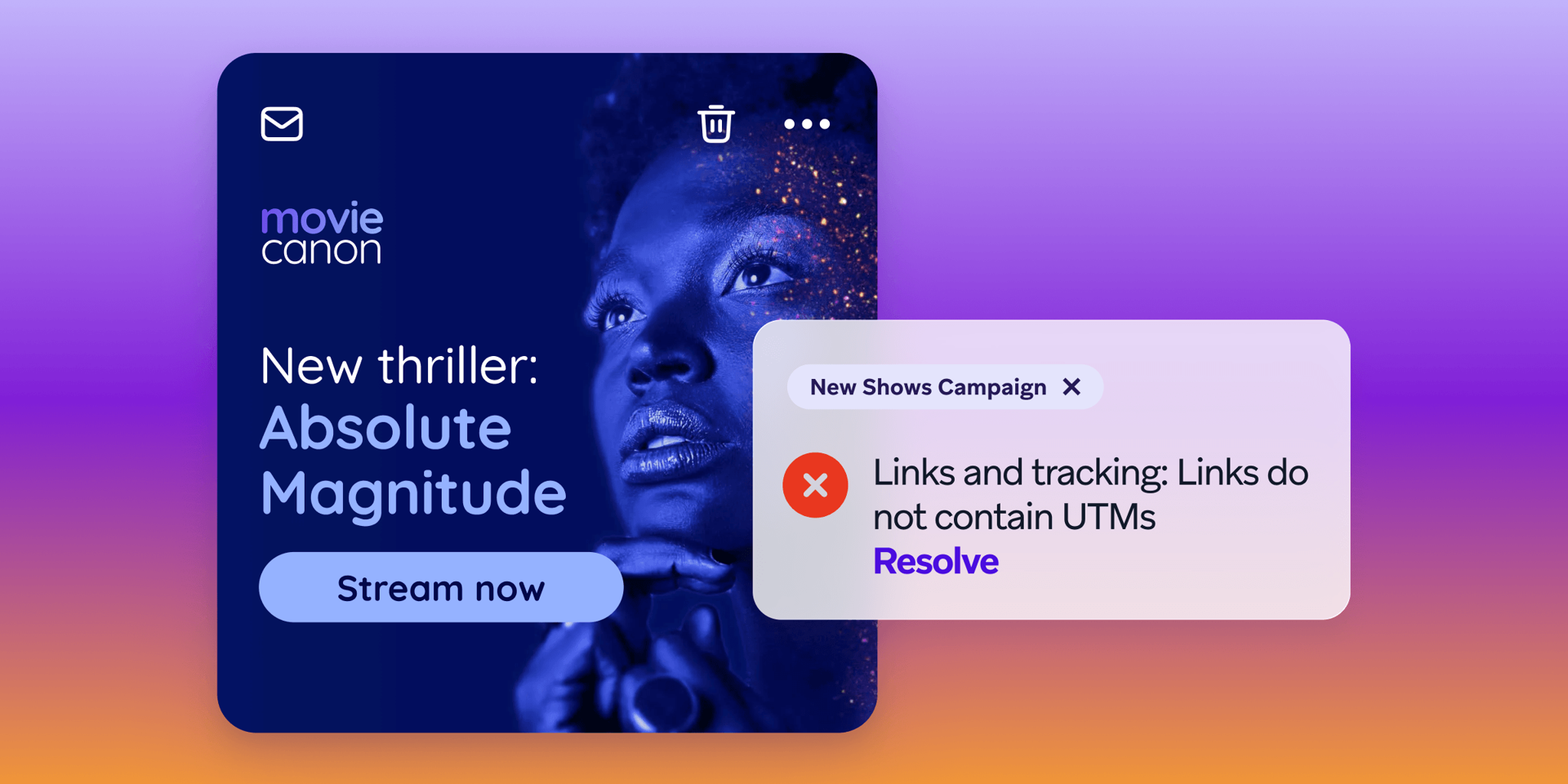
How many hours did you spend checking your last campaign or Canvas before launch? You probably have a QA checklist telling you what to review; maybe every promotional message needs a "while supplies last" disclaimer, or every campaign needs to clear a brand check before it ships. With Agentic Standards (planned availability in October), you write your QA rules once into Braze in plain language, defining your standards for brand guidelines, required disclaimers, tagging conventions, and more. Agentic Standards then automatically assesses every campaign and Canvas before launch. If something's missing, it can tell you what to fix—instead of just flagging that something broke.
Let your priorities hold the line
Large teams often run dozens of campaigns and Canvases at once, and those messages can end up competing for the same customer’s attention at the very same moment; for instance, an individual might be eligible for a shipping confirmation email, a promotional push, and a monthly newsletter on the same day. You’ve probably been managing that process by hand or in a spreadsheet. But with Message Prioritization (available now), you can rank your message categories once, and Braze will automatically hold that order across all of your campaigns and Canvases. Among the messages you’ve ranked, the highest-priority goes out first, and lower-priority messages are rescheduled for later. The upshot? You no longer have to worry about the conflict or referee your messaging calendar send-by-send.
Know before your customer tells you
QA doesn’t stop once a campaign is launched. You want to know what’s working and what needs your attention throughout the entirety of the customer journey. But while once you would have had to manually build a report to get those insights, now Operator can easily answer plain-language questions about your campaign performance. Canvas Threshold Alerts (available now) can catch the moment a journey's send volume drops below its normal range, while the Messaging Observability Dashboard (available now) can show why messages were sent, held, or dropped.
Act on the full picture
A customer's Shopify order. Their survey response. The row sitting in your data warehouse. They're all describing the same person, but stitching that information together to gain a full view of that individual usually means an engineering project...or a stale export. To close that gap, we're launching new capabilities in Braze that will provide you with a clearer view of exactly who you're talking to.
Data that arrives ready to use
The data you need to personalize a campaign often already lives in a data warehouse, but getting it into Braze meant an engineering ticket. Cloud Data Ingestion helps streamline that process by adding Google Cloud Storage and Azure Blob Storage as new data sources, as well as a data mapper that lets you map warehouse columns into Braze attributes by yourself, using easy dropdowns. Cloud Data Ingestion now feeds directly into Decisioning Studio, making it possible for an agent to make decisions based on a customer's actual history.
A two-way relationship with your warehouse
Databricks OpenSharing (available now) closes the loop the other direction. You can join Braze engagement data with the rest of your business data already in your Lakehouse, so you can see how a specific message actually affected a given purchase or a renewal, instead of reporting on opens and hoping that the connection holds. User profile streaming (available now) keeps that warehouse current with the same attributes Braze already knows, like an updated loyalty tier or churn risk, so any model built on top of it isn't just working from last week's picture.
Look like a local everywhere you sell
Expanding into a new market used to mean a new build: A separate regional Canvas, manual consent tracking for that country’s rules, and manual currency conversions. For customers using Shopify, Shopify Markets (available now) makes it easy to test and expand into new markets by syncing localized language, pricing, currency, and consent into Braze, so a single Canvas can render correctly in every market you sell in. Shopify Segment Sync keeps those market-specific audiences current automatically, so a shopper who moves into a "lapsed" segment can quickly trigger a re-engagement message. Shopify Banners carry that same personalization into the storefront itself, supporting on-site banners that you can launch without writing code.
Know more about who you're actually talking to
Not every customer is a single person acting alone, and not every question about them has to be inferred from their behavior. Accounts (available now) gives you a way to group related users under a shared account. That makes it possible to message the primary contact about billing issues while still sending everyone else their own relevant updates, all without duplicating data across every profile. Surveys (available now) bring native, drag-and-drop feedback collection into in-app messages and landing pages; that way, a detractor response can be routed straight to a support queue and a promoter response can be dropped straight into a referral Canvas the moment it comes in, instead of you guessing at what they wanted from their behavior alone.
Work where you work best
Not every team builds campaigns or customer journeys exclusively inside the Braze dashboard, and Operator shouldn't be limited to it, either. Your day might start in Claude (or Cursor, or another tool) before you switch over to Braze to ask a question or kick off a build, a transition that can break whatever momentum you had going. Here's what we're launching to bring Braze to wherever you work best:
Bring Operator to wherever you already are
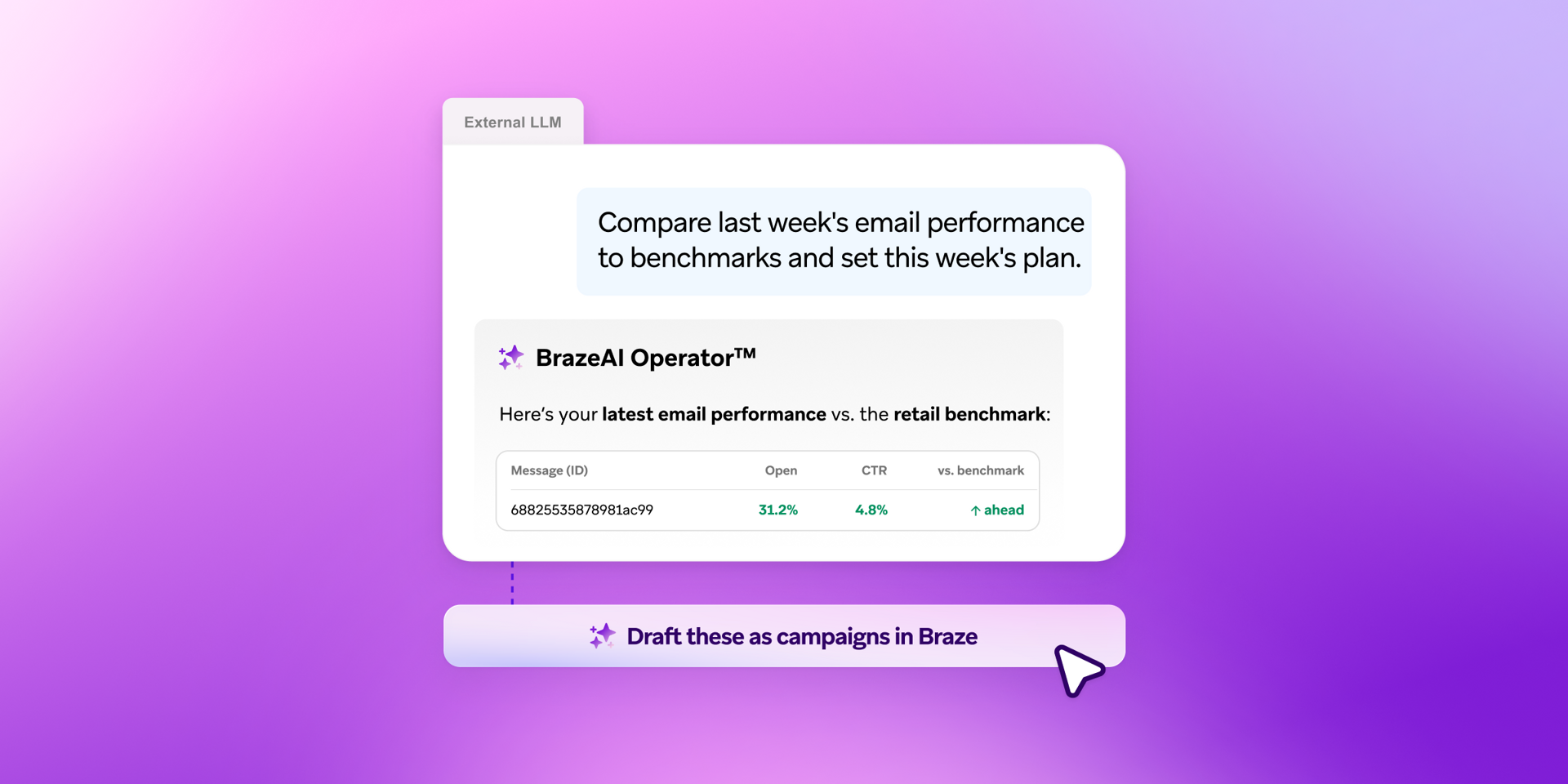
Operator Connect (in beta) brings Operator into the AI tools you already have open, including Claude, ChatGPT, and Cursor. You can ask Claude to analyze last week's email performance against benchmarks and draft next week's plan, grounded in real Braze data, then have Operator build the resulting campaign without switching tabs. Through Operator Connect, your AI tools will be able to work with the same Operator knowledge of your Braze workspace, your data, and your campaigns, and every action still stays governed by your own dashboard permissions.
One connection, everywhere
Operator Connect runs on the Braze MCP Server (now available), which connects AI tools and agents to Braze through a single URL and your standard dashboard login. There's no API key to manage and no custom infrastructure for your team to stand up and maintain. Point a client at it, sign in the way you already do, and it's all connected.
That connection means a question about performance or customer behavior can be answered from your own data, not a generic model's best guess. Ask Claude: "Can you show me the details for the Flash Sale test segment?" and it pulls the answer straight from Braze: The segment’s filters, when it was created, its tags, who has access to it. Follow up with “pull its audience size and analytics," and the numbers come back in seconds.
Final thoughts
Being a great marketer once meant having to choose between things that should never have had to compete: Personal or scalable, fast or careful, creative or measured. That's not true anymore. Today, marketers can make a million customers each feel like they're the only one. AI gives you the ability to think bigger by absorbing the tradeoffs that used to eat up your time and attention.
The products we launched today are powerful, but they aren't intended to replace the judgement you've built up over the years: That is, knowing what's worth testing or when a customer needs a different tone or even when to hold back when the tool says to move forward. That said, they can reduce the work that exists around that judgement, allowing more of your time to be devoted to decisions only you can make.
Here’s where to start, depending on what’s slowing you down today. If it's building your first Canvas, start with Operator. If it's personalization you've been doing by hand for too long, start with Decisioning Studio Go. If it's trust in what your team is shipping, start with Agentic Standards.
This is a new era for marketing. You were made for this, and Braze was made to help.
Interested in learning more? Sign up for the Braze Q3 What’s New webinar and see these new products in action.
Related Tags
Releated Content
View the Blog
Congratulations to the Forge 2026 Torchie Awards winners
Team Braze
Made for this: How Braze is providing new ways to build, support, and extend your campaigns
Christy Poulos

Cracking Microsoft: A deep-dive into Outlook and Hotmail deliverability