
Experience optimization: Turning data insights into better journeys
Published on December 18, 2025/Last edited on December 18, 2025/11 min read


Team Braze
Most teams already have more than enough data on the customer moments that leave a mark, good and bad. The hard part is turning that information into journeys that keep improving over time, especially when customers are bouncing between channels, devices, and touchpoints in a matter of minutes. Simple tests on a single page or campaign only get you so far.
Experience optimization treats the whole journey as something you can tune continuously. It brings experimentation, data, and orchestration together so you can make smarter decisions about what to send, when to send it, and where it should show up. Layer in AI, and you get systems that adjust timing, channels, and content as people interact, rather than months later.
This guide walks through what that looks like, what you need to consider for your customer lifecycle, and how Braze helps you build experience optimization into the way you already work.
What is experience optimization?
Experience optimization is the process of improving the customer journey across every possible touchpoint with a brand. That means looking at interaction and customer engagement on every channel and platform and looking further than just a company website. It blends experimentation, data, and orchestration so every opportunity is taken to move people closer to the next meaningful action—signing up, purchasing, subscribing, or coming back.
Many teams start with conversion rate optimization (CRO), which focuses on a single page or funnel, or A/B testing, but experience optimization adds both breadth and depth.
How experience optimization differs from CRO and A/B testing
Traditional CRO and A/B testing answer the question: “Which of these options works better?” In contrast, experience optimization continues to ask: “What should this experience look like for this customer right now?”
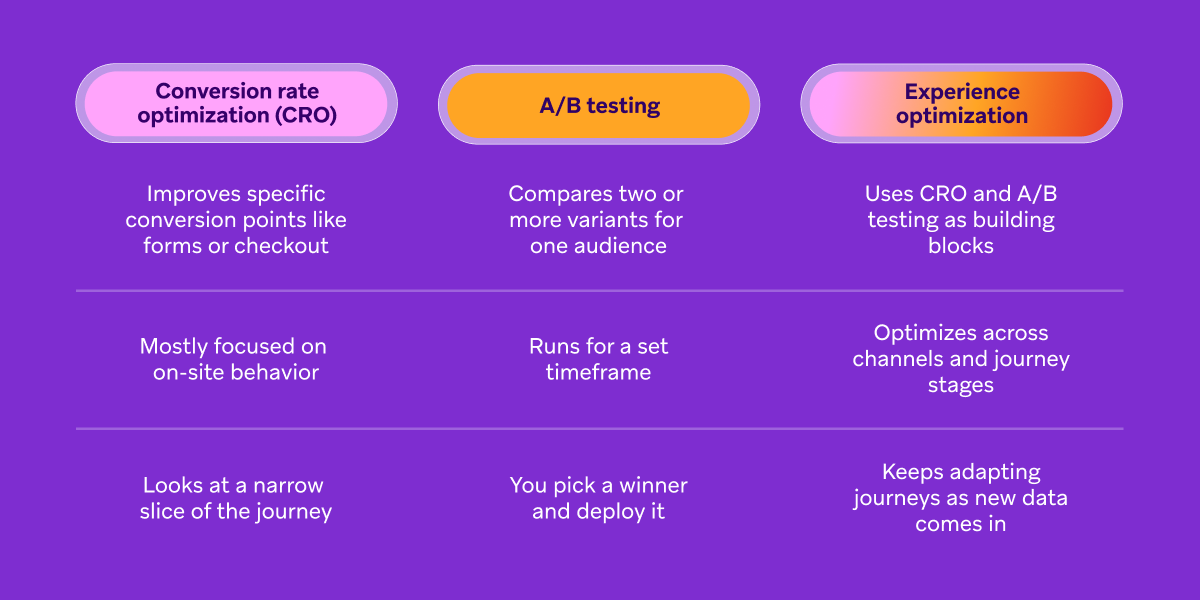
- Conversion rate optimization (CRO) focuses on improving specific conversion points—like a checkout page or form. It typically lives on-site and looks at a narrow slice of the journey.
- A/B testing compares two or more variants (A vs. B vs. C) for a defined audience and timeframe. Once the test ends, you pick a winner, deploy it, and often move on.
- Experience optimization combines both, but adds a broader scope and a continuous loop. You still care about conversions and run tests, but you also:
- Optimize across multiple channels, not just web pages
- Fold in context (behavior, preferences, lifecycle stage)
- Keep adapting journeys as new data comes in
Why AI matters for experience optimization
Experience optimization matters because it shows up directly in performance. When journeys feel smooth and relevant, customers are more likely to:
- Leave interactions feeling satisfied
- Engage more often with your product, content, or services
- Complete key actions like sign-ups, upgrades, and purchases
- Stay with you longer and recommend you to others
- Contribute to stronger revenue and more reliable growth
AI takes this from isolated wins to a repeatable system. Instead of hand-tuning a single page or campaign, AI can look across the full journey and:
- Read signals from web, apps, email, SMS, and other channels like WhatsApp
- Spot patterns in behavior that are hard to see manually at scale
- Adjust experiences as behavior and context change, not just after a report lands
With AI, more of your interactions can be optimized for meaningful gain, at scale. For example, you can use:
- Predictive analytics to estimate churn risk, purchase likelihood, or open probability
- Real-time engagement optimization to adjust send times, channels, and offers based on live behavior
- Data-driven experimentation to steadily shift more traffic toward higher-performing variants
From testing to learning: the evolution of optimization
Most teams begin with simple A/B testing. You tweak a subject line, compare two onboarding flows, check the numbers, and pick a winner. That still has value, especially when you apply AI to A/B testing, but customer journeys have become far more complex.
People jump between the web and apps within minutes, pause and restart sessions on different devices, and take very different paths from first touch to purchase and beyond. When experiments run for weeks and journeys only get revisited a few times a year, the insight often lags behind how people actually behave. Static tests struggle to pick up smaller high-value segments and overlook interactions beyond a single page or campaign.
Data-driven experimentation across journeys
Experience optimization treats experimentation as an ongoing loop. Teams build tests and control groups into journeys from the beginning, then watch how real customers move through paths while campaigns are live.
AI extends that loop. Classic testing often revolves around one hypothesis and one experiment at a time. With AI-supported experience optimization, models scan behavior, highlight patterns worth exploring, and point to journeys or audiences where data-driven experimentation will have the greatest effect.
Traffic can lean toward stronger variants as evidence builds, without waiting for a long test window to close. Teams gain room to run continuous experiments across journeys, channels, and offers, guided by live signals rather than guesswork.
The data foundation for experience and customer journey optimization
Effective experience optimization always starts with a strong data layer. You do not need every possible signal, but you do need consistent, trustworthy inputs.
The types of data that matter
For most brands, three categories matter most:
- Behavioral data: Sessions, pageviews, purchases, feature usage, content views, cart events, and in-app actions
- Contextual data: Device type, location, language, platform, time of day, and acquisition source
- Engagement data: Email opens and clicks, push opens, in-app interactions, SMS replies, and channel preferences
Real-time streaming and unified customer profiles
To support real-time engagement optimization, your data needs to be:
- Streaming in, not batch-only so journeys can react to events as they happen
- Unified around a single user profile so behavior in one channel influences decisions in another
- Accessible to both marketers and models inside your orchestration tool
Privacy and responsible data practices
Experience optimization relies on trust as much as data. That means aligning experiments with legal requirements, and honoring consent and channel-level preferences, being open about what you collect and how it will be used, and keeping data collection focused on what is genuinely needed, especially for sensitive attributes.
It also means watching for fatigue by using frequency caps, smart suppression, and thoughtful test design, so experimentation does not leave people feeling bombarded. Ideally, you want a program where optimization makes interactions feel better for customers while it lifts results for your team.
AI-powered optimization: from insights to action
Once you have data flowing and journeys mapped, AI helps translate insight into action—deciding what to send, when to send it, and through which channel.
AI decisioning for dynamic journeys
AI decisioning uses reinforcement learning to continuously learn and optimize decisions for individual customers based on real-time signals and past interactions. Unlike predictive models that forecast outcomes and score users to suggest the next best action, reinforcement learning agents optimize experiences by taking actions and learning from the results, adapting over time—the way humans do. In Braze, AI decisioning can:
- Learn which actions drive the highest value for each customer based on their unique characteristics and behavior patterns
- Optimize message content, channel, timing, and frequency—at the same time, considering overall impact
- Adapt as customer preferences and market conditions change, without manual retraining or rule updates
- Feed insights into Braze Canvas so customer journeys adapt in real time based on what the AI has learned
Intelligent Timing and Connected Content
Two Braze capabilities directly impact experience optimization:
- Intelligent Timing analyzes each user’s past interactions to send messages when they are most likely to engage—across push, email, and in-app.
- Connected Content lets you pull in real-time data from external systems (like inventory, pricing, or loyalty balances) at send time, so messages always reflect up-to-date context.
Experience optimization in action: use cases
Once you look beyond a single channel, the impact of experience optimization becomes clearer. Here are three common scenarios.
Retail and eCommerce: real-time offer optimization
Retail brands often deal with fast-moving catalogs, frequent promotions, and varied intent levels. Experience optimization can:
- Use browsing and cart behavior to trigger tailored offers, such as free shipping, bundle discounts, or relevant recommendations
- Run data-driven experimentation on offer framing, layout, or channel mix
- Coordinate email, push, and in-app so customers see consistent offers without being flooded
Example: Real-time offer and merchandising optimization
Use: Data-driven experimentation across web, app, and messaging
What it might look like in practice: Retailers combine browsing, cart, and purchase behavior with live inventory data to decide which promotion or product mix to show next. Experiments run on headlines, layouts, and incentives across email, push, and on-site modules, with stronger variants gradually shown to more shoppers.
Outcome: Higher conversion rates and average order values as offers stay relevant to intent and availability.
Travel and hospitality: adapting cadence to trip milestones
Travel journeys are event-heavy. Customers research destinations and dates, book transport and accommodation, add extras like insurance or car hire and need to receive reminders and in-trip communications.
Experience optimization helps you:
- Adjust cadence around key milestones (booking, check-in, mid-stay, departure) using event triggers
- Personalize upgrades or ancillary services based on past trips and real-time intent
- Deliver important alerts in the channel each traveler responds to fastest (for example, SMS for last-minute gate changes, push for in-app boarding passes)
Example: Trip-aware messaging cadence
Use: Journey-based personalization
What it might look like in practice: Travel brands use booking details and trip milestones to time and tailor communications. Pre-trip emails highlight add-ons and upgrades, in-trip push notifications share reminders and relevant offers, and post-trip messages reflect what the traveler actually used.
Outcome: More ancillary revenue, repeat bookings, and fewer support contacts thanks to clearer, better-timed updates.
Media and subscriptions: dynamic content curation
Media, streaming, and subscription apps need to keep people engaged over time, not just at signup. Experience optimization can:
- Use consumption behavior to build dynamic segments (for example, genre fans, binge-watchers, or casual visitors)
- Test different content mixes in recommendations, newsletters, or in-app modules
- Promote series or articles that drive the strongest downstream engagement, like completing a season or subscribing to a premium tier
Example: Smarter show and content recommendations
Use: Real-time personalization
What it might look like in practice: Streaming and news platforms use learning systems to understand what keeps viewers and readers engaged. Every play, pause, skip, and completion feeds into experiments on rows, tiles, and content mixes across home screens, emails, and in-app recommendations.
Outcome: Increased watch time, reduced churn, and higher cross-platform engagement as recommendations adapt to changing tastes.
How Braze enables continuous experience optimization
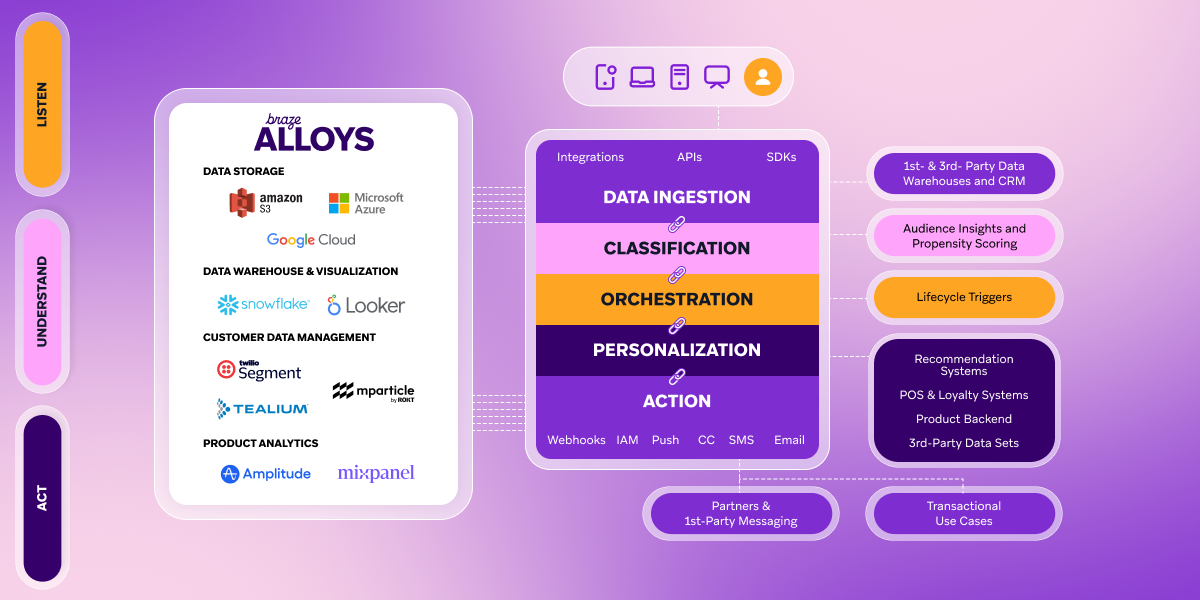
Braze is built to bring data, decisioning, and delivery into one place, so your experience optimization strategy doesn’t sit within a separate tool or a single team.
Canvas for adaptive journeys that learn
Canvas is the Braze journey orchestration solution that lets you:
- Build event-driven, cross-channel journeys with a visual, drag-and-drop interface
- Add Experiment Paths to compare different cadences, channels, or content at any stage
- Trigger follow-up paths based on real outcomes—purchases, log-ins, feature use, or lack of engagement
Because Canvas sits directly on top of live user profiles and streaming data, it becomes the backbone of customer journey optimization across your lifecycle programs.
AI decisioning to determine the best action for each individual
BrazeAI Decisioning Studio™ supports experience optimization by applying reinforcement learning to experiment continuously and learn from every interaction for each customer. The system automatically optimizes channel, message, timing, and cadence to help maximize the results against your chosen KPI, and then feeds those decisions into your orchestration.
That can look like:
- BrazeAI Decisioning Studio™ dynamically determines which action is most likely to optimize the agent’s success metric, such as “optimizing conversions on an abandoned cart” campaign experience.
- Intelligent Timing and Intelligent Channel choosing when and where to reach someone based on how they usually behave, so messages land in moments when people are most likely to engage.
- Intelligent Selection dynamically allocating traffic to different variants and gradually favoring the options that perform best against your KPIs.
These tools reduce the manual effort needed to keep journeys effective. Teams spend less time maintaining rules and more time on strategy, creative, and the next round of ideas to test.
Experimentation and personalization testing with control groups
Braze supports experimentation and personalization testing at multiple levels:
- Campaign- and Canvas-level A/B and multivariate tests through Experiment Paths and message variants
- Global and campaign-level control groups to measure incremental lift across your entire programFeature Flag Experiments to test changes in product experiences and flows, not just marketing messages
Every experiment ties back to KPIs like opens, clicks, conversion, retention, and revenue.
The future of experience optimization
Experience optimization is heading toward a model where systems handle more of the work autonomously, within clear guardrails set by your team.
Agentic marketing systems watch signals across channels and devices, suggest or launch new experiments within agreed limits, rebalance traffic and paths as performance changes, and surface useful insights in plain language so teams can act quickly.
Many brands are trading large, fixed campaign cycles for always-on feedback loops. Journeys run continuously, tests are built-in from the start, and live performance views make it easier to see where small changes will have the biggest effect.
Automated allocation tools, including bandit-style approaches such as Intelligent Selection, keep experiments progressing in the background. As AI takes on more execution, marketers gain more space to focus on brand, customer insight, and longer-term strategy.
Key takeaways for experience optimization
Experience optimization is about making every interaction more valuable—for customers and for your business. With Braze, you can:
- Treat experimentation and personalization testing as part of everyday journey orchestration
- Use AI to optimize send times, channels, content, and offers based on real behavior
- Run data-driven experimentation with clear KPIs, holdouts, and control groups
- Connect streaming data, decisioning, and delivery in one platform, so optimization is automated, measurable, and always on
Related Tags
Releated Content
View the Blog
A day in the life of a data scientist on the BrazeAIᵀᴹ forward-deployed engineering team

McKay Jensen

The new inbox reality: How iOS changes are reshaping email marketing

Aparna Prasad
Experience optimization: Turning data insights into better journeys