Designing digital omotenashi with Braze
Published on December 04, 2025/Last edited on December 04, 2025/9 min read

Marlowe Geramanis
Senior Lead Solutions Consultant
Taku Kakino
Senior Director, Marketing
Yosuke Sato
Strategic Business Consultant IIn Japan, hospitality is not merely a service; it is an art form, one that exists quietly in every corner of daily life. Omotenashi, often translated as "hospitality," goes deeper than simply welcoming a guest. It is the quiet mastery of anticipating a need before it’s spoken, of delivering an experience with such care, craftsmanship, and intuition that the guest feels wholly seen, valued, and honored.
You find it in the perfectly portioned bento box and the subtle choreography of an omakase dinner. It’s an ethos that puts deep intentionality behind every touchpoint and it’s what brought 427° Innovation to Tokyo.
- Our Braze colleagues in Tokyo had our business cards printed in Japanese ahead of our arrival and taught us that meishi kōkan, the ceremonial exchange of business cards, is more than a formality. Each meeting began with a bow and the deliberate presentation of cards; a shared acknowledgment of identity and presence before any discussion of business or technology.
That same thoughtfulness carried through every customer conversation that followed. Instead of asking “What’s the ROI?” or “How does this increase lifetime revenue?”, it was “How does this build trust with my customer?” and “How does this make their life better?”. It’s a necessary reminder that in many parts of the world, data isn’t gathered to monetize a need, it’s gathered to anticipate it, to serve it, and to earn trust.
Contrast this with the United States, where the marketing playbook can often feel like a hall of mirrors: Optimization within optimization. We’ve gotten very good at acquisition, but it's a costly revolving door. Customers arrive only to leave just as quickly, and as Harvard Business Review notes, acquiring them is 5 to 25 times more expensive than retention.
In our race for short-term gains, we’ve lost the long-term art of loyalty. We’ve traded thoughtfulness for immediacy. Omotenashi reminds us that true enduring loyalty isn’t bought with discounts. It’s earned with care.
Braze: A platform built for Omotenashi
When I first joined Braze, it wasn’t just another engagement platform to me. I had spent 4.5 years working for a partner technology, integrating with every major messaging and CRM system in the market. I saw firsthand how many platforms prioritized business needs over customer needs.
Braze was different. It placed the customer at the center. It enabled brands to anticipate needs, not just react to them. It made loyalty possible not through manipulation, but through relevance, value, and timing.
It’s no wonder Japan loves Braze: Braze was built for digital omotenashi. But digital Omotenashi doesn’t happen by accident. It requires more than good intentions, it demands infrastructure built for empathy at scale. Braze was architected for Digital Omotenashi around three core pillars:
- Context: Flexible real-time data integration and a person-centric data model that allow you to listen to customer’s digital body language as it happens, not in batches, not hours later.
- Intelligence: AI tools that are integrated through every layer and channel in the Braze stack empowering you to connect the omotenashi principle of anticipation directly to the power of AI
- Interaction Single native cross-channel platform built on real-time streaming architecture means that messaging, journeys, preferences, and reporting work in unison, not in silos. Braze is committed to continuous innovation with the latest emerging channels and messaging platforms
Without which omotenashi remains a philosophy. With them, it becomes practice. So what does that look like in action? To illustrate these three pillars, let's follow the journey of a fictional customer, Anna, a frequent traveler and self-proclaimed "foodie." She has just booked a trip to Tokyo with a premium travel brand that uses Braze. For this brand, her journey isn't just a transaction—it's an opportunity to provide seamless, thoughtful care from the moment she lands. We'll see how context, intelligence, and interaction transform her experience.
Part 1: The foundation (context)
True Omotenashi begins with listening. It’s the art of understanding a guest's needs, spoken and unspoken, by observing their digital body language. This is context. It requires a flexible, real-time data platform that can unify app behavior, profile data, location, and third-party APIs not hours later, but in the exact moment of need.
The omotenashi moment: The reassuring arrival
Anna’s flight has just landed in Tokyo. The single most pressing anxiety for any traveler is: "Where is my bag?"
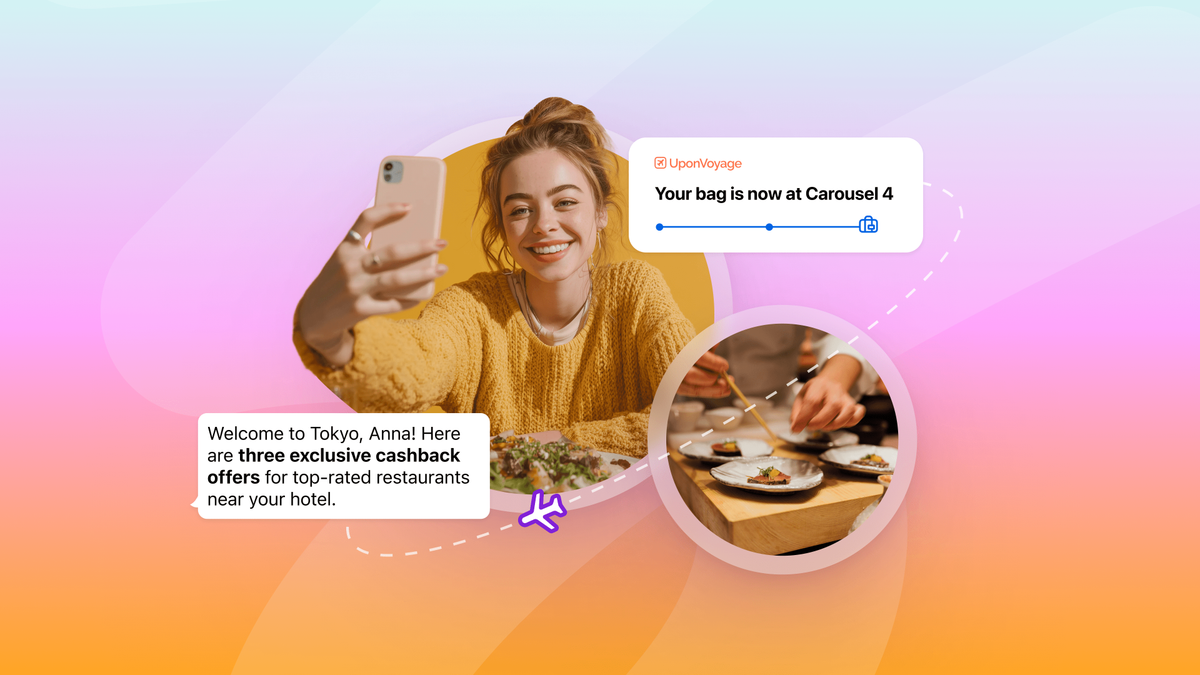
The moment she turns on her phone, a geofence detects her arrival at Narita Airport and triggers a Canvas. Instead of a generic "Welcome!" push, a Live Activity appears on her lock screen. This isn't just a message; it's a dynamic, helpful companion.
Fueled by Braze, the airline's app uses her "Landed" status to instantly call its internal baggage claim status API via Connected Content. The Live Activity updates in real-time as she walks from the gate:
- "Your bag has been unloaded from the plane."
- "Your bag is on its way to the carousel."
- "Your bag is now at Carousel 4."
This is context in practice. The brand understood her entire situation by unifying app, location, and API data. It transformed a moment of stress into one of reassurance, providing a genuine service. This deep, real-time understanding is the foundation upon which all thoughtful engagement is built.
Part 2: The insight (intelligence)
Anna's baggage claim experience solved her immediate anxiety. She felt cared for because the brand understood her context. But true omotenashi doesn't just solve problems, it anticipates desires. This is the second pillar: Intelligence.
Intelligence is the "what's next?" It’s the art of moving from "what is happening?" to "what would make this moment perfect?" This requires an empathetic brain that can interpret data and make creative, thoughtful decisions at scale.
The omotenashi moment: The perfect welcome
Anna is in her taxi, heading to the hotel. Her bag-tracking Live Activity has just ended. The brand has a critical opportunity to welcome her, but a generic "Welcome!" message is just noise. It could offer her a spa discount, a room service credit, or a restaurant deal.
This is a job for the BrazeAI Decisioning Studio™. It acts as the intelligent decision-maker, weighing potential offers against the business goal of "maximizing guest engagement."
BrazeAI Decisioning Studio analyzes Anna's unique first-party data to build a holistic view of her interests and understands her passions for unique culinary experiences. Decisioning agents also recognize she has "Gold Tier" status and know she is arriving late afternoon and will likely want a nice dinner after a long day of travel. Therefore, she's highly likely to engage with a cashback offer at a local restaurant than with a spa discount.
But the timing is just as important. The system doesn't interrupt her check-in. Thirty minutes after her phone's geofence registers her at the hotel, just as she's settling into her room and starting to think about dinner, a message arrives via WhatsApp:
"Welcome to Tokyo, Anna. To help you explore the local food scene, here are three exclusive cashback offers for top-rated restaurants near your hotel. We hope you have a wonderful stay."
This is intelligence. It wasn't a random promotion. It was a single, curated offer, selected by AI, and delivered at the perfect moment, making Anna feel like the brand truly understood her.
Part 3: The practice (interaction)
If context is the art of listening and intelligence is the art of anticipating, then interaction is the art of responding.
This is the final pillar, where thoughtfulness becomes a two-way conversation. It’s where a brand proves it has used context and intelligence to not only craft a perfect moment, but to also show up with empathy when things go wrong.
The omotenashi moment: The real-time recovery
Following the brand's recommendation, Anna goes to one of the "top-rated" restaurants. But the experience is a disaster. The service is slow, and the food is a disappointment.
She's frustrated. She pulls out her phone, finds the helpful WhatsApp message from earlier, and replies directly to it.
- Anna (via WhatsApp): "This is a joke. You sent me to this restaurant and the service is awful. I've been waiting 45 minutes for a drink. This is not the 'welcome' I expected."
In a legacy system, this message would go into a void. But here, it triggers an intelligent Canvas built for real-time interaction.
Step 1: The AI agent assesses sentiment
First, her free-form text message is instantly routed to the BrazeAI Agent Console™. It's not looking for keywords—it's assessing intent and emotion.
- Agent Instructions: "You are a customer service specialist. Analyze this feedback. Identify the core problem, the emotional sentiment, and the urgency."
- Agent Output (JSON): In milliseconds, the agent provides its analysis:JSON:
{
"problem_category": "partner_experience",
"sentiment": "angry",
"urgency": "high"
}
Step 2: The Canvas routes intelligently
The Canvas immediately uses this JSON output. Because the sentiment is "angry" and urgency is "high," it skips the standard FAQ bot and initiates an immediate human handoff.
Step 3: The seamless handoff
The system does two things simultaneously:
- To Anna: An automated reply is sent to her WhatsApp to reassure her: "Anna, we are so sorry. This is not the experience we want for you. We are escalating this to a human agent right now."
- To the team: It creates a high-priority ticket in Zendesk, automatically attaching Anna's full profile, her loyalty status, the AI sentiment analysis, and the entire chat history.
Step 4: The Human Touch
Less than 60 seconds later, a human agent (who has the full context) replies directly via Zendesk, which routes seamlessly back into Anna's WhatsApp chat:
"Hi Anna, this is Ken from the travel team. I am so sorry about your experience. That is completely unacceptable, and we are removing that restaurant from our recommendations. We've just added a $50 travel credit to your account for the frustration. Your feedback is invaluable, and we will not let this happen again."
This is true interaction. It combined the AI Agent's emotional intelligence with a seamless bot-to-human workflow. Anna was in control, her problem was solved in her chosen channel, and she never had to re-explain herself. The brand turned a moment of failure into a demonstration of ultimate care.
Conclusion: A thoughtful future
As the marketing world continues its arms race for more data, faster conversions, and tighter optimizations, we have an opportunity, maybe even a responsibility, to choose a different path.
One rooted in thoughtfulness.One that sees customers not as KPIs, but as honored guests.One that wins not just the transaction, but the trust.
Omotenashi is the future of enduring business.And Braze is how we can build it.
From Tokyo, with thoughtfulness.