Cross-channel personalization with email platforms: Why consolidation drives better results
Published on June 18, 2026/Last edited on June 18, 2026/15 min read
Team Braze
Cross-channel personalization with email platforms means that email works as a part of a whole set of other channels that customers are on to deliver relevant, valuable messaging as customers move through those channels.
Marketers know they need to expand their reach: More than 80% of brands are working to engage their audiences across multiple channels (Mix and Match Guide)
Yet they struggle with low customer understanding and siloed systems: 79% of marketing executives aren’t fully confident in understanding user preferences; additiobnally, 50% of brands still depend on single-channel or siloed solutions.
So let's look at the opportunity, where most teams hit problems, and how to build a cross-channel personalization that can co-exist with an email strategy that drives the kind of results no single channel can match on its own.
TL;DR
- Cross-channel personalization with email platforms means building a using a unified platform where every channel draws from the same customer data and behavioral signals in real time.
- Running email, SMS, push, and in-app messaging from separate point solutions creates disconnected profiles, duplicated effort, inconsistent experiences, and double-counted attribution.
- Each channel has a distinct job: email for depth, SMS for time-sensitivity, push for urgency, in-app for context, and Content Cards for persistence.
- Building the strategy requires five steps: unify data, map the lifecycle, build intelligent journeys, implement AI-powered channel selection, and measure with cooperative attribution.
- According to the 2024 Retention Guide, brands see an average 56% uplift in 90-day retention for each new channel added to their marketing mix, up to a total of six.
Key takeaways
- Multichannel and cross-channel are not the same thing. Multichannel means a presence on multiple channels. Cross-channel means each channel responds to what's happened everywhere else, so the experience builds rather than repeats.
- Consolidating channels is a prerequisite for AI personalization. Fragmented data produces fragmented outputs, and no AI system makes good decisions from partial context.
- Email and SMS consolidation is where most teams start, but the full opportunity extends to push, in-app messaging, Content Cards, WhatsApp, web messaging, and via webhook integrations or direct mail.
- Cooperative attribution models are what make a multi-channel strategy genuinely improvable over time, by crediting every touchpoint that contributed to an outcome rather than just the last one.
- Rule-based channel selection doesn't scale. As channels grow, manual conditional splits become unmanageable. AI decisioning improves with use rather than requiring constant reconfiguration.
What is cross-channel personalization with email platforms?
Cross-channel personalization with email platforms means using a unified marketing platform to deliver coordinated, individually relevant messages across email, SMS, push notifications, in-app messaging, and other touchpoints. Rather than managing each channel in a separate tool, a single platform shares customer data, behavioral signals, and engagement history across every channel to personalize each interaction in context.
Cross-channel should not be confused with multichannel, however. The two terms get used interchangeably but they describe very different approaches:
- Multichannel marketing puts a brand on multiple channels but sends broadly the same message across all of them. Presence without connection. Each channel operates independently, with no shared data or awareness of what's happening elsewhere.
- Cross-channel marketing is context-aware. What a customer does on one channel directly influences what they receive on the next. Each signal, whether a browsed category or an ignored push notification, feeds into the next interaction so the experience flows with relevance.
However, while email may have a wide reach for many brands, support the richest content formats, and has a measurable track record for driving results, it cannot deliver results in a silo.
The problem with siloed email marketing
Point solutions are built to solve one specific problem really well. Running email, SMS, push, and in-app messaging from separate point solutions feels like a reasonable way to get the best tool for each channel. In reality, it creates problems that get harder to manage as the number of channels grows.
Here's what to watch out for:
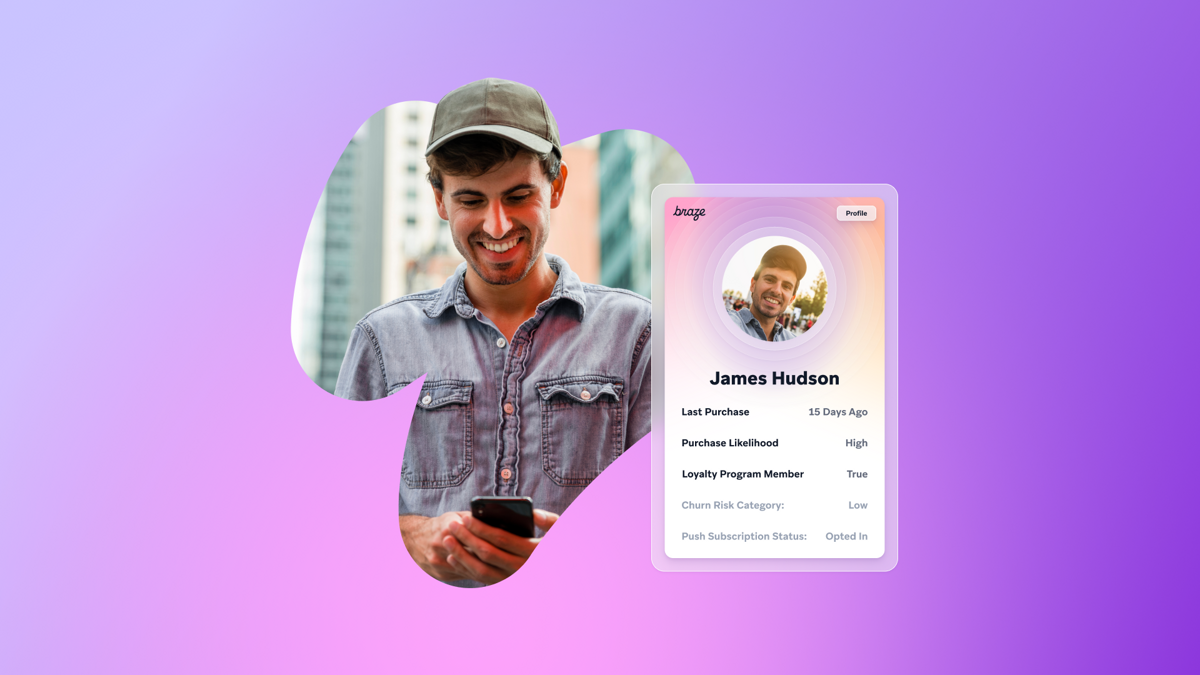
- Disconnected customer profiles: When each tool holds its own slice of customer data, no single platform has the full picture. The email tool sees one version of a customer. The SMS tool sees another. Neither knows what the other is doing, so decisions about what to send, when, and on which channel are based on incomplete information.
- Duplicated effort: Every campaign means rebuilding audiences, lists, and segments across multiple tools. Teams end up spending significant time reconciling data rather than acting on it.
- Inconsistent experiences: Without a shared view of engagement history, customers receive contradictory or redundant messages. A discount offer sent hours after a full-price purchase, or the same re-engagement message arriving on three channels at once.
- Double-counted attribution: When every tool claims its own conversions, measuring true cross-channel lift becomes unreliable. Two platforms attributing the same purchase to their respective channels tells you nothing useful about which combination of messages actually drove it.
According to the 2026 Global Customer Engagement Review, 48% of marketers say they still lack the tools needed to orchestrate coordinated cross-channel experiences. Many teams are already managing more channels than their current stack was designed to handle, and might be rethinking how many platforms they actually need, and what consolidating onto a single one would change.
What channel consolidation marketing means (and why it matters)
Channel consolidation marketing brings all your messaging channels under one platform, running on a single customer profile that every channel draws from. Email, SMS, push notifications, in-app messages, Content Cards, each one shares the same behavioral data, engagement history, and customer attributes, updated in real time.
According to the 2024 Retention Guide, brands see an average uplift of 56% in 90-day retention for each new channel they add to their marketing mix, up to a total of six. Each channel added, coordinated from a single platform, consistently builds on that retention gain, but the market has evolved in distinct stages.
A standalone email marketing platform was where most brands started: powerful for email, blind to everything else. Adding SMS integration was the next step, creating a two-channel setup that shared some data but remained limited in scope. Full cross-channel engagement platforms are where that evolution lands, with email, SMS, push, in-app messaging, WhatsApp, and web messaging all operating from a single unified customer profile, each channel informing the others in real time.
Most brands today sit somewhere in the middle of that spectrum. The pressure to move further along it is coming from three directions:
- Rising customer expectations: Customers have little patience for messages that ignore what they've already done. A coordinated experience across channels has become a baseline expectation rather than a competitive advantage.
- AI readiness requirements: Effective AI-powered personalization depends on complete, unified data. A fragmented marketing tech stack produces fragmented inputs, and fragmented inputs produce poor outputs. Consolidation is a prerequisite for AI to function well.
- Operational cost: Separate contracts, separate integrations, and separate teams for each channel add up quickly. Every additional point solution brings its own renewal cycle, its own maintenance overhead, and its own learning curve for the team managing it. Marketing tech stack consolidation is one of the most direct ways to reduce that burden.
Beyond email and SMS: The full cross-channel opportunity
Email and SMS consolidation has real value. Bringing those two channels onto a shared data layer removes duplication, fixes attribution, and produces more coherent messaging. But customers don't experience brands on just two channels. They open apps, browse websites, receive push notifications, use WhatsApp, and interact with Content Cards while they're already inside a product. A strategy built around email and SMS alone leaves most of that experience unaddressed.
Consolidating email and SMS marketing onto one platform removes data silos, fixes attribution, and reduces duplicated effort across the team. Channel consolidation takes that logic further, bringing all your messaging channels under one platform running on a single customer profile that every channel draws from.
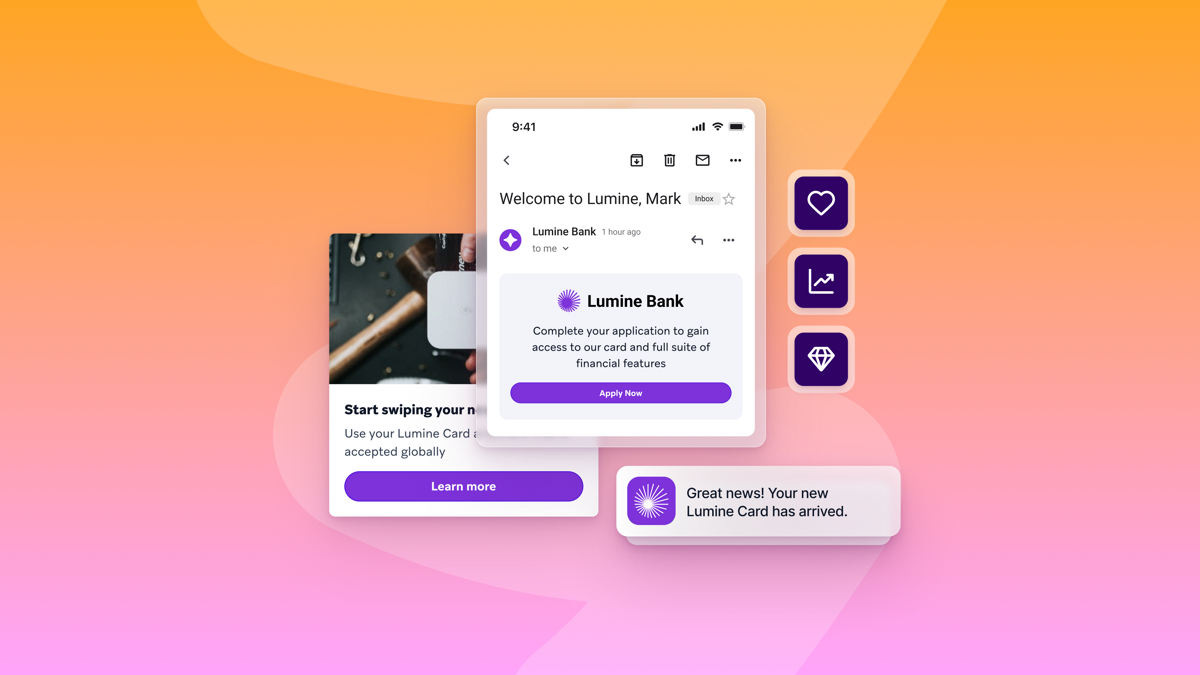
In a cross-channel customer engagement platform, each channel plays a specific role in how customers receive and respond to communication:
- Email: the channel for depth. Long-form content, detailed personalization, product recommendations, lifecycle marketing campaigns, and rich visual design all belong here.
- SMS/RCS: built for time-sensitivity. Short, direct, and fast, with open rates that make it effective for urgent offers, order updates, and transactional messages.
- Push notifications: the primary tool for urgency and re-engagement. They reach customers outside the product entirely, prompting a return at a moment the customer might not have initiated themselves.
- In-app messages: context-aware by design. Delivered at the exact moment a customer is actively using the product, making them effective for onboarding, feature discovery, and in-session offers.
- Content Cards: persistent and pull-based. Unlike push or SMS, Content Cards sit inside the app and are available when the customer chooses to engage rather than interrupting them.
- WhatsApp: conversational and two-way. In many global markets it's the primary communication channel, supporting rich media and interactive messaging that broadens what a brand can do in a single thread.
- Web messaging and audience sync: in-browser messaging reaches customers while they're on your site; audience sync connects owned engagement data to paid media, reducing ad waste the moment a customer has already converted.
According to the Mix and Match report, brands using email alongside in-app messaging, mobile push, and web push see 41.6X more sessions per user compared to email alone. The platform you choose must be able to run across all channels, not just the two that have the highest-volume.
How to build a cross-channel personalization strategy
Follow the five steps below to build a cross-channel personalization strategy with email at the center.
Step 1: Unify customer data into a single profile
Build a complete, real-time view of each customer: first-party behavioral events, purchase history, channel engagement, channel preference, and declared attributes. This is what behavioral segmentation draws from, so it needs to update as customers interact across channels, not arrive in a batch overnight.
Step 2: Map the customer lifecycle and identify channel-appropriate touchpoints
Different lifecycle stages call for different channels. A new user who just made their first purchase needs a different response than someone who hasn't opened the app in 30 days. Map those moments first, then decide which channel belongs to each one.
Step 3: Build cross-channel journeys with intelligent routing
Set up behavioral triggers to set journeys in motion: an abandoned cart, a completed session, a product viewed twice without a purchase. From there, intelligent routing selects which channel carries the next message based on where that customer has been most recently active, and the content delivered through that channel is personalized to what they've done and where they are in their lifecycle. Journey orchestration tools let you build and manage these multi-step flows without rebuilding the logic for every campaign.
Step 4: From manual rules to unified marketing platform personalization
Replace fixed conditional splits with unified marketing platform personalization. Feed the system complete, unified customer data and it tests across channel, timing, content, and frequency for each individual, learns from what drives outcomes, and adjusts over time.
Step 5: Measure with cross-channel attribution
Decide between last-touch and cooperative attribution models. Last-touch awards the conversion to the final touchpoint only, which creates double-counting in multi-channel strategies where each tool claims the same outcome. Cooperative models credit the full combination of touchpoints that contributed, showing which channel sequences drive retention, which combinations drive purchase, and where customers drop out before they convert.
Cross-channel personalization in practice
The way cross-channel personalization gets built varies considerably by industry. These four case studies show how email works alongside other channels across different contexts, and what each brand was able to achieve.
1. BlaBlaCar gets back in the driver's seat with a 30% uplift in booking conversions
BlaBlaCar is a community-based travel platform connecting over 100 million members across 22 global markets, offering rideshare and bus travel that saves an estimated 1.6 million tons of CO2 annually.
The challenge
Users were starting the booking process but dropping off before completing it. BlaBlaCar needed a way to re-engage those high-intent customers at the right moment, with the right message, on the right channel.
The strategy
Using Braze Canvas Flow, the team built cross-channel abandoned booking journeys spanning email, push notifications, Content Cards, and in-app messages. Custom event properties let them personalize each message based on exactly where a user had left the booking process, whether they were searching for a carpool, browsing a bus route, or somewhere else in the flow. Action paths held users in segments for a defined window before routing them into a personalized message sequence. Connected Content pulled relevant trip details into each email, making the outreach specific to what each user had been looking for.
The wins
- Up to 48% uplift in message click rate
- Up to 30% uplift in booking conversions, compared to non-enriched messaging
2. Peacock ruffles fewer feathers with a personalized year-in-review email that drives 20% churn reduction
Peacock is NBCUniversal's premium streaming service, offering original series, live sports, movies, and next-day access to NBC and Bravo content.
The challenge
As a direct-to-consumer streaming service, Peacock needed to keep subscribers engaged, reduce cancellations, and convert free users to paid. A high-impact campaign was needed to deepen subscriber relationships and demonstrate the value of staying ahead of a natural churn window at year end.
The strategy
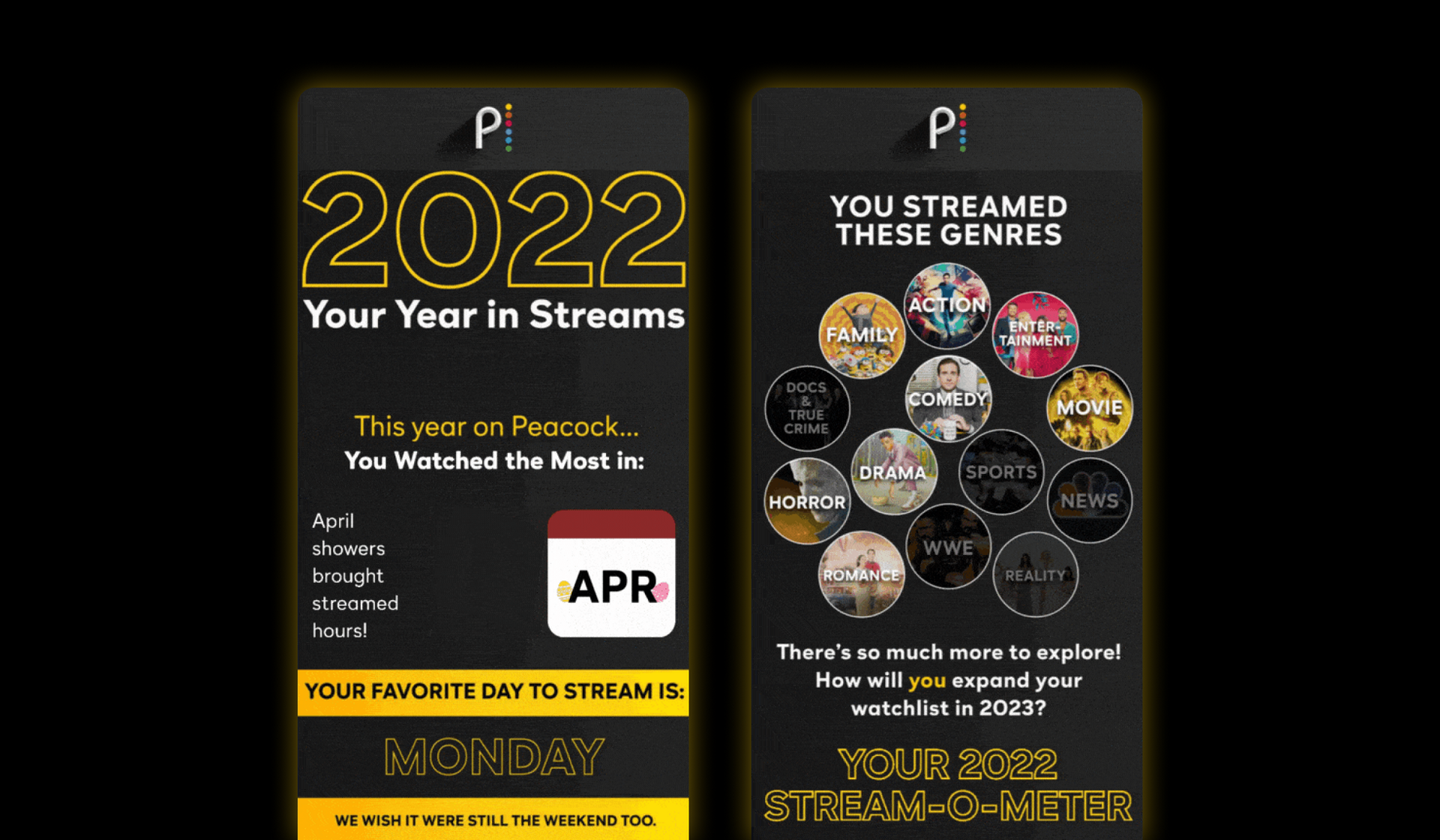
Peacock built a personalized year-in-review email campaign using Braze alongside mParticle and Movable Ink. Each subscriber received a message tailored to their actual viewing behavior: their most-streamed month, their most-watched day of the week, the genres they consumed, and the length of their biggest binge session. The audience was split into four segments based on subscription tier and recent activity, with free-tier subscribers receiving messaging specifically designed to show what a paid plan would unlock. Planning began six months before launch to align creative, targeting, and compliance with the US Video Privacy Protection Act.
The wins
- 20% decrease in churn rate over 30 days, compared to the control group
- 6% higher upgrade rate from free to paid subscriptions, compared to the control group
- 2-point lift in return rate to view content, compared to the control group
3. Paying dividends: Legal & General drives 220% uplift in meaningful actions with cross-channel personalization
Legal & General (L&G) is a global UK-based financial services group listed on the FTSE100, serving customers across pensions, investments, protection, and insurance.
The challenge
L&G's long history came with a modern infrastructure cost: siloed technologies, disconnected CRM platforms, and batch processing that introduced delays where customers needed speed. Without a unified data layer, the team couldn't deliver the kind of personalized, real-time engagement their customers' financial journeys required.
The strategy
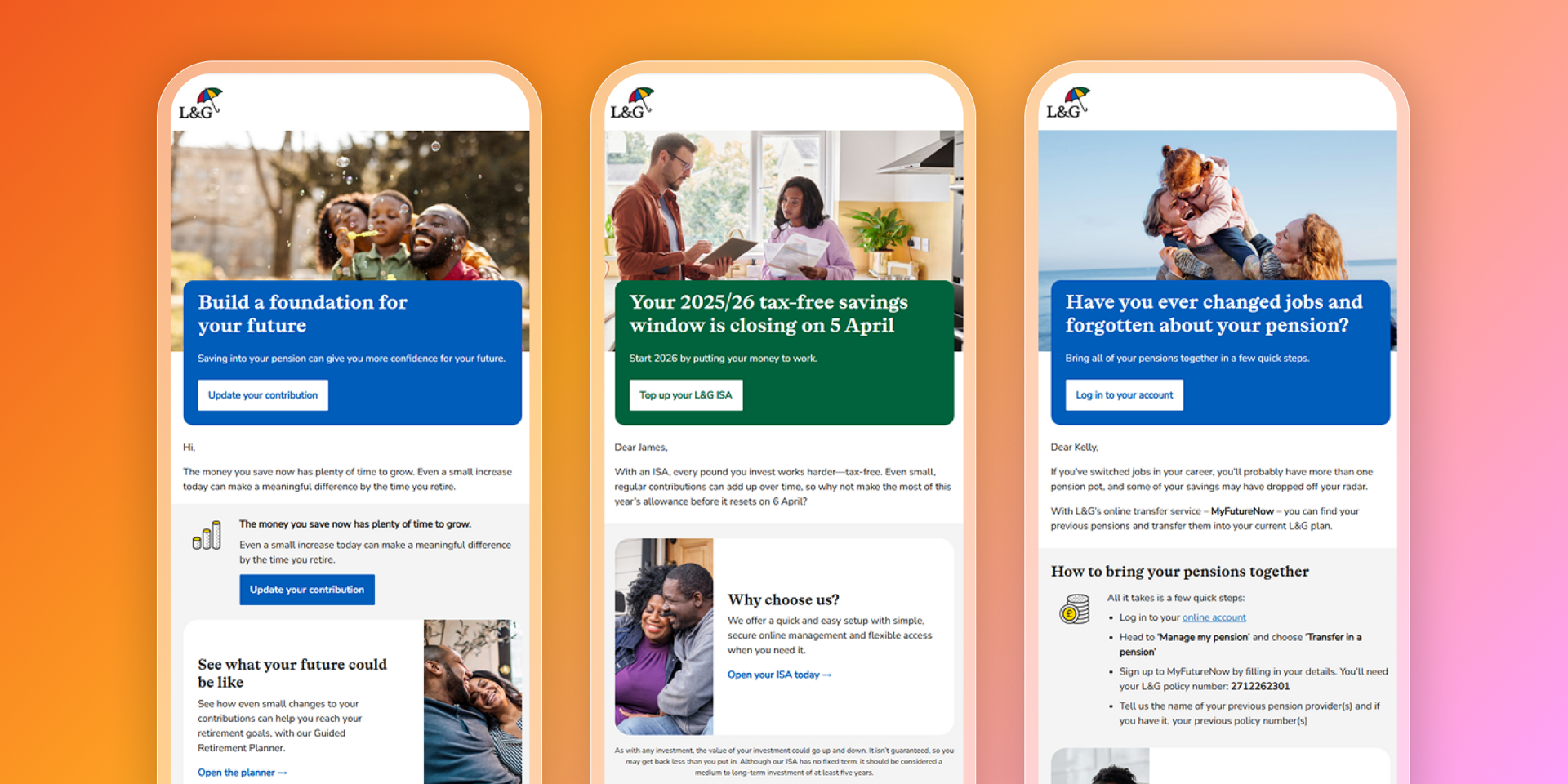
L&G implemented Braze alongside Tealium as their CDP, creating unified real-time customer profiles that feed into cross-channel journeys across email, SMS, mobile push, and Content Cards. Braze Canvas orchestrates multi-step experiences routed by each customer's lifecycle stage, product holdings, and real-time behavior. Content Cards power personalized financial guidance within the pension app, tailored by lifestage and engagement history. A targeted message to eligible customers for pension consolidation—using a single prioritized communication to the most relevant segment— showed what precise audience targeting can do to product adoption.
The wins
- 30% increase in engagement compared to previous email capabilities*
- 220% overall increase in meaningful actions from email activity*
- 17% increase in users completing the pension consolidation journey, compared to non-targeted messaging
- 125% increase in digital registrations
- 85% increase in app downloads
*Results measured against prior non-personalized or control cohorts
4. Bucket list results: KFC India's "Bucket It" campaign drives 23% daily revenue uplift
KFC India operates over 1,000 locations across India and is one of KFC's key global growth markets.
The challenge
KFC India wanted to increase app engagement, drive more purchases from existing customers, and grow their user base, all without adding significant technical resources to execute.
The strategy
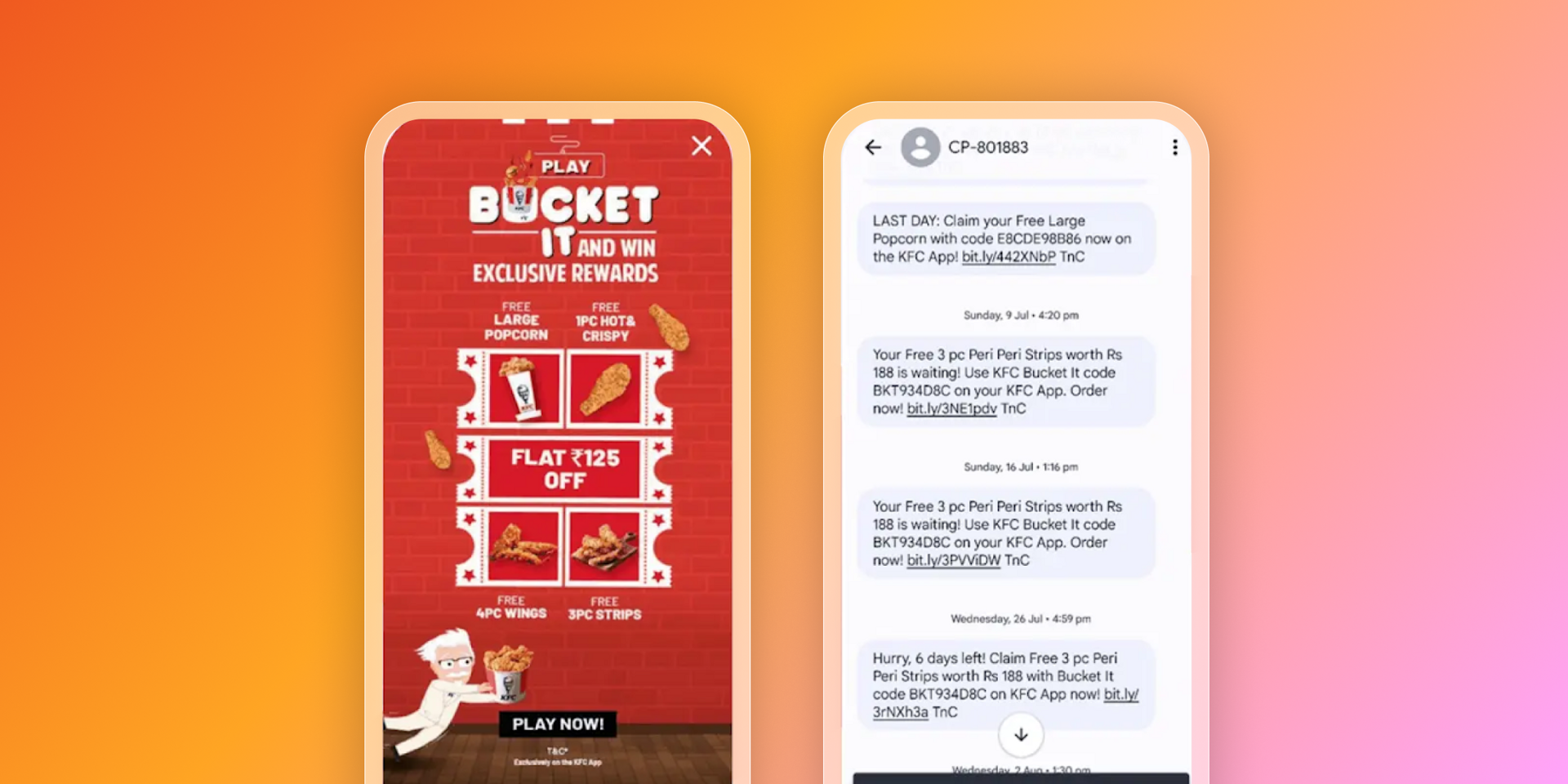
KFC India launched a gamified "Bucket It" campaign running simultaneously across email, push notifications, in-app messages, and SMS, with each channel playing a distinct role in the sequence. Email and SMS were sent biweekly to users who hadn't redeemed rewards; push notifications went out daily to the same audience; in-app messages appeared daily to redirect users to the game. Every message was personalized using Liquid, including individual coupon codes and offer attributes. The campaign was built and launched in under 10 days.
The wins
- 22% increase in average daily orders per store
- 23% lift in daily revenue per store
- 22% growth in new users
- 27% growth in repeat orders
- 3X increase in game sessions driven by in-app message redirect
- SMS drove 20% higher conversion rate than that month's average SMS campaign performance
What about offline channels?
Digital channels cover most of the customer journey, but not all of it. Through webhook integrations with direct mail partners like Inkit and Lob, brands can include physical mail in the same behavioral trigger logic that fires digital messages.
A customer who has browsed a product category repeatedly without purchasing, or a high-value member showing signs of lapsing, can automatically receive a personalized piece triggered by the same Canvas workflow that would send a push notification or email. The channel is different, but the data and trigger logic are the same.
From manual rules to AI-powered personalization
Rule-based channel selection, "if email not opened after 24 hours, send SMS," is how most platforms still work. It's a reasonable starting point. But rules are fixed at the moment someone writes them, they don't adapt as customer behavior changes, and as the channel count grows, the number of rules required to cover every combination becomes unmanageable.
Why consolidating email marketing channels unlocks AI decisioning
AI decisioning needs a complete data foundation. When each channel holds its own slice of engagement history, any system making channel decisions is working from a partial picture. Consolidating email marketing channels onto a single platform creates the unified customer profile AI decisioning requires across every touchpoint.
According to the 2026 Global Customer Engagement Review, only 33% of marketing leaders say their content is assembled for each user at the moment of engagement. With a unified foundation in place, BrazeAI Decisioning Studio used AI decisioning agents to simultaneously optimize across channel, timing, content, offer, and frequency for each individual customer, running continuous experiments and learning from outcomes as they happen. The agents keep learning. As the number of channels grows, the system improves rather than breaks down.