
Conversational marketing: What it is and how to do it
Published on August 25, 2026/Last edited on August 25, 2026/14 min read


Team Braze
BrazeConversational marketing is a customer-centric approach built on real-time, one-to-one, two-way conversations across channels like chat, messaging apps, SMS, and email. Rather than broadcasting one message to everyone, it engages each person individually.
Search habits are moving the same way. Google's AI Mode passed 1 billion monthly active users within a year of launch, and people who have learned to ask a search engine follow-up questions expect the same back-and-forth from brands.
This guide covers what conversational marketing is, the channels and examples that define it, the benefits worth measuring, how AI agents are changing what's possible, and how to build a strategy of your own.
TL;DR
- Conversational marketing engages customers in real-time, two-way dialogue on their preferred channel, rather than broadcasting one message to a segment and waiting for a response.
- Four things make it work: Asynchronous timing, a split between automation and people, customer context carried between interactions, and the customer's choice of channel.
- Chatbots, live chat, WhatsApp and Messenger, SMS, and reply-enabled email each handle a different moment in the journey. Rappi saw an 80% increase in purchasing users through WhatsApp, and Pazza Pasta drove six times the purchase rate of the same campaign on email.
- This means faster answers for customers, first-party data no analytics tool would produce, and higher conversion, with two-way messaging driving a 17% higher session start rate than one-way across Braze customers.
- AI agents make it scalable by responding in real time and carrying context across channels, but a strategy still needs a business goal, segmented audiences, a unified customer profile, and continuous measurement.
What is conversational marketing?
Conversational marketing is the practice of engaging customers in real-time, personalized, two-way dialogue across the channels they already use, rather than sending one message to a broad audience with no back and forth. It spans website chat, messaging apps, SMS, and email that accepts replies.
The exchange happens in real time, so a customer gets an answer immediately and what the customer says shapes what comes next. It's personalized to the individual too, with AI drawing on what the brand already knows about them and making 1:1 conversation possible at scale.
In contrast with broadcast marketing, a campaign is built once, scheduled, and sent to a segment. Success is measured by how many people in that segment opened, clicked, or converted.
Conversational marketing measures and optimizes the individual exchange.
The key elements of conversational marketing
Conversational marketing happens asynchronously, on customer-time. It scales through a mix of automation and people, carrying customer context and meeting individuals on the channels they already use.
Let’s break that down:
It happens on customer-time
A conversation belongs to the customer's schedule, not the brand's. Someone can ask a question at 11 p.m., go to bed, and pick the thread up on their commute the next morning without starting over.
The thread has to survive the gap, and it has to survive the customer switching devices partway through.
It scales through automation and people
No brand can staff one-to-one dialogue with its entire customer base. Automation handles the high-volume, predictable interactions, like order status, sizing questions, opening hours, and returns policy.
People take on the situations that need judgment, whether that's a complaint, a complex purchase decision, or anything with an emotional charge to it. When a customer gets passed to a human, the transcript and the account history travel with them, so the person picking it up starts where the automation left off.
It carries customer context
Every conversation should start with what a brand already knows, such as previous purchases, browsing behavior, support history, channel preferences, and loyalty status. CRM and first-party data allows replies to be useful rather than generic, and stops customers from having to repeat themselves.
It meets customers on the channel they already use
A customer who prefers WhatsApp should be able to reach you there, and one who prefers SMS marketing shouldn't have to install anything to get an answer.
Preference also varies by moment, not just by person. The same customer might want a push notification for a delivery update and a live chat window for a returns question.
Conversational marketing channels and examples
Conversational marketing runs across chatbots, live chat, messaging apps, SMS, and email that accepts replies. Each suits a different moment in the customer journey.
Conversational marketing chatbots and live chat
Take a look at how chatbots and live chat help build a relationship with customers.
Chatbot and live chat use cases
A chatbot handles first contact on a website or in an app, answering common questions, tracking orders, and narrowing a large catalog down to a few relevant options. Quiz-style flows work well here, asking two or three questions around product related specifics, like skin type, budget, or fit, then returning a short list instead of a category page. Chatbots also handle the routine questions a business hears constantly, like delivery times or return policy, without sending the customer to a separate help page.
Live chat covers what automation shouldn't, such as a frustrated customer, a charge dispute or a decision about which product is best. The chat window creates a handover without forcing them onto a phone line. Integrations like Front carry the customer's history across that transition, so the agent picking up the thread can see what the automation already covered.
Stori turns payment reminders into page-turners: Real-life example
Stori is a Latin American fintech offering digital financial products to people underserved by traditional banking, with a mission built around financial inclusion across the region.
The challenge: Several of Stori's processes were awkward for customers to navigate, including updating profile details and finding account information like balances and payment due dates.
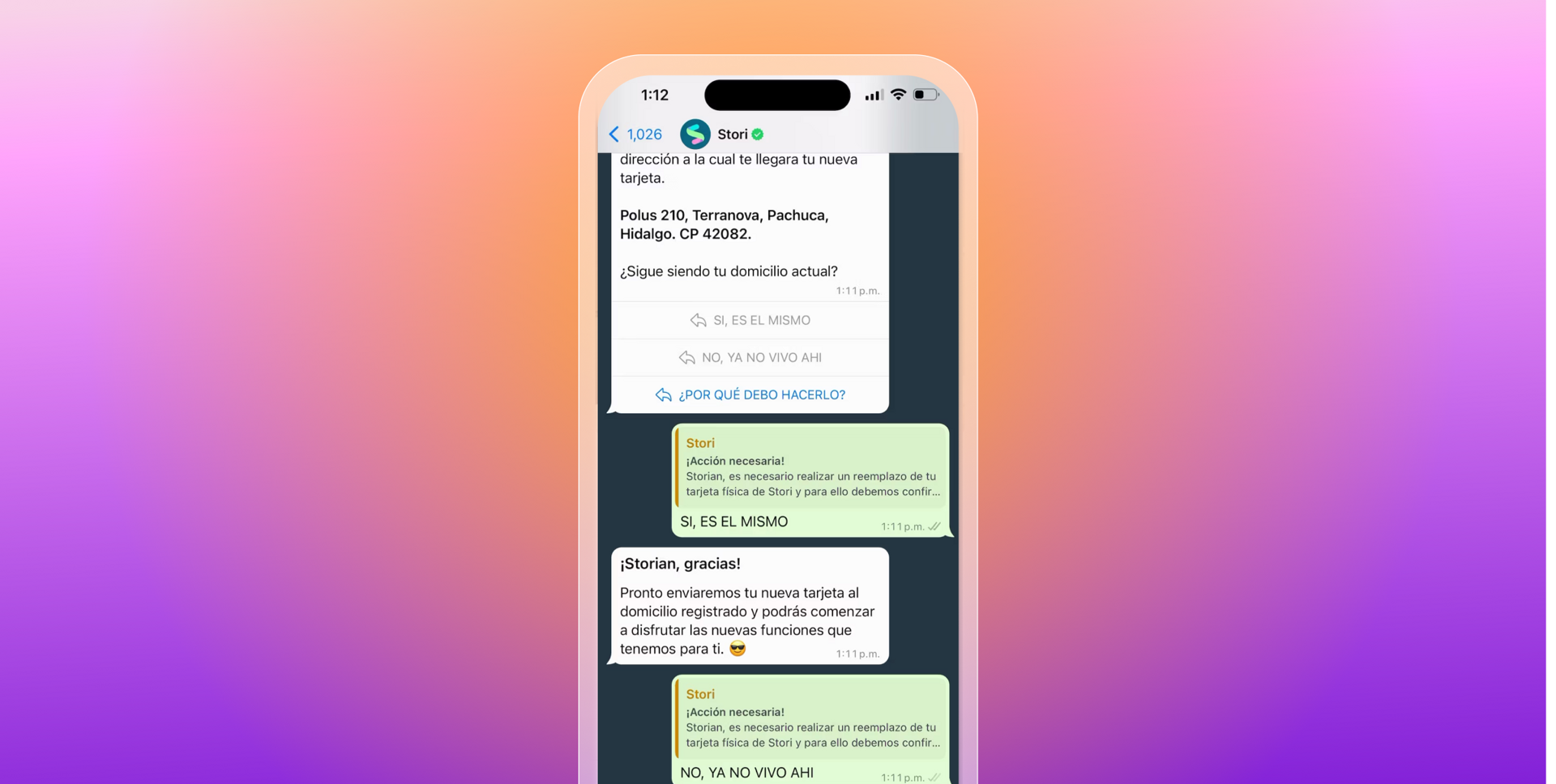
The solution: Stori built a WhatsApp chatbot that turns a payment reminder into an interactive exchange, passing quick-reply responses back into Braze to keep the conversation moving. A companion campaign lets customers update their address for a card replacement in a single tap inside the message thread.
The results: The chatbot drove three times the response rate of push notifications, and the address update flow converted 26% higher than the equivalent in-app process.
Messaging apps and click-to-message
Messaging apps move the conversation onto platforms customers already have open. WhatsApp and Facebook Messenger both support branded conversations, and click-to-message ads open a chat thread directly rather than sending someone to a landing page, which removes the form-fill step between interest and contact.
Read rates on these platforms tend to run well above email, which is both the opportunity and the constraint. A message that lands next to one from someone's family has to be worth the intrusion, so the channel rewards relevance and punishes volume.
Rappi wraps up lapsed users for an 80% purchase uplift: real-life example
Rappi is the Latin American superapp that connects consumers to couriers for groceries, food, prescriptions, and more, serving more than 300 cities across nine countries.
The challenge: Rappi needed an out-of-product channel to reach lapsed users that its push and email programs weren't reaching, and to drive more frequent purchases from active ones.
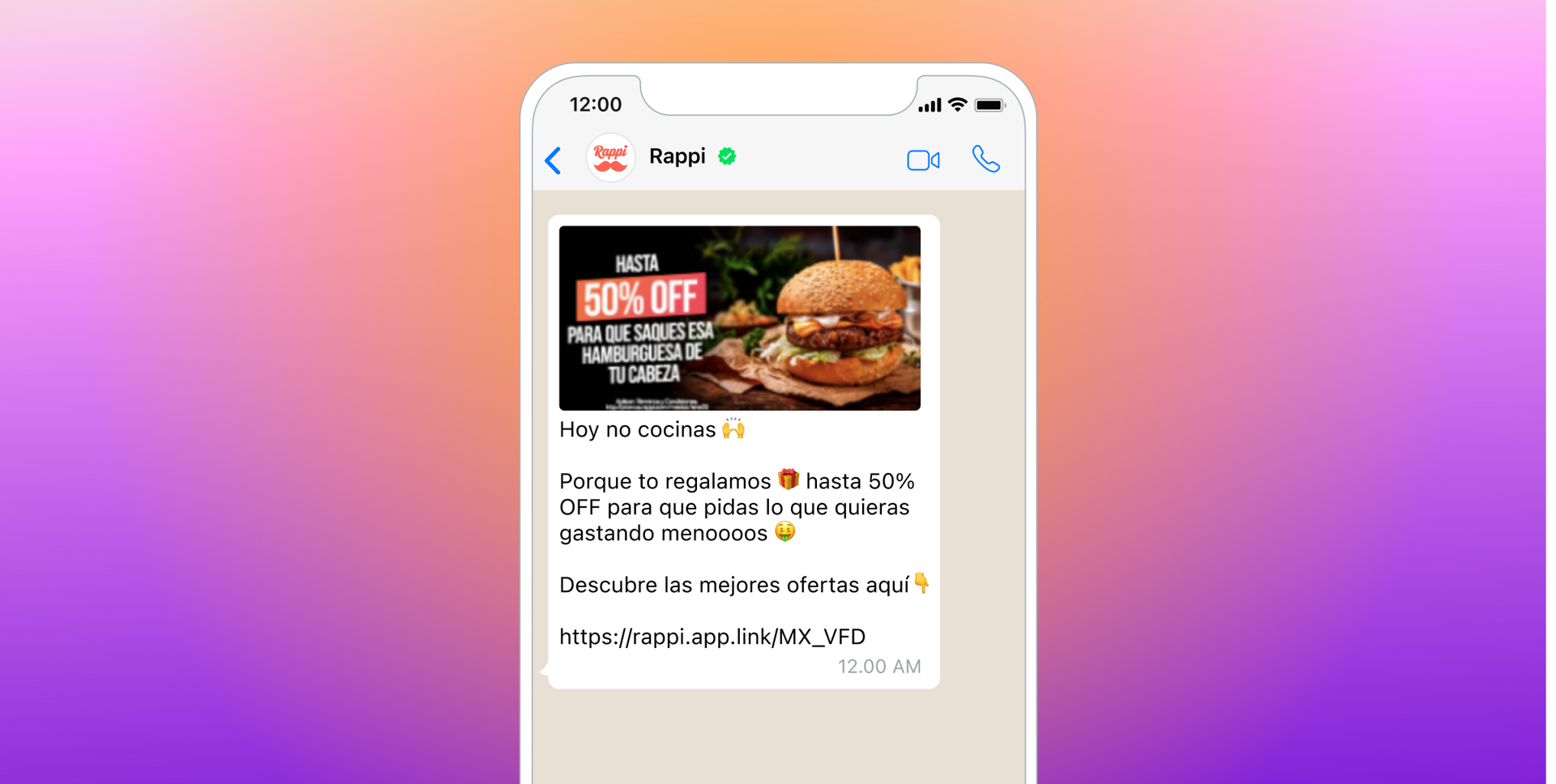
The solution: The team segmented its audience into active and lapsed users, then sent personalized deals over WhatsApp based on individual user data, running the campaigns alongside its existing push and email journeys.
The results: The reactivation segment saw an 80% increase in users who made a purchase against a control group receiving the same offers by push and email alone, with a 43% lift in users who returned and purchased twice or more within 30 days.
Floward's WhatsApp campaign comes up roses: real life example
Floward delivers flowers and gifts online across MENA and the UK, built around occasion gifting and a high standard of customer service.
The challenge: Floward faced high new user churn and weak re-engagement among lapsed customers heading into its peak Valentine's Day season.
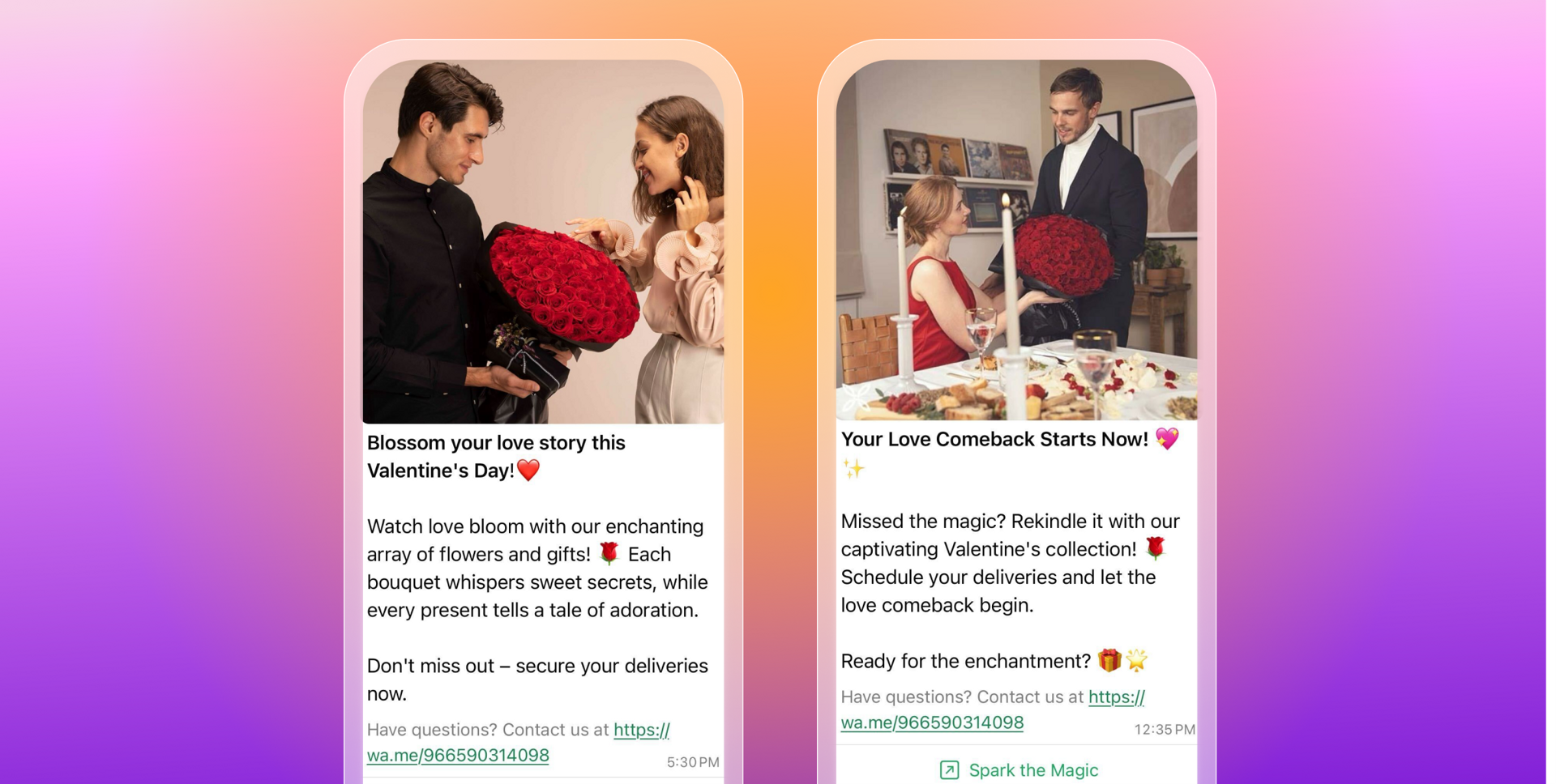
The solution: The team ran a cross-channel campaign across WhatsApp, push, in-app messaging, and email, using recency, frequency and monetary (RFM) analysis to segment customers and tailor content by market and cohort.
The results: WhatsApp generated the highest revenue and conversion rates of every channel used, with a 55% read rate and a 21% increase in positive reviews.
Pazza Pasta cooks up 6X purchase rates: real-life example
Pazza Pasta is a food delivery brand from Germany's Circus Group, founded to combine robotics and proprietary software with fresh, affordable meals.
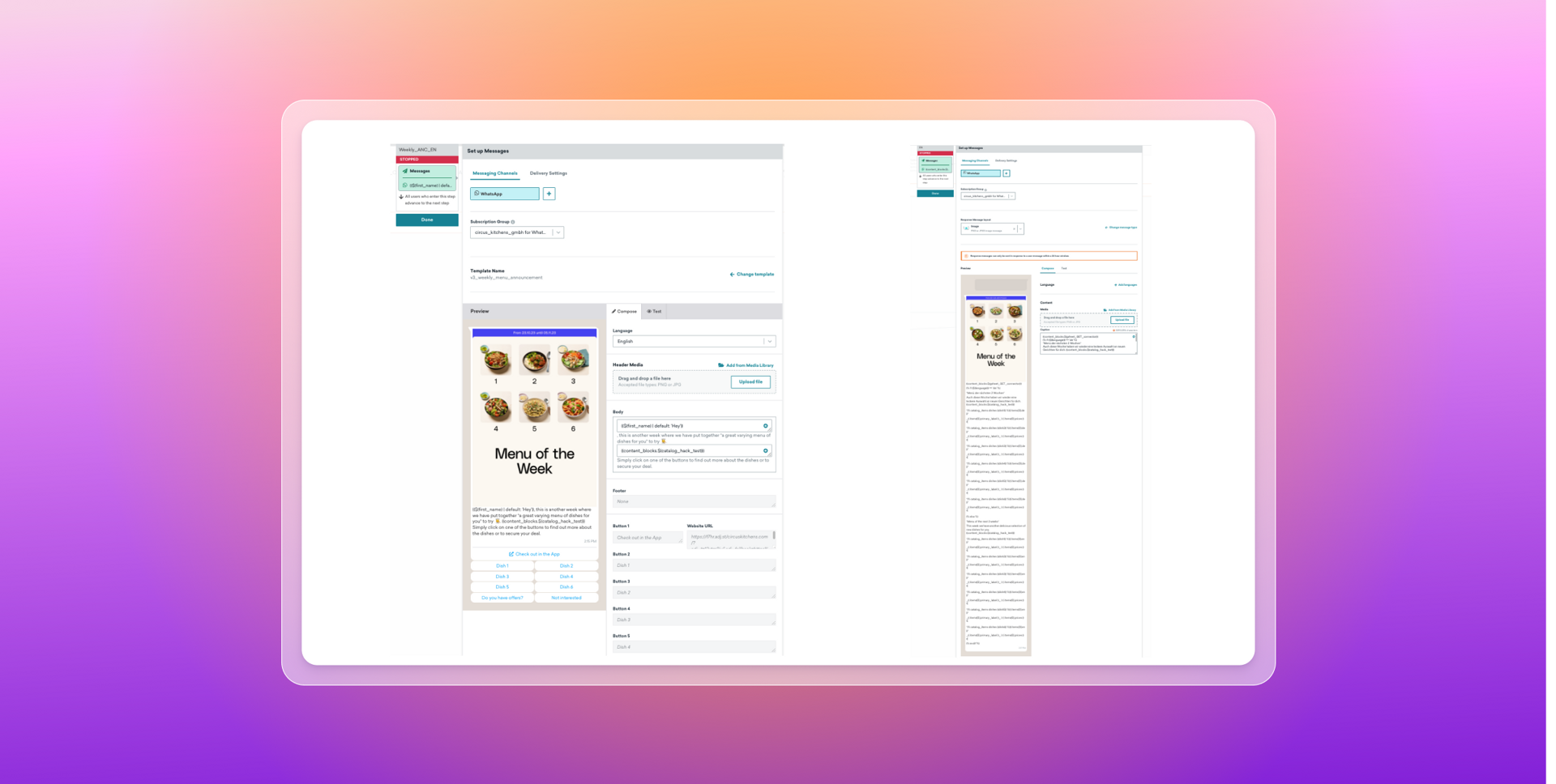
The challenge: With a CRM team of two, Pazza Pasta wanted to expand into WhatsApp without the resource load that usually comes with launching a channel.
SMS and reply-enabled email
SMS earns attention because it’s where personal messages arrive, which makes it suited to time-sensitive updates like deliveries, appointments, and payment reminders. Those messages become conversational when replies go somewhere, so a customer can respond "change my address" rather than logging into an account to do it.
Email is the channel most often left one-way, usually because the from-address is a no-reply. Switching to a monitored address and inviting responses turns a broadcast into an opening, and the replies themselves are first-party data about what customers actually want.
sweetgreen dresses up SMS for 10,000 new subscribers: real-life
sweetgreen is the fast-casual chain known for salads and grain bowls made from scratch, serving lunch and dinner crowds across around 100 US restaurants.
The challenge: After launching its own delivery app, sweetgreen needed to move customers away from third-party delivery services and toward ordering direct.
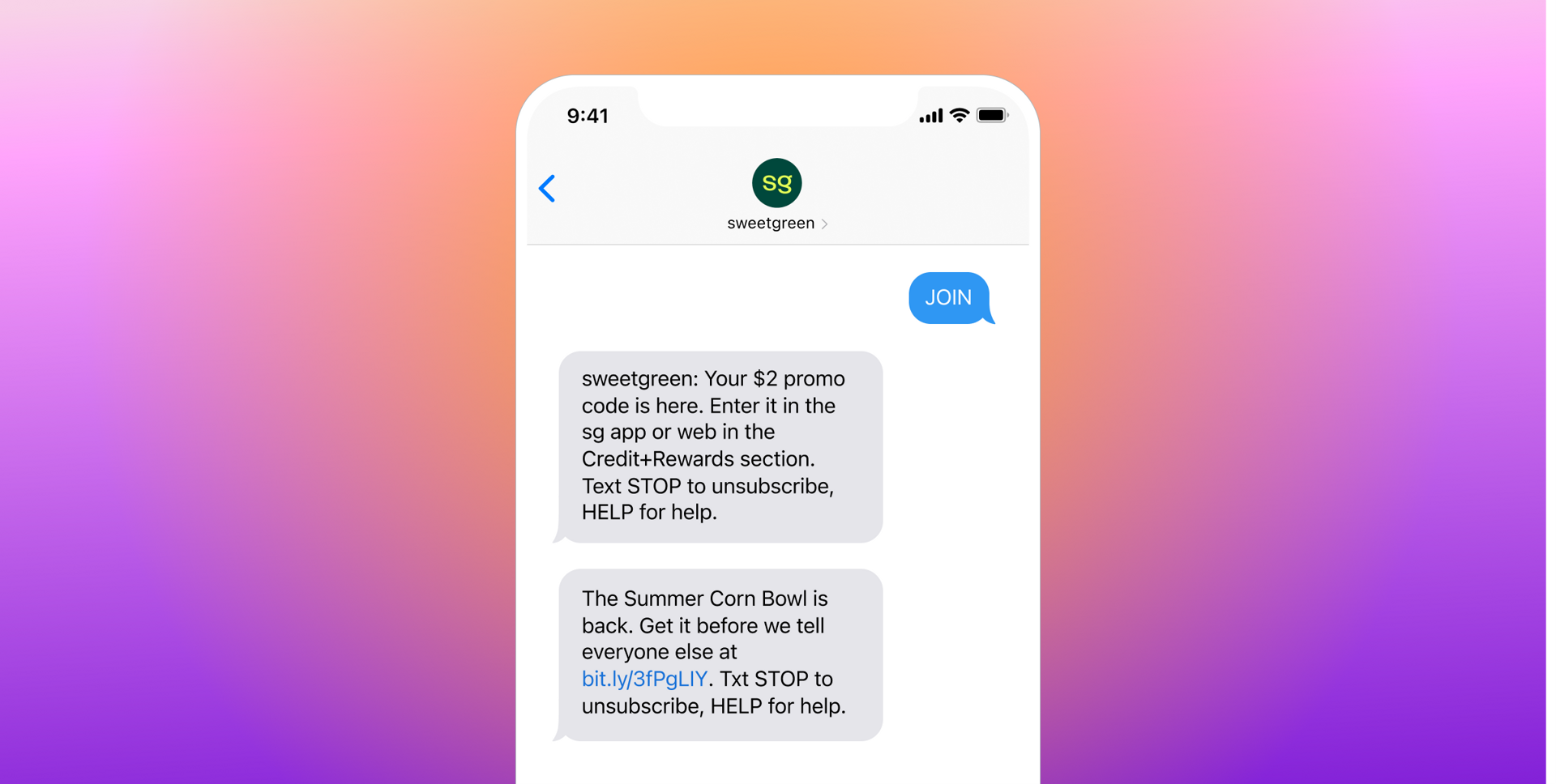
The solution: Customers who downloaded the app and opted in to SMS received a welcome email inviting them to order direct, and anyone who didn't respond was sent a text with a promo code for money off an in-app order.
The results: The campaign added more than 10,000 new SMS subscribers and drove a 10% order rate.
Benefits of conversational marketing
Conversational marketing gives customers a more delightful, mobile-friendly way to get answers, produces richer first-party insight from real conversations, and shortens the path from interest to purchase. Each maps to a business outcome.
Better, faster customer experience
A question answered inside the thread the customer is already in removes every step that usually sits between them and an answer. No hold music, no contact form, no hunting through a help center. On a phone, this difference decides whether someone finishes what they started.
Expectations have already moved this way. McKinsey's 2026 State of the Consumer survey found that 60% of Gen Z regularly use the AI summary at the top of search platforms, against 29% of baby boomers, making conversational answers the default way younger customers get information.
The business outcome: Fewer abandoned journeys and lower support cost.
Richer first-party insight and stronger relationships
Behavioral data tells you what someone did. A conversation tells you why. When a customer types "I need this before Friday" or "the last one ran small," they are volunteering information no analytics tool would have inferred.
A direct line to customers is getting harder to hold. McKinsey's 2026 research notes that large retail platforms and marketplaces offer scale and conversion but limit brands' direct access to consumer data and relationships, which makes conversations one of the few places a brand still owns both.
The business outcome: Sharper personalization at scale and stronger loyalty, built on data customers chose to give you.
Higher engagement and conversion
Two-way messaging outperforms one-way messaging on the metrics that precede revenue. Across Braze customers, two-way conversational messaging drove a 17% higher session start rate than one-way messaging.
A customer weighing a purchase has a specific question standing between them and checkout, and answering it in the moment converts better than a follow-up email the next day.
The business outcome: Higher conversion rates on messages you already send, and a faster path from interest to purchase.
How AI agents are reshaping conversational marketing
The first wave of conversational marketing ran on live chat and scripted bots, which meant every conversation started from zero and anything off-script went to a queue. AI agents change what a brand can hold a conversation about, and how many it can hold at once.
From live chat to AI agents carrying context
An AI agent arrives at the conversation already knowing the customer. It can read the account history, the last three orders, the abandoned basket, and the support ticket from March, then respond in natural language to whatever the person actually asks.
The context travels across platforms too. A question asked in WhatsApp on Tuesday informs the email that goes out on Thursday, and a customer who explains their situation once doesn't explain it again in a different channel.
New search habits are pulling customers toward this, as AI modes become the default. Sundar Pichai described Search at Google I/O 2026 as having become less about individual queries and more like an ongoing conversation, and people who have learned to interrogate a search engine that way bring the same expectation to brands.
Two-way marketing and engagement at scale, with human input
Adoption is moving quickly. The 2026 Braze Customer Engagement Review found that 19% of consumers currently use AI agents to interact with brands, a figure expected to reach 46% by the end of 2026.
BrazeAI™ Agents generate and localize content from customer attributes and event data, segmenting in real time, and converting unstructured inputs like chat messages and survey responses into structured customer data through BrazeAI Agent Console™.
Human input is still important though. The same research found that 27% of consumers refuse to share any data with AI agents, even when offered a better experience in return, so complaints, high-value decisions, and anything with an emotional charge belong with a person. An agent that recognizes its own limit and routes the conversation onward, with the transcript attached, protects the relationship rather than testing it.
Generative AI compared with AI decisioning
Generative AI and AI decisioning work together on different problems, and conversational marketing needs both.
Generative AI drafts many versions. It writes the reply, adapts the tone, translates the message, and produces variants at a speed no copywriter can match. What it doesn't do is decide whether that message should be sent, to whom, on which channel, or at what moment.
AI decisioning makes that call. BrazeAI Decisioning Studio™ draws on hundreds of customer characteristics to make 1:1 decisions that optimize any business KPI, selecting the channel, product, offer, creative, timing, and frequency for each individual, with every decision traceable back to the customer-level reasoning behind it.
How to build a conversational marketing strategy
A conversational marketing strategy holds together when conversations are tied to a business goal, aimed at defined segments, grounded in a unified customer profile, coordinated across channels, and measured continuously. It belongs inside your wider customer engagement program rather than running alongside it as a separate experiment.
1. Align conversations to business goals
Decide what the conversation is for before you decide where it happens. Recovering abandoned baskets, reducing support volume, converting trial users, and reactivating lapsed customers are different objectives that produce different conversations.
2. Segment audiences for personalized dialogue
A new customer, a loyal one, and someone who hasn't opened anything in six months should not be entering the same conversation. Segment before you build, using behavior, lifecycle stage, value, and channel preference, then design a distinct entry point for each.
3. Ground every conversation in context
Conversations should draw on a unified customer profile rather than starting from whatever the current channel happens to know.
Most teams are not there yet. The 2026 Braze Customer Engagement Review found that while 60% of marketers use AI to support personalization across channels, nearly half lack the tools to orchestrate coordinated experiences across them.
4. Build seamless transitions across channels
A conversation should survive changing venue. Someone who starts in a website chat window and finishes over SMS should find the next message reflects what they just said. That context is the practical difference between multichannel messaging and cross-channel engagement.
5. Measure and optimize continuously
Track response rate, resolution rate, time to answer, handoff rate, and conversion by segment and by channel.
Then test the parts that move. Opening messages, quick-reply options, timing, and the threshold at which a conversation goes to a person are all variables worth running experiments against.
How Braze powers conversational marketing
Conversational marketing asks four things of a platform: cross-channel orchestration, a profile that carries context between them, AI that can respond and decide in real time, and a way to test and optimize what works.
Braze handles cross-channel messaging across email, push notifications, in-app messages, SMS, and WhatsApp from one place, and inbound message processing picks up replies and quick-reply selections as they arrive, which is what turns a send into an exchange.
A unified customer profile updates on live behavior underneath all of it, so what someone says in WhatsApp on Tuesday is available to whatever you send them on Thursday.
Real-time engagement and personalized two-way marketing is where AI agents and decisioning come in. BrazeAI™ Agents is the foundation, helping brand automate conversations, personalize copy, and transform unstructured data into powerful messaging. BrazeAI Agent Console™. BrazeAI Decisioning Studio™ then personalizes everything at scale, based on first-party data and advanced experimentation across multiple variants at once.
A/B and multivariate testing cover content, timing, and journey paths, and reporting on sends, deliveries, reads, and conversions feeds back into the journeys so you can optimize as you go.
See how Braze helps brands turn one-way campaigns into real-time, cross-channel conversations.
Releated Content
View the Blog
Cracking Microsoft: A deep-dive into Outlook and Hotmail deliverability

Steve Butcher
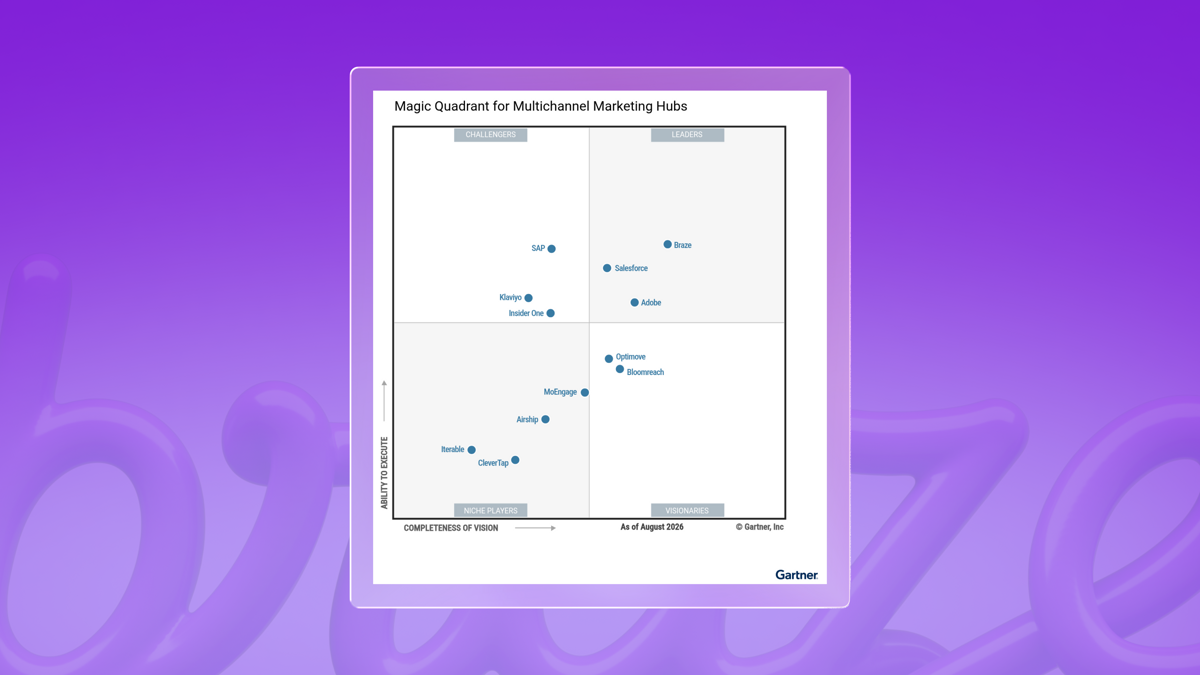
Braze named a Leader in the 2026 Gartner® Magic Quadrant™ for Multichannel Marketing Hubs
Team Braze

Email deliverability 101: What actually goes into a healthy email program