
Best customer engagement platforms for startups
Published on April 22, 2026/Last edited on April 22, 2026/7 min read


Team Braze
Building a customer base is one thing. Keeping those customers engaged as that base grows is where most startups hit a wall.
A customer engagement platform is software that helps companies deliver real-time, personalized messaging across channels like email, push, SMS, and in-app, from a single interface. For startups, with small teams and tight budgets, the choice of platform can have serious consequences. Founders are often delighted with how fast they grow but surprised by how unscalable their systems are. Early choices about customer engagement software shape the channels you can use, the automation and AI-driven personalization available, how well data integrates, and the speed and deliverability your brand can achieve as it grows.
Choose the wrong platform and you'll find yourself migrating to another one at exactly the moment you can least afford the disruption. Here's how to evaluate the best customer engagement platforms for startups.
TL;DR
- Startups have fundamentally different platform requirements to enterprises. Speed of implementation, lean team operability, and pricing that scales with growth all matter more than feature lists
- Choosing a lightweight platform or point solution early often forces a costly re-platform at exactly the moment growth is accelerating
- A customer engagement platform does something different to a CRM. It activates customer data to deliver personalized, real-time messaging across channels, and that distinction matters from day one
- The right platform choice depends on where a startup is in its growth, but the core criteria remain consistent: cross-channel capability, marketer-operable automation, flexible data integration, and scalability
Key takeaways
- Platform decisions made early have long-term consequences. The data architecture and channel coverage built in from the start determine what becomes possible as the business grows.
- A platform that requires engineering support to build journeys or launch new channels will slow a lean team down at every stage.
- Switching platforms mid-growth is expensive in ways that go beyond the financial. Rebuilding journeys, reconnecting data, and retraining teams all consume time and resources that a scaling startup can't afford to lose.
What should startups look for in a customer engagement platform?
When choosing a customer engagement platform, startups should prioritize solutions that align with their unique challenges and growth stages. McKinsey research suggests that 78% of companies that have successfully built a product and found product market fit fail to scale. Unlike enterprises, startups need platforms that offer flexibility, ease of use, and scalability without overwhelming complexity.
Many platform comparisons focus solely on features, but startups should evaluate how those features support rapid iteration, cost efficiency, and the ability to adapt quickly as they grow. Understanding these distinct criteria can help startups select a platform that not only meets their immediate needs but also supports sustainable scaling.
1. Speed to value
latform implementations can take months before a single campaign goes live, and for a startup, that timeline can have competitive consequences. Audiences shift and habits form early. Startups can end up missing the window to establish meaningful customer relationships.
2. Lean team operation
Startup marketing automation is almost always run by small teams, sometimes a team of one, covering channels, content, data, and campaigns simultaneously. A platform that requires engineering support to build journeys, connect data sources, or launch a new channel adds overhead and extends campaign creation time that most startups can't absorb.
3. Budget sensitivity combined with growth trajectory
A pricing model that works at 10,000 users but becomes unworkable at 500,000 will force a re-platform at precisely the moment growth should be accelerating.
4. Channel flexibility
It takes time and experimentation to discover which channels an audience responds to. A platform that makes channel changes slow or technically complex removes one of the biggest advantages a startup has over larger, more established competitors — the freedom to move fast and change direction without bureaucracy or legacy constraints holding it back.
5. Data integration flexibility
Startups build their technology stacks from scratch, which means the platform needs to connect cleanly to modern tools like data warehouses and eCommerce platforms from day one. Data that can't flow freely between systems limits what personalization and automation can do.
What is a customer engagement platform?
Unlike a CRM, which manages customer records and sales relationships, a customer engagement platform activates that data to deliver relevant experiences at scale, across the full customer lifecycle.
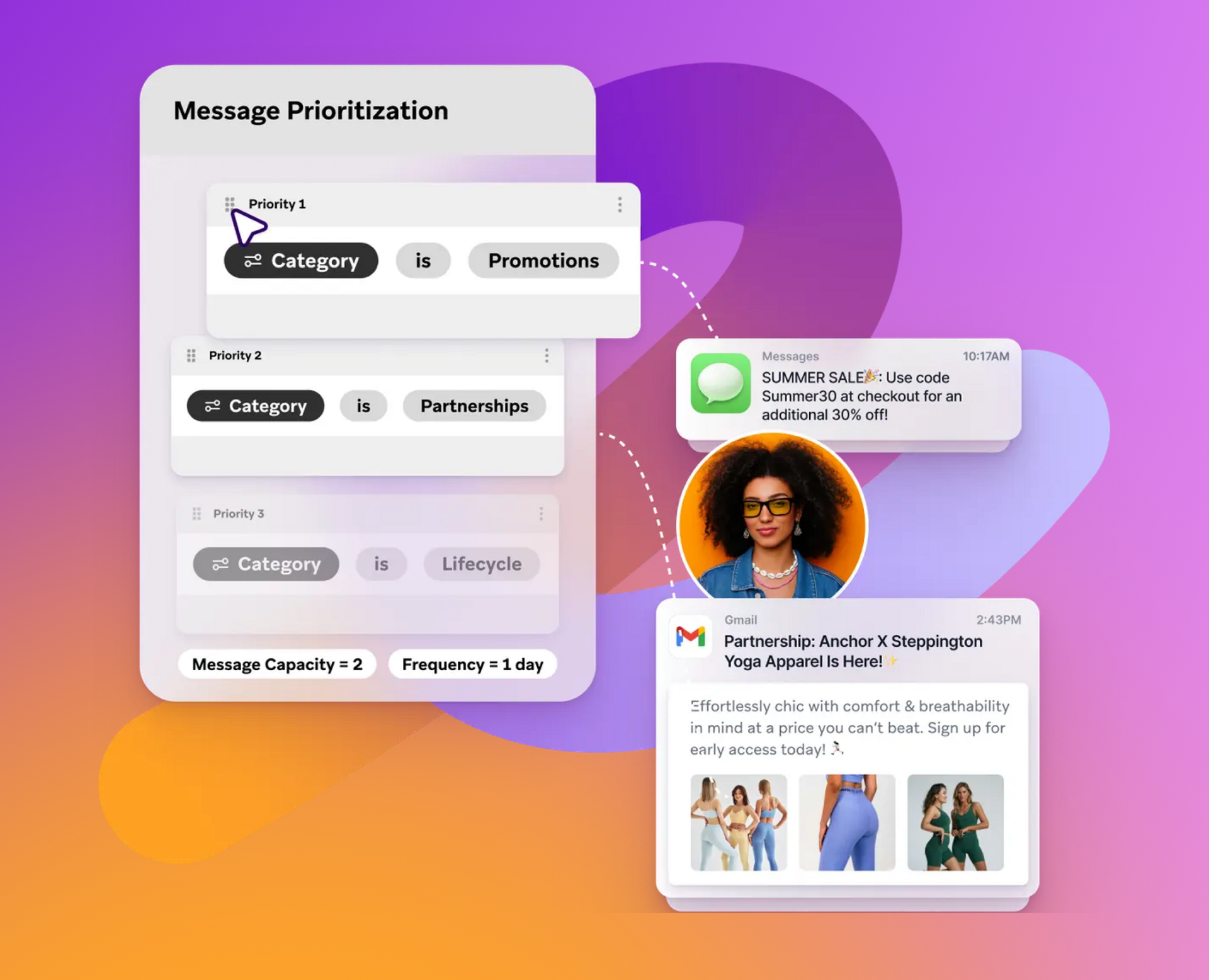
For startups, the timing of this decision has long-term consequences. The data architecture and channel coverage built into a platform early on determines what the team can actually build as the customer base grows. A platform without flexible data integration or cross-channel lifecycle automation will limit the entire growth marketing strategy before the company has had a chance to find its footing.
Key themes to evaluate as a startup
Choosing the best customer engagement platform as a startup means looking past feature checklists and asking whether a platform can operate the way a startup operates. This framework covers the key themes to evaluate when making that decision.
Cross-channel messaging capability
Startup audiences engage across email, push, SMS, and in-app messaging, often in different combinations depending on the product and growth stage. For many startups, mobile-first engagement is hugely important. The platform should make adding and switching channels straightforward as the strategy develops.
Journey building and lifecycle automation
For lean teams, the ability to build and automate customer journeys without relying on engineering resources is one of the most important considerations. From onboarding engagement through to retention, if a marketer can't set up a lifecycle automation sequence independently, the team loses speed and flexibility every time a campaign needs to launch or change.
AI-assisted personalization and experimentation
Generative AI features such as content generation and subject line optimization help teams produce better messaging faster. AI-driven optimization goes further, selecting the best channel, timing, and message for individual customers based on how they behave. Both have value, but understanding if and how a platform offers these, determines the level of personalization that can realistically be achieved.
Data integration flexibility
Startups need platforms that integrate cleanly with the rest of their tech stack so that customer data can flow freely across the stack and power meaningful segmentation and automation from early on.
Transparent, scalable pricing
Pricing structures that obscure true costs or penalize growth create problems that compound quickly. Startups need clear visibility into what a platform will cost as their audience grows, so that pricing never becomes a reason to delay or limit engagement with customers.
Onboarding speed and time-to-first-campaign
How quickly a team can move from implementation to live campaign is a practical measure of platform efficiency. Going from idea to execution should never be a bottleneck. Marketer independence is key. The faster a team can test new ideas and launch campaigns without relying on technical handoffs, the sooner customer engagement software delivers measurable value and drives business impact.
How to choose the right platform based on your startup's stage
Customer engagement platform decisions made under pressure tend to prioritize the immediate problem over the longer-term one. It's understandable, but it's also where many startups create a much bigger headache for themselves later.
The problem tends to surface months later, when the customer base has grown, the team has expanded, and what the platform can do no longer matches what the business needs.
Sending a single-channel campaign is one thing. Building personalized, multi-step journeys that respond to how individual customers behave across different channels is another. When a platform can't support that evolution, the team faces switching to a new one. This means rebuilding everything they've already created, reconnecting their data, and learning a new system, all while trying to keep existing customers engaged and campaigns running.
Related Tags
Releated Content
View the BlogBest customer engagement platforms for startups
Team Braze

Braze pricing for startups: Investing in retention-led growth
Team Braze

Beyond abandoned cart emails: How AI decisioning helps retail brands build loyalty