
AI Decisioning: Definition, how it works, and real examples
Published on August 05, 2025/Last edited on January 27, 2026/12 min read

Team Braze
AI decisioning gives brands a way to use their customer data to make 1:1 decisions for each customer across messages, channels, creative, product offer, incentive, time, day, frequency, and more. Even with rich zero- party and first-party data and advanced automation, many customers still experience campaigns that feel generic and out of sync with their behavior.
The manual work of deciding who to target, what to send, and how often quickly adds up as data, channels, and audiences expand. Teams struggle to keep journeys aligned with what customers do from moment to moment.
What is AI decisioning?
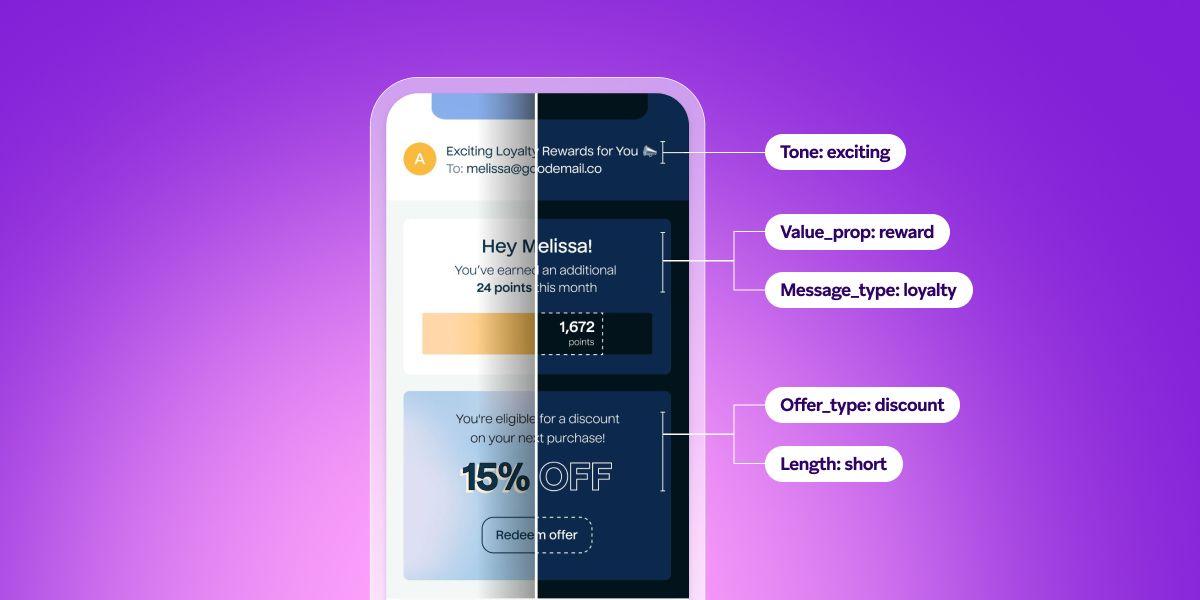
AI decisioning is an AI-powered decision system that uses reinforcement learning (RL) to personalize experiences to optimize a specific goal, such as revenue, retention, or engagement. It takes first-party data about each customer—like recent activity, preferences, and lifecycle stage—and makes 1:1 decisions across messages, channels, offers, and timing.
An AI decisioning agent autonomously experiments, learns from every customer interaction, and then updates its strategy for choosing future actions. Decisions are continuously optimized within your business rules, so customer journeys adapt as behavior, inventory, and campaign objectives change.
AI decisioning agents adapt by using data, business rules, and machine-learning models to make “next-best-everything” decisions based on all available signals. They can autonomously experiment and continuously learn from every interaction, so choices across content, channel, message, offer and timing, become more effective over time for each individual.
In this guide, we’ll look at what AI decisioning is, how it works across industries, and how marketing teams can use tools like BrazeAI Decisioning Studio™ to bring this kind of intelligent, 1:1 decisioning into their marketing lifecycle.
How does AI decisioning work?
AI decisioning works by using reinforcement learning to test different actions for each person, see what leads to better outcomes, and update its decisions over time. It pulls in first-party data, customer profiles, and live behavior, then makes 1:1 choices across messages, channels, offers, and timing to optimize toward a goal.
Decisioning agents autonomously experiment and continuously learn. They choose from a set of actions, receive positive signals when they hit targets (like conversions, upgrades, or lower churn), and negative signals when they miss. Those rewards and penalties update the system’s strategy, so decisions become more nuanced and effective for each individual.
What is reinforcement learning?
A reinforcement learning agent tries to learn from its environment – it iteratively chooses from a set of actions, receives some reward in response, and then chooses another action based on what it’s learned. As the model learns from the rewards it receives, it updates its policy for selecting future actions with the goal of maximizing the reward achieved over time.
What are AI agents?
An AI agent is a system that interprets data, makes decisions, and takes actions autonomously to achieve a goal.
What can AI decisioning do for specific industries?
AI decisioning is beneficial wherever teams need to turn complex data into specific actions—who to contact, what to offer, how to price, or what to prioritize. The details differ by sector, but the pattern is the same—continuous experimentation that learns which choices work best for each person.
Financial services
In financial services, AI decisioning helps balance growth and risk. Teams use it to support credit and eligibility decisions, detect fraud, sequence onboarding and education messages, and tailor product offers to each customer’s behavior and financial profile.
For example, a digital-first financial provider wants more customers to activate and regularly use a new card or money-transfer feature. AI decisioning uses transaction history and app behavior to decide who gets educational content, who receives an incentive-led prompt, and how often to follow up. As it observes which patterns lead to activation and ongoing usage, it tailors cadence and messaging for each customer, reducing noise while lifting engagement.
Retail and eCommerce
In retail and eCommerce, AI decisioning focuses on turning browsers into buyers and one-time purchasers into repeat customers. It guides which products to feature, what offers to present, how often to reach out, and which channels to use, based on each shopper’s activity and value.
A global beauty brand wants to increase repurchases from existing customers. AI decisioning tests variations in messaging (e.g., free gift vs. routine-focused copy), featured products, calls to action, send times, and outreach frequency. As customers respond, it shifts toward the combinations that drive higher revenue per customer and pulls back on discounts where people are likely to buy anyway.
Media, entertainment, and gaming
In media and entertainment, AI decisioning helps platforms keep viewers and listeners engaged. It shapes content recommendations, upsell paths for premium tiers, and win-back journeys, adjusting suggestions and outreach as tastes, habits, and engagement patterns shift.
Here’s one way this could look. A sports streaming service wants to win back lapsed subscribers. An AI decisioning system experiments with different subject lines, offers, creative themes, send days, times, and email frequencies for each viewer. Over time, it learns which combinations bring each person back to watch more games without driving unsubscribes.
Telecom and utilities
In telecom and utilities, AI decisioning supports long-term relationships and recurring revenue. It informs plan and package suggestions, upgrade and retention offers, collections and arrears strategies, and the cadence of account communications for different segments and risk profiles.
Travel and hospitality
In travel and hospitality, AI decisioning is used to convert intent into bookings and deepen loyalty. It influences follow-up to searches and abandoned carts, ancillary product recommendations, loyalty offers, and re-engagement programs, tuned to each traveler’s history, preferences, and trip patterns.
What can marketers do with AI decisioning?
AI decisioning for marketing means using reinforcement learning to make 1:1 decisions for each customer that optimize toward a clear goal, such as revenue, trial starts, or retention. Instead of relying only on segments and static rules, AI agents use first-party data and past interactions to decide which experience each person should receive across offers, channels, timing, and creative.
AI decisioning builds on your existing segmentation rather than replacing it. You can still group customers by lifecycle stage, value, or intent, but within those groups AI agents treat every individual differently—testing combinations of content, channel, and cadence, then updating decisions as people browse, buy, pause, or churn. Over time, campaigns become ongoing 1:1 experiments instead of fixed paths.
Marketers stay in partnership with these agents. Teams choose the objective, define the action set (for example, different templates, discounts, channels, and a “no message” option), and set guardrails on things like frequency and offer depth. AI decisioning then decides who receives which experience and whether they should be contacted at all, while marketers monitor results, adjust constraints, and add new variants without rebuilding whole journeys.
What are some AI decisioning use cases?
AI decisioning helps teams turn data into sequences of decisions that are constantly being tested and improved. AI agents experiment with different actions, see which ones drive the right “reward” (revenue, margin, retention, health outcomes), and then update what they do next for each individual. Across industries, use cases and patterns show up—even if the goals, constraints, and regulations are different.
Lifecycle engagement and feature adoption
What it might look like in practice: A digital bank uses AI decisioning to experiment with subject lines, education messages, incentives, send days, and frequencies for new cardholders. The AI agent learns which combinations lead to faster activation and regular usage, while easing off for customers who are already highly engaged.
Outcome: Higher activation and ongoing usage, with fewer generic blasts to low-intent customers.
Retail and eCommerce
Example: Repeat purchases, upsell, and revenue per customer
What it might look like in practice: A commerce brand tests different offers, product mixes, creative angles, and cadences for past purchasers across email, push, and onsite. AI decisioning agents learn which combinations drive repeat orders and higher basket sizes for each customer and reduce discounting where people tend to buy without incentives.
Outcome: Uplift in conversions and revenue per customer, with more efficient promotional spend
Churn reduction and premium upsell
What it might look like in practice: A streaming platform runs AI-driven reactivation journeys for lapsed or low-engagement viewers. The agent experiments with themes (content-led vs. offer-led), upgrade incentives, send days, and frequencies, then leans into the patterns that bring each viewer back and encourage premium upgrades without driving unsubscribes.
Outcome: More win-back conversions and subscription revenue from audiences that were drifting away.
ARPU growth, retention, and long-term value
What it might look like in practice: A telecom and utilities group uses AI decisioning to decide which customers should see a higher-tier plan, a contract extension, or a new rate, and in which channel. The system tests different offers, terms, and outreach cadences, learning where to present richer plans or higher rates and where to hold back to avoid churn or payment risk.
Outcome: Higher upgrade and extension rates, improved NPV per customer, and more targeted use of incentives.
Booking recovery and loyalty engagement
What it might look like in practice: An airline or travel brand applies AI decisioning to abandoned searches and loyalty members. The agent experiments with follow-up messages, route and fare recommendations, limited-time offers, and timing across email, push, and in-app, then adapts based on which patterns turn searches into bookings and one-time guests into repeat travelers.
Outcome: More completed bookings, stronger loyalty engagement, and higher revenue per traveler without overwhelming customers with irrelevant offers.
4 Steps to implement AI decisioning
Implementing AI decisioning starts with clean, connected data and clear business goals. From there, marketers define the decisions they want agents to make, put guardrails around those decisions, and activate them through an AI decisioning platform such as BrazeAI Decisioning Studio™.
1. Data readiness
AI decisioning depends on solid data foundations and a clear “reward” signal for the agent to optimize. You need a unified view of customers, reliable event tracking, and consent signals that are easy to act on.
That means:
- Consistent user IDs across channels and devices
- Trustworthy event data (opens, clicks, page views, purchases, cancellations)
- Accessible first-party data in a CDP or warehouse
- Clear flags for consent, preferences, and opt-outs
- A defined success metric for each use case (for example, revenue per user, conversions, or renewals)
A simple first step is to map which customer data and KPIs you have today, where they live, and which gaps would block real-time decisions.
2. Decision design
Next, you decide which decisions the agent will handle.
For each use case:
- Define the goal and reward signal (for example, incremental ARPU or completed orders)
- List the dimensions you want to optimize (offer, message, channel, time, day, frequency, and a no-message option)
- Specify the options available for each dimension (for example, three offers, two templates, three channels)
- Capture any hard rules (eligibility, compliance, pricing floors) as guardrails the agent must respect
Under the hood, the platform can combine rules, predictive scores, and reinforcement learning. Marketers focus on framing the decision, not tuning models.
3. Governance
Governance helps to provide oversight and alignment with your brand guidelines and risk approach. It covers policies, approvals, monitoring, and controls.
Key elements include:
- Guardrails on frequency, discounts, and channels
- Eligibility and exclusion rules for sensitive audiences
- Approval flows for higher-risk or regulated use cases
- Dashboards for KPIs, lift versus control, and model health
- Clear ways to pause, roll back, or adjust strategies mid-flight
Marketing, data, legal, and customer support should all have input, so decisioning behaves responsibly across the customer lifecycle.
4. Choose and activate an AI decisioning platform
Choosing an AI decisioning platform means selecting a decision layer that can plug into your data, orchestration tools, and channels—and grow with your program over time. Most teams don’t build reinforcement learning systems from scratch; they evaluate vendors like BrazeAI Decisioning Studio™, Hightouch, Pega, and others.
When you’re evaluating platforms, it helps to look at:
- Integrations: Does it connect cleanly to your CDP, warehouse, and engagement channels?
- Capabilities: Can it optimize across multiple dimensions (offer, channel, time, frequency, and more) and ingest existing predictive scores?
- Governance: Does it provide clear controls, role-based access, and transparent reporting on lift versus control?
- Scale and roadmap: Can it handle your current data volume and the complexity you expect in the next few years?
With BrazeAI Decisioning Studio™, marketers can plug decisioning directly into existing Braze campaigns, define goals and guardrails, and configure the dimensions and options agents will experiment with. The platform then runs continuous 1:1 experimentation, keeping decisions aligned to your KPIs while you focus on strategy and creative.
If you’re weighing different tools, it’s worth taking a closer look at the best AI decisioning platforms and how they compare on integrations, control, and long-term fit.
What are some of the best AI decisioning tools?
While AI decisioning is still a new concept, many brands have built sophisticated reinforcement learning tools to help brands create 1:1 personalization. Here are a few examples:
Braze AI Decisioning Studio™ (formerly known as Offerfit)
Braze AI decisioning studio is a sophisticated decisioning later integrated with the Braze Customer Engagement Platform. It uses reinforcement learning agents to find the optimal combination of channel, message, offer, timing and frequency for each individual. Braze AI Decisioning Studio™ also offers forward deployed data scientists, offering white glove services for brands.
Salesforce Einstein Decisions
Einstein Decisions requires integration with the sales force marketing cloud, looking at each customer’s profile and behavior to choose the next best offer, promotion, or experience from a defined set.
Adobe Target Auto-Target and Automated Personalization
Uses machine learning to decide which experience or offer combination works best for each visitor.
Pega Customer Decision Hub
An enterprise decisioning section used widely in financial services and telecom, it focuses on decisioning often framed as next-best-action.
Final thoughts on AI decisioning
AI decisioning gives teams a practical way to move from static campaigns to adaptive, 1:1 experiences that update as customers behave. It turns your data, rules, and ML models into a system that keeps making smarter choices with every interaction.
For most brands, the next step is to start small and focused. Pick a clear outcome—like reducing churn or improving conversions—then pilot AI decisioning on a few high-impact journeys, using the data and channels you already have in place.
If you’re ready to explore what this could look like for your team, talk to Braze about how BrazeAI Decisioning Studio™ can power your next experiment and help you bring intelligent 1:1 decisioning into your lifecycle programs.
Releated Content
View the Blog
A look at Braze Banners: What marketers and engineers need to know

Mark Biales

Email deliverability in Canada: Everything marketers need to know

Ess Adjekum

Maximizing your reach: Why it’s time to move to WhatsApp messages with optimized delivery