
How the Braze Data Platform closes the the gap between data and interaction to unlock faster growth and ROI
Published on June 16, 2026/Last edited on June 16, 2026/10 min read

Sahiz Kaur
Senior Product Marketing Manager, BrazeTwo years ago, Braze announced the Braze Data Platform (BDP) to reflect a core truth: Data is the backbone of exceptional customer engagement and marketers shouldn’t have to navigate a maze of disconnected systems to activate it. While AI makes output easy, delivering measurable outcomes—like higher revenue, retention, and loyalty—requires deep, real-time context from your data. Yet, most brands are battling a growing complexity of siloed data and disconnected, legacy middleware systems.
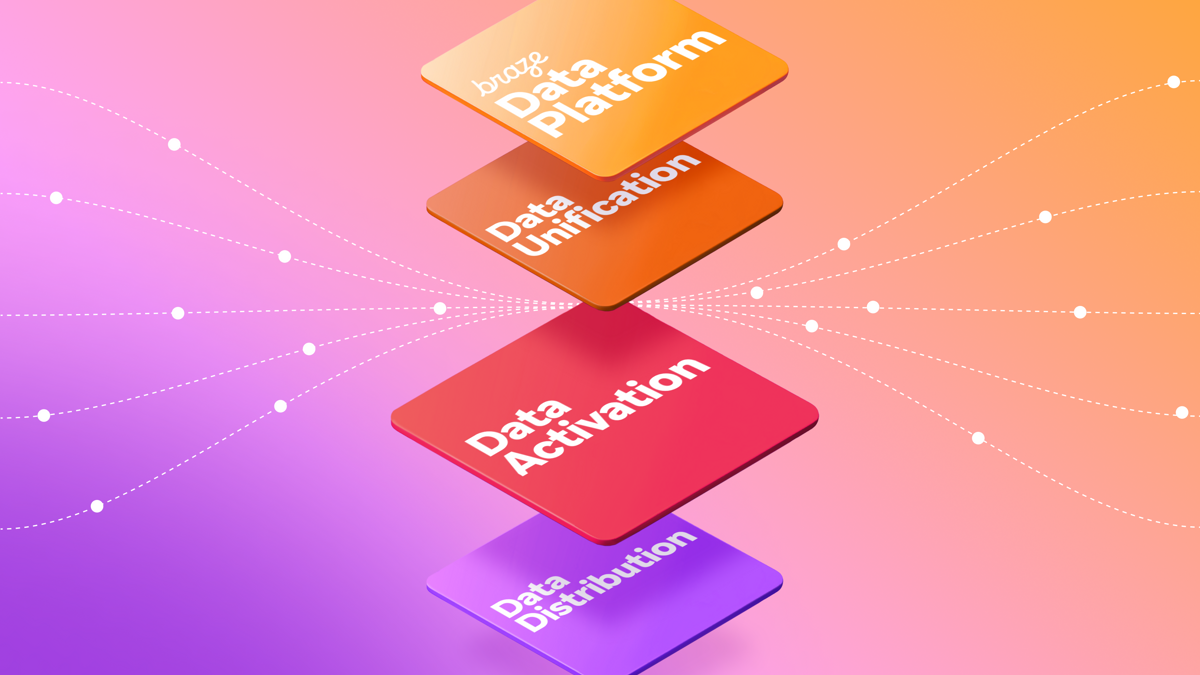
The BDP is a composable data platform built for customer engagement that closes the gap between data and interaction. Data warehouses are today’s source of truth, and Braze is the engagement layer that sits directly on top of your data engine to drive faster time-to-value and higher ROI. We reduce the friction, cost, and complexity of standalone CDPs by enabling your campaigns, canvases, and BrazeAI to have instant access to live customer context.
Over the past two years, our investments in zero-copy data activation, automated identity resolution, eCommerce Events, Report Builder, Dashboard Builder, and more have enabled marketing and technical teams to drive concrete business outcomes through seamless customer engagement.
And today, we're announcing a suite of new capabilities and key partnership enhancements that take that vision even further, empowering you to move faster, personalize in real time, and finally prove campaign impact.
Reducing the middleware tax
Standalone CDPs promised to simplify data. Instead, as data warehouses continue to bolster their data activation capabilities and customer engagement continues to innovate, they often create more complexity (leading to duplicate data storage, multiple syncs, redundant licensing costs, and engineering teams drowning in ETL maintenance work) and introduce what we call the middleware tax. For every new data source a marketer wants to activate, there's another ticket, another delay, another engineering sprint.
Meanwhile, most brands have already invested heavily in their cloud data warehouses (like Databricks, Snowflake, Google BigQuery, and AWS Redshift) as their operational source of truth. The data, compute, and governance live in the warehouses. The question became obvious: Why replicate data in multiple places and pay the tax when you can activate it where it lives?
Warehouse-native customer engagement
As brands work to remove the middleware tax from their ecosystems, warehouse-native architectures are becoming the industry standard. Warehouse-native customer engagement is how you move faster and the Braze Data Platform is built to help deliver context-aware customer engagement at scale. We see our role clearly: Your warehouse is the data engine—the source of truth—and Braze is the real-time engagement layer that sits directly on top.
Deliver real time, context aware customer experiences with an enhanced Databricks partnership
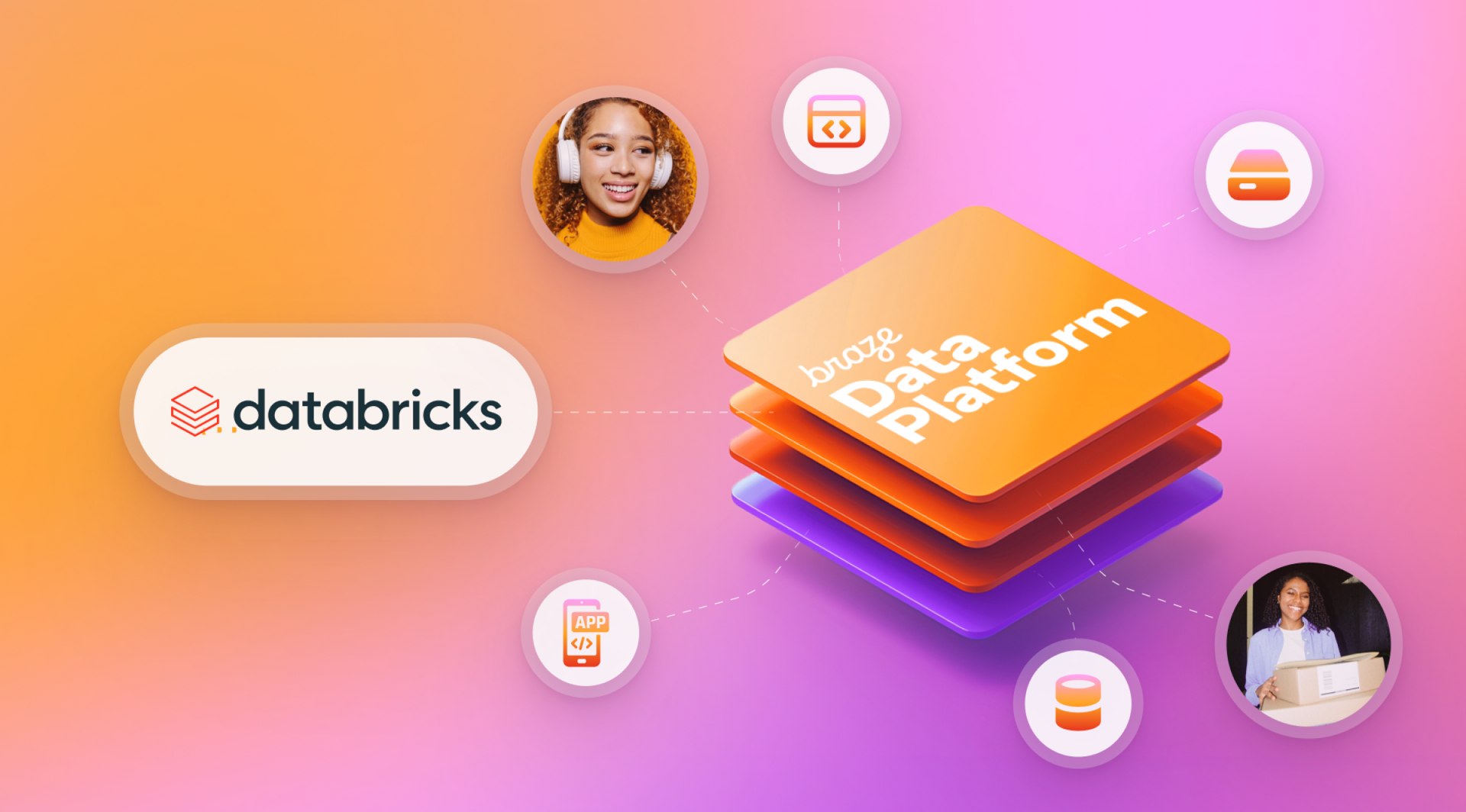
Braze and Databricks empower brands to turn enterprise-scale data into immediate, in-the-moment customer engagement by eliminating the integration complexity between data organization and marketing execution. This modern architecture creates direct pipelines from governed intelligence to real-time, cross-channel interaction, completely removing the "middleware tax" that slows down innovation.
Braze customers today already have the ability to sync relevant user and non-user data from Databricks without any data duplication using Braze Cloud Data Ingestion (CDI). Databricks has now launched Databricks CustomerLake, an agentic CDP embedded natively within Databricks, which allows customers to push their governed cohort audiences into Braze for segmentation to help marketers deliver the next generation of personalized customer experience.

“Braze, implemented in partnership with Stitch, helps our team move faster and create more relevant experiences for our guests. With Databricks at the center of our data strategy, we’re able to remove a lot of the usual limitations, especially when speed and data complexity push beyond what connected platforms can handle. By feeding real-time engagement data back into Databricks, we can combine it with the bigger picture of our business and better understand our guests so we can show up in the right moments.”

Lanna O'Connor
Director, Loyalty & Digital Marketing, RaceTrac, RaceTracThe new Braze new integration with Databricks Delta Sharing (beta), a widely adopted open protocol for secure data sharing, unlocks a bi-directional data system, allowing for the seamless ingestion of data from Databricks using Cloud Data Ingestion (CDI) or Databricks CustomerLake and the immediate delivery of valuable engagement signals—such as clicks, opens, and conversions—back to your warehouse through Databricks Delta Sharing.
This feedback loop means that engagement data from Braze flows into Databricks, where it is designed to enrich segments, joined with business outcomes like revenue, retention, and lifetime value (LTV). This governed intelligence can then be fed into machine learning (ML) models and returned to Braze as smarter, more targeted segments without any manual pipeline work, enabling marketing teams to prove the business value of every campaign in the same environment where the CFO tracks revenue.
What this partnership can unlock:
- Full-funnel attribution: A retail and eCommerce marketer can join engagement data from Braze with point-of-sale (POS) data in Databricks to measure the true lift of campaigns against real business outcomes—purchases, renewals, revenue impact.
- Customer 360-degree personalization: A travel and hospitality brand can feed real-time engagement updates into a Databricks ML model, then push that refined segment back to Braze for immediate targeting—without batch exports or pipeline maintenance.
- Regulatory & financial reporting: A financial services brand can send delivery logs that are instantly mirrored in your Databricks-based audit trail for compliance, without manual file transfers.
- Warehouse-native segmentation: A compliance-focused team can maintain superior governance and security by pulling governed cohorts directly from Databricks via CDI, ensuring sensitive data never leaves the trusted warehouse environment.
Data unification: Seamlessly access customer behavior and preference insights in one place
Successful engagement relies on swift, agile access to relevant customer context. The BDP is engineered to provide effortless, high-speed access to your first-party data right where you need it. Cloud Data Ingestion allows brands to directly connect, sync, and delete user data (e.g. user attributes, events, purchases) and Catalog data from the leading data warehouses.
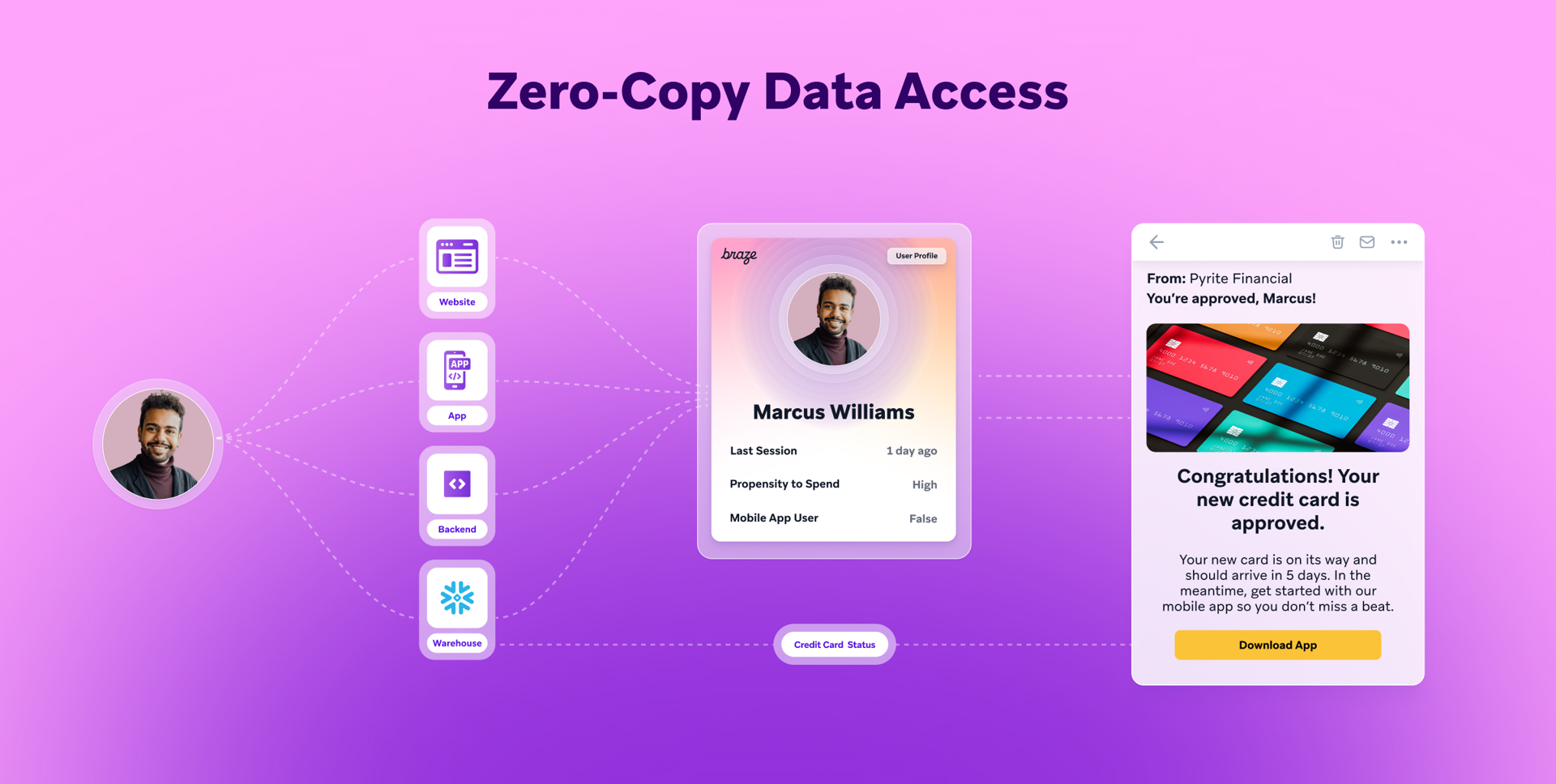
In 2024, Braze launched CDI Segments to provide Braze customers with zero-copy access to warehouse data. In 2025, our customers made 16.6 billion zero-copy updates through the Braze Data Platform. Earlier this year, we launched Zero-Copy Canvas Triggers that allow brands to trigger experiences using warehouse data without copying it to Braze. Now, we are expanding the CDI capabilities to further enable marketers and tech teams to seamlessly leverage warehouse data for customer engagement.
New user interface (UI) for CDI (Generally Available now)
When marketers want to sync new data from their warehouse, they often need an engineer to re-authenticate and configure the connection to the data warehouse. If the source changes, all syncs need to be updated as well, adding repetitive work for both marketing and technical teams, while also making the process more prone to manual errors.
"By automating CRM processes with Braze CDI, we saved 640 work hours monthly. Our new workflow syncs up to 5 million users to Braze in just 10 minutes with a single click." — Marketing & Ads Intelligence Team, NAVER WEBTOON
The new UI for CDI accelerates your time-to-value and improves data governance by separating the source and sync configuration. This allows the marketers to move at the speed of business by leveraging a single, one-time source configuration set up by your tech team to launch unlimited data syncs independently. By minimizing manual setup and engineering dependency, the new UI enhances experience while also reducing the risk of configuration errors with a secure, governed flow of information.
For instance, a retail marketer can now activate a "high-value holiday segment" from the warehouse in minutes and launch the sync immediately through a seamless UI, turning warehouse insights into live campaigns faster than ever.
CDI SQL Editor (Early Access now)
Traditionally, tech teams created pre-formatted data tables in their data warehouse that could be synced to Braze using CDI. That meant marketers needed to wait for data engineers to create, host, and maintain relevant data tables in the warehouse before they could sync them to Braze.
The CDI SQL Editor allows brands to query data warehouse tables directly using standard SQL—right within the Braze interface. This streamlines the operational flow, granting marketing teams more control to activate warehouse data connections in minutes, thereby eliminating engineering dependency and accelerating time-to-value.
Imagine, a travel brand marketer powering personalized itineraries by joining bookings and user_preferences tables directly in the CDI setup, rather than waiting for a pre-formatted field to be built upstream.
Data activation: Personalize experiences for complex hierarchical customer relationships
Not all engagement is one-to-one. Some of your customers are families, some are enterprises, and some are contractors working for multiple different companies. Treating every user as an isolated individual can often create identity blindness for brands with multi-user products and services. Modeling these complex hierarchies often requires heavy technical workarounds and custom-coded logic.
Account Objects (Early Access planned for FY27 Q2)
Deliver deeply relevant experiences for every customer relationship—from families and households to complex organizations. Account Objects eliminate the identity blindness of treating every user as an isolated individual, allowing you to natively model the real-world hierarchical structures that represent your customers.
By bridging the gap between user behavior and group context, you can now:
- Streamline data management: Group users under a single "Account" entity to maintain a clean source of truth without duplicating data across thousands of profiles.
- Precision targeting at any scale: Build sophisticated segments based on account-level status—like targeting only primary policyholders for billing or alerting SaaS admins at companies in a specific onboarding stage.
- Large-scale personalization: Use Liquid to pull group-level context into every message, ensuring that users within the same organization receive consistent, role-relevant information that reflects their unique relationship to your brand.
Data Distribution: Continuously stream user profile data to your tech ecosystem
In 2025 alone, the Braze Data Platform streamed nearly 13 trillion events via our Currents high-volume data export tool, providing brands with clear visibility into customer behavior. That's an incredible volume of engagement data flowing through our system. But marketers and analytics teams needed more. They needed not just the events (the what they did) but also the profile attributes—the who they are right now.
Introducing User Profile Streaming
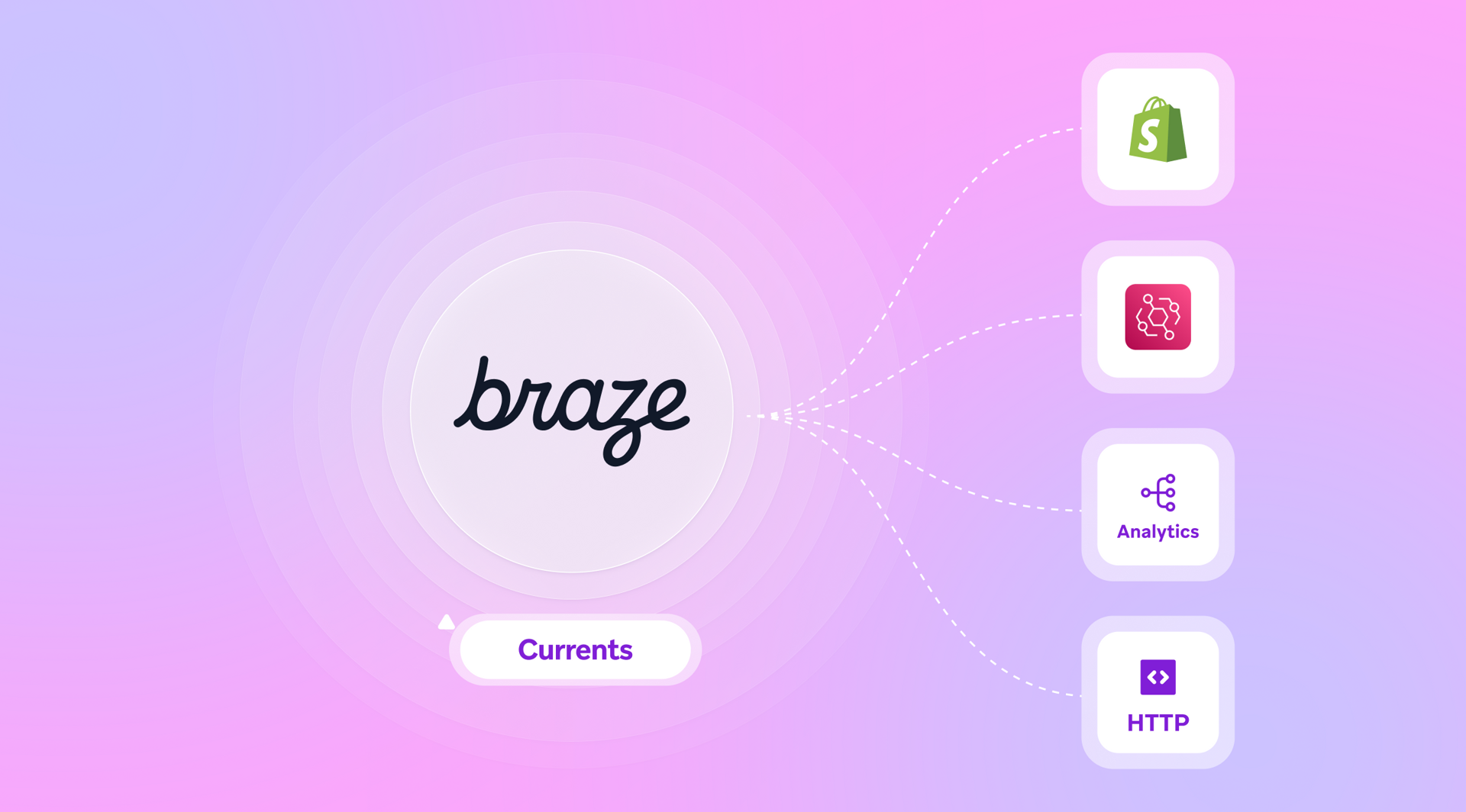
Seamlessly power real-time business intelligence and eliminate data gaps by streaming comprehensive customer context directly to your data ecosystem. We are expanding our data distribution capabilities so you can stream user-level attributes and custom data directly from Braze to external destinations. This complements existing event-based streams (Currents) and ensures your source of truth has the most current user profile information—giving you a 360-degree view of customer behavior (events) plus identity (profiles), all in real time.
This capability empowers you to:
- Eliminate data gaps: Automatically sync custom attributes and user data, so your source of truth always has the full "who" behind the "what."
- Ensure real-time BI accuracy: Build dashboards and analytics models on platforms like Snowflake using the freshest, most current user context available.
- Reduce operational complexity: Replace complex, manual ETL processes with a direct, automated stream, freeing up engineering time.
This capability is generally available for Snowflake Data Sharing, with Currents currently available for Amazon S3, Google Cloud Storage, and Azure Blob Storage.
Final thoughts
The Braze Data Platform is built to streamline your stack and your customer engagement. By activating data directly where it lives, brands achieve a faster time-to-value and higher ROI on existing cloud data investments.
The shift to warehouse-native martech stacks delivers clear benefits across the entire organization:
- Data and engineering teams stop managing fragile ETL pipelines and focus on governed intelligence.
- Marketing teams gain instant access to real-time customer context for deeper personalization.
- Finance & operations reduce operational overhead and eliminate redundant storage costs.
Ultimately, a composable, warehouse-native strategy ensures your engagement is as fresh as your data, turning your source of truth into your most powerful engine for growth.
Interested in learning more about the BDP and how it can close the data/interaction gap? Check out the Braze Data Platform product page.