
AI marketing personalization: Deliver 1:1 experiences at scale
Published on May 20, 2026/Last edited on May 20, 2026/11 min read

Team Braze
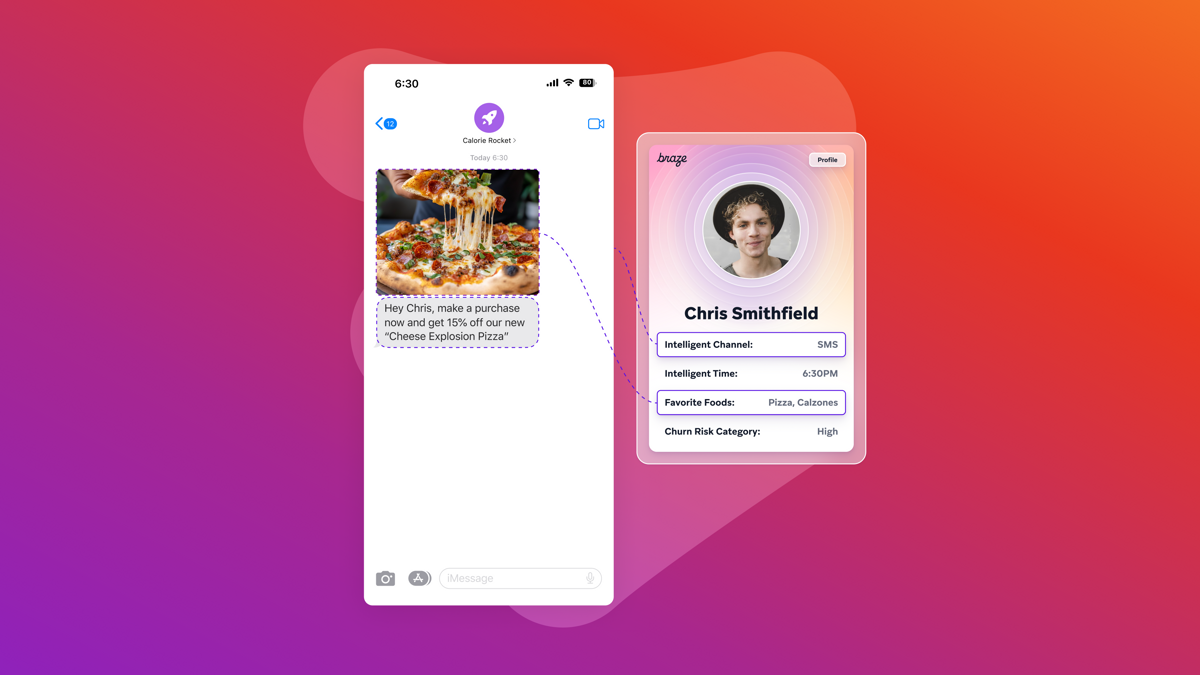
AI marketing personalization helps brands move from generic campaigns, to dynamic, 1:1 experiences. With solutions like predictive insights, real-time content personalization, automated A/B testing and cross-channel orchestration, delivering highly relevant, tailored experiences to thousands or even millions of customers at scale has never been more achievable.
Seventy-six percent of consumers get frustrated when brands don't personalize their interactions. That's a stat from McKinsey, and it's been cited so often it feels like it should be framed on the wall. But behind the stat is a real commercial cost: lower conversion, higher churn, and customers who stop coming back.
What makes AI marketing personalization even stronger is that it has measurable benefits, including higher engagement, improved CLTV, reduced churn, and better ROI.
This guide is for marketers who want to implement AI marketing personalization but aren’t sure where to start. We’ll take a look at key benefits, capabilities and how to begin, backed up with real life case studies.
TL;DR
- AI marketing personalization uses machine learning to tailor messages and experiences to individual customers, in real time and at scale
- Key capabilities include predictive marketing, real-time personalization, AI content optimization, cross-channel AI, automated A/B testing, and AI-assisted segmentation
- Companies that excel at personalization generate 40% more revenue than slower-growing competitors, according to McKinsey
- Measurable outcomes include higher conversion rates, stronger retention, improved CLTV, and campaign performance that improves over time
Key takeaways
- AI-driven personalization adapts continuously to real-time behavioral signals; rule-based approaches require manual updates to stay current
- Predictive marketing anticipates churn risk, purchase intent, and CLTV before behavior occurs, enabling proactive rather than reactive campaigns
- Cross-channel AI coordinates messaging across email, push, SMS, and in-app so each touchpoint informs the next
- AI-assisted segmentation keeps audiences dynamic, capturing behavioral shifts that static segments miss
- Results compound: the more data the system processes, the more accurate its decisions become, and the stronger the returns get over time
What is AI marketing personalization?
AI marketing personalization is the use of artificial intelligence to tailor messages, offers, and experiences to individual customers based on their behavior, preferences, and history, in real time and at scale.
AI marketing personalization matters because customer expectations have fundamentally changed. People now interact with brands across multiple channels and expect each interaction to feel relevant to them specifically. A first-time browser and a loyal, high-spending customer are very different people, and treating them the same way doesn't serve either of them well.
The benefits of AI-driven personalization
The advantages of AI-driven personalization run in both directions, benefiting the business and the customer simultaneously.
- Stronger brand loyalty: Customers who feel understood are more likely to trust a brand and keep coming back. Personalization builds that familiarity at scale
- Better user experience: Relevant recommendations, timely offers, and intuitive journeys make interacting with your brand feel effortless rather than effortful
- Higher engagement and conversion: Targeted content and offers land better than generic ones, which means more clicks, more purchases, and a stronger return on every campaign
- Real-time responsiveness: AI personalization reacts to customer behavior as it happens, keeping interactions current rather than based on outdated data
- Continuous improvement: The system learns from every interaction, which means personalization gets sharper over time without additional manual effort from your team
Key capabilities of AI personalization
AI personalization covers a broad set of capabilities that work together across your campaigns. Here's what each one does and why it matters.
Predictive marketing: CLTV, churn risk, and next best actions
Predictive marketing uses machine learning to forecast what a customer is likely to do next, whether that's making a purchase, going quiet, or churning altogether. Rather than reacting after the fact, you can act before behavior changes, with the right message already in motion.
AI content optimization: Emails, SMS, push, and dynamic recommendations
AI content optimization shapes what each customer sees across every channel, from subject lines and push copy to product recommendations that update based on their most recent behavior.
Dynamic content means a single campaign can show genuinely different, individually relevant experiences to thousands of people simultaneously. Across channels, this continuous feedback loop drives automated campaign optimization, with each send generating data that sharpens the next.
Cross-channel AI: Smart sending and channel affinity
Not every customer responds to the same channel. Cross-channel AI tracks where each person actually engages and weights future messaging decisions accordingly, so your email-first customers get email, and your SMS responders get SMS, without you having to manually manage that logic.
Automated A/B testing for continuous campaign optimization
Automated A/B testing runs experiments across message variables continuously, evaluating results in real time and deploying winning variants without waiting for manual review. Campaigns improve with every send rather than staying static between reviews.
AI-assisted segmentation for precise audience targeting
AI-assisted segmentation builds dynamic audiences based on behavioral targeting signals and predicted future behavior, not just past actions. As customer behavior changes, segments update automatically, so your campaigns always reflect where customers are right now.
How to implement AI marketing personalization
Getting started with AI personalization can seem more complicated than it actually is. Work through the steps below in order, because each one builds the foundation for the next.
1. Connect and unify your customer data
Before any model can make a useful prediction, it needs a complete, unified view of each customer: behavioral data, purchase history, channel preferences, and real-time events all feeding into one place. If your data is siloed across platforms and updating on a delay, the personalization built on top of it will reflect that.
2. Use AI to predict behavior and segment audiences dynamically
With clean, unified data in place, machine learning models can start producing predictions: who is likely to purchase, who is flagged by churn risk prediction, and which customers rank highest for CLTV prediction. AI-assisted segmentation turns those predictions into dynamic audiences that update automatically as behavior changes, so your campaigns always reflect where customers are right now.
3. Launch automated campaigns with personalized content and optimal timing
Lifecycle campaigns, triggered messages, and cross-channel sequences can run based on real-time customer behavior, with AI content optimization shaping what each person receives and predictive decisioning choosing the right channel and timing. Journey orchestration sits at the center of this, coordinating personalization across every point simultaneously.
4. Continuously monitor, test, and optimize
Personalization is not a set-and-forget exercise. Automated A/B testing keeps campaigns improving with each send, while engagement analytics identify where customers are responding well and where they're dropping off. Those signals feed back into your segmentation and content models, making each subsequent round of decisions sharper than the last.
5. Personalization at scale: Grow your channels without scaling your team
Sophisticated multi-channel personalization across millions of customers is entirely achievable without a proportional increase in headcount. With the right AI-powered automation in place, your team stays focused on strategy and creative, while the system handles execution, timing, and channel decisions at a scale no manual process could match.
Real-world use cases and examples
Here's what AI marketing capabilities look like when brands put them to work for personalization across different industries and team sizes.
1. Luxury Escapes escapes the rules: AI-assisted segmentation drives 10% revenue uplift per user
Luxury Escapes is one of the world's fastest-growing travel platforms, connecting over 9 million global members with exclusive hotel and holiday deals across 30 countries.
The challenge
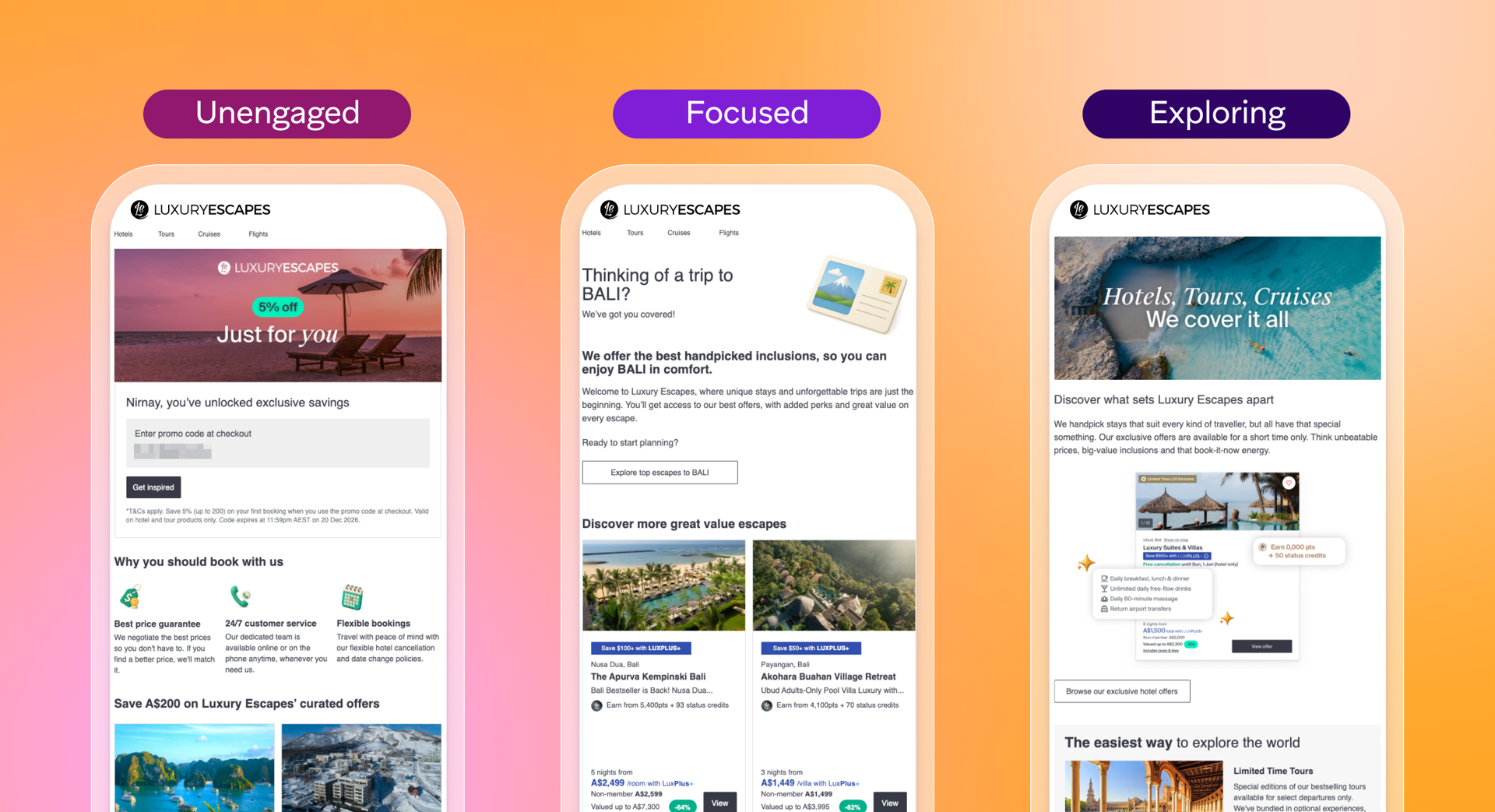
New users were grouped into welcome journey cohorts based on session count. The approach worked, but the team had access to far richer behavioral signals with no way to use them without rewriting rules from scratch.
The strategy
They deployed BrazeAI Agent Console™ as a decisioning step, replacing fixed thresholds with an AI agent that evaluated ten distinct website event signals simultaneously to assign each new user to the right cohort.
The wins
- 10% lift in revenue per user vs. the rule-based control, driven entirely by conversion rate
- 7% increase in total transaction value
- 6% increase in purchase volume
2. 8fit works out who's ready to buy: predictive marketing delivers 3.75X conversion lift
8fit is a health and fitness app with 40 million downloads globally, offering workouts, meal plans, and meditations across six languages.
The challenge
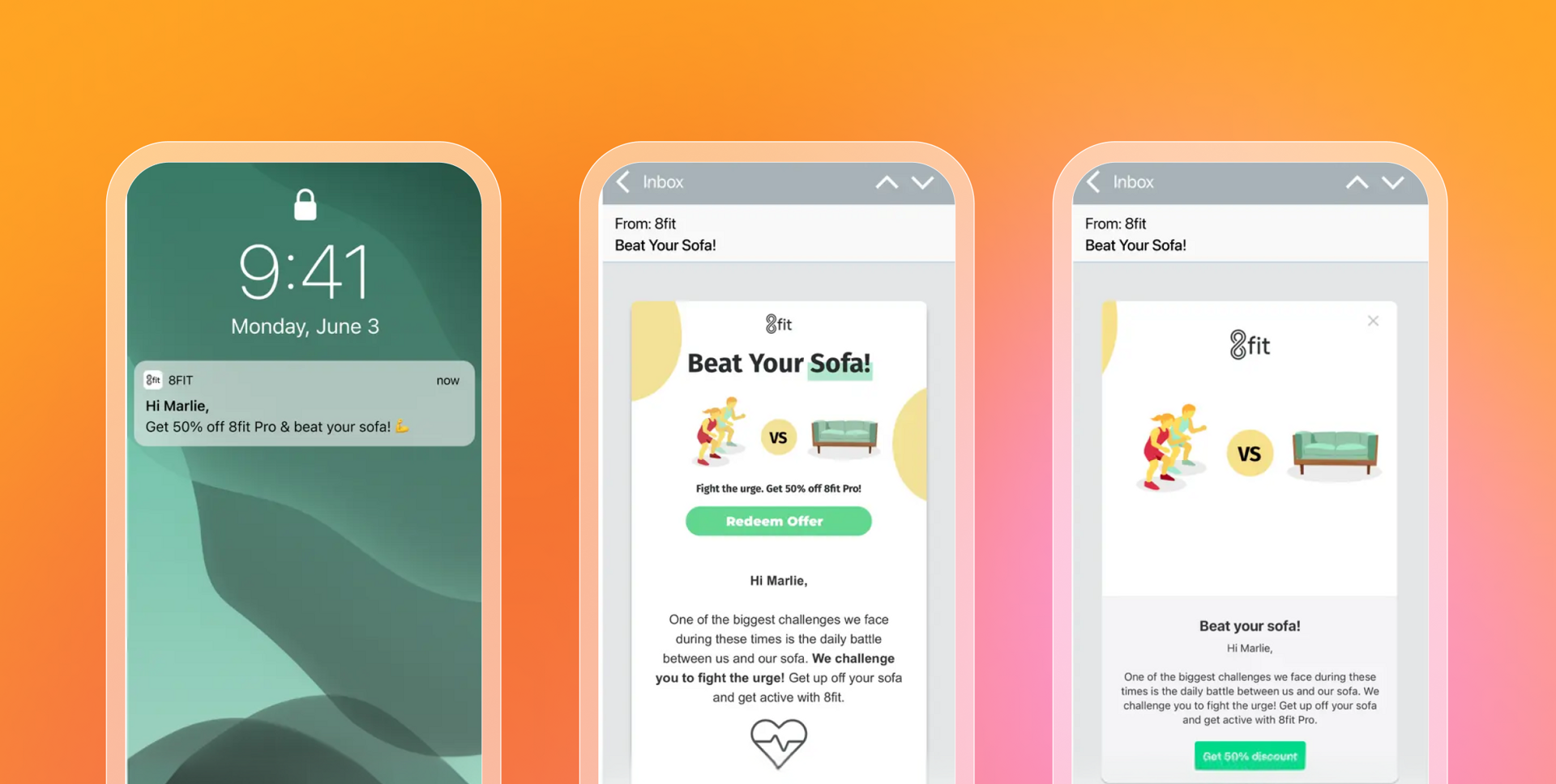
The team wanted to grow paid subscribers without offering the same discount to everyone, but had no visibility into which users were actually worth targeting with which offer.
The strategy
Using Braze Predictive Purchases, 8fit assigned each user a Purchase Likelihood Score from 0 to 100. Higher-scoring users received smaller discounts, lower-scoring users received bigger incentives only when the model indicated it was warranted, and the least likely converters were excluded from some campaigns entirely.
The wins
- 3.75X higher conversions for high-likelihood users vs. a randomly selected cohort of the same size
- 100,000 fewer emails sent weekly with no negative impact on conversions
3. Dayuse checks in to real-time personalization and doubles incremental revenue
Dayuse is a global hotel reseller operating across 30 countries, offering daytime room access to guests without requiring an overnight stay. Many users discover the platform out of necessity, making repeat bookings the central retention challenge.
The challenge
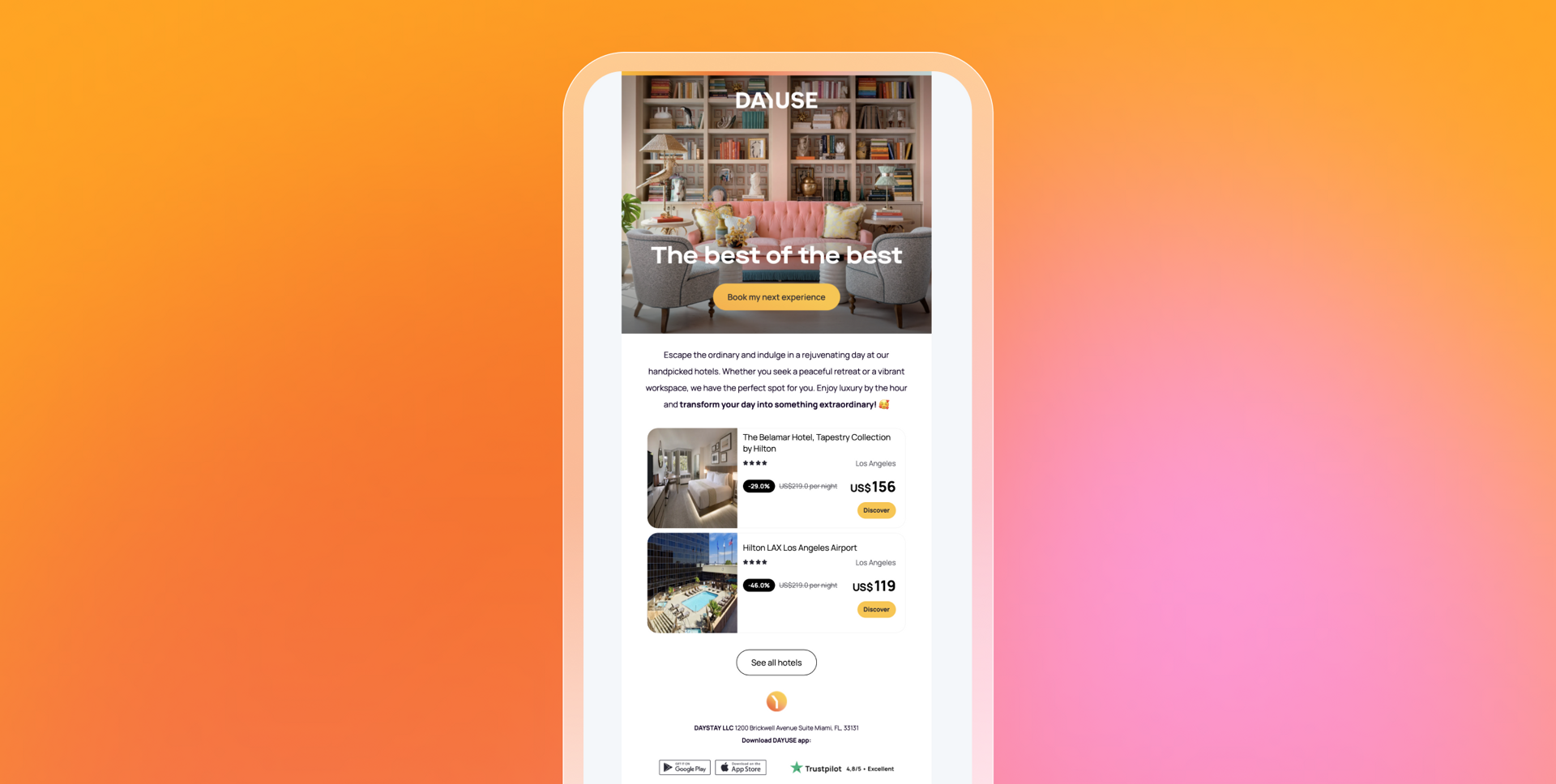
Re-engagement campaigns sent the same structure to all users regardless of booking history, location, or language. With a CRM team of three managing a global user base, genuine 1:1 personalization at scale wasn't achievable manually.
The strategy
Dayuse embedded BrazeAI Agent Console™ directly into Braze Canvas, with each agent step receiving user data including wish-listed hotels, booking history, property type preferences, and preferred language, then generating individually tailored copy for each person.
The wins
- 2X incremental revenue from the "favorite campaign" vs. the control group
- 23% additional uplift in the "repeat booking campaign" after migrating to BrazeAI Agent Console™
- 90% increase in overall booking conversion rate
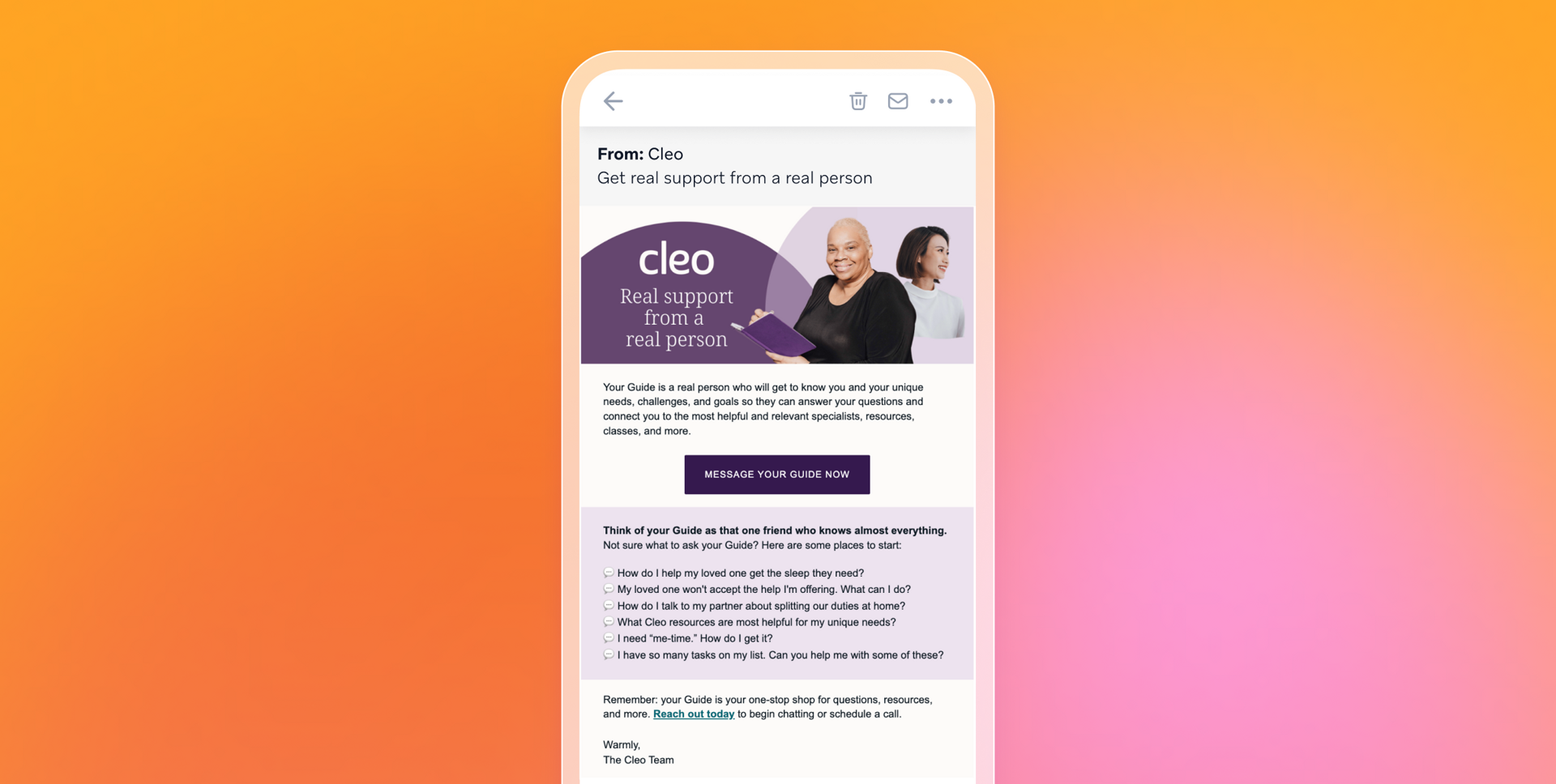
4. Cleo's autonomous optimization turns a solid welcome series into a 284% app open lift
Cleo is a global family care platform offered as an employee benefit, supporting members from expecting parents through to those caring for aging relatives.
The challenge
Cleo's welcome series performed above benchmarks but used deliberately broad messaging to avoid irrelevance across a diverse member base. With rich data available on care recipient types, package purchased, and life stage, the team knew there was room to make every welcome experience more individually personalized.
The strategy
Lifecycle marketing manager Holly Jacobson used BrazeAI Operator™ to write and debug the Liquid code for a new personalized welcome series, building a 'Cleo Quickstart' plan tailored to each member's specific situation. BrazeAI Operator™ also proactively anticipated edge cases the team hadn't yet considered.
The wins
- 81% reduction in unsubscribes across the welcome series
- 97% drop in opt-outs on the first email
- 284% increase in app opens
- 124% lift in push notification engagement
- 178% increase in meaningful in-app behaviors in the first 30 days
Measuring success
Knowing which metrics to track is just as important as the personalization strategy itself. These are the numbers that tell you whether your AI marketing personalization is actually working.
Engagement metrics: open rates, click-through, and interactions
Engagement metrics are your early warning system. Open rates, click-through rates, and in-app interactions show whether your personalized messages are landing before any commercial impact becomes visible. If these numbers are moving in the right direction, conversion usually follows.
Conversion rates and revenue impact
Conversion rate and revenue per message are where personalization proves its commercial value. Track these against a control group or pre-personalization baseline, and measure them consistently over time. That's what gives you a clear picture of the revenue impact your personalization strategy is actually generating.
Customer retention and lifetime value
Retention rate, churn rate, and CLTV over defined time periods are the long-view test of whether AI-driven personalization is building lasting customer relationships. A personalization strategy that drives one-off purchases but doesn't improve retention is only doing half the job.
Optimization insights from autonomous testing
The data coming out of your autonomous testing tells you what's working at a granular level: which content variants, channels, and timing combinations are winning, and how quickly the system is learning. These insights feed directly back into your models, and campaign performance compounds over time as a result.
Final thoughts and takeaways
AI transforms personalization into a scalable, predictive, and actionable marketing strategy. Campaigns that would have required significant manual effort to build, maintain, and optimize can run autonomously across channels, adapting to individual customer behavior in real time.
Real-time, cross-channel orchestration maximizes engagement and ROI by connecting every touchpoint into a coherent customer experience, where each interaction informs the next rather than operating in isolation.
Continuous AI-driven optimization means your campaigns don't plateau. Every send generates data, every test produces insight, and the system uses both to make the next decision better than the last.
Related Tags
Releated Content
View the Blog
Braze ERGs surpass $1M donated in 4th year of grant program

Blair Pettit
AI marketing personalization: Deliver 1:1 experiences at scale
Team Braze
May 2026 Bonfire Marketer of the Month: Founders Table’s Alison LaGatta